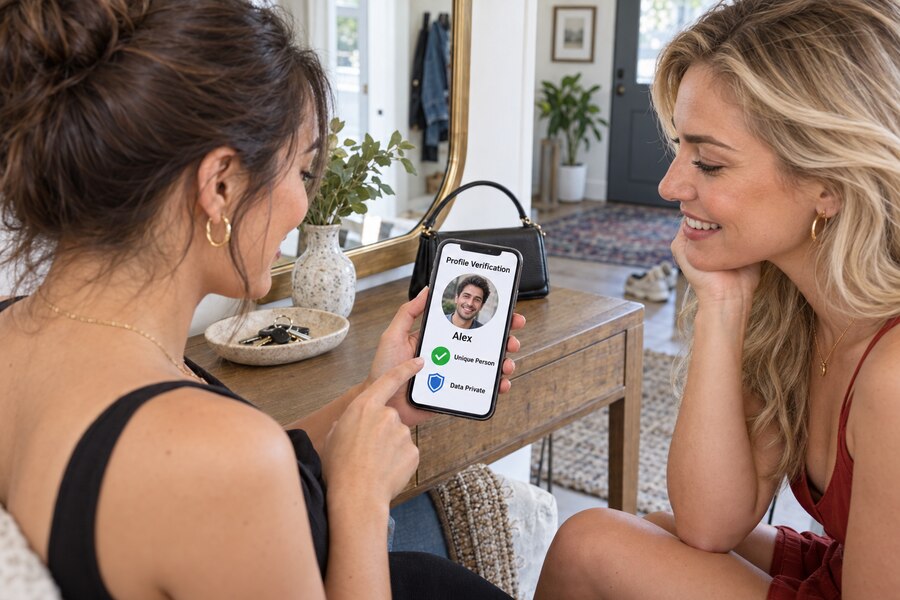
Swiping through a dating app has always involved a small leap of faith. A profile photo, a short bio, a handful of details about someone’s job or interests, these are the only signals a person has to go on before deciding whether to start a conversation, and for most of the history of online dating, the industry has simply asked users to trust that the person on the other end of the screen is who their profile claims to be. That leap of faith has grown considerably riskier in recent years. Generative AI tools can now produce a completely fabricated but entirely convincing profile photo in seconds, write a bio that mimics natural human phrasing, and even sustain a flirtatious text conversation well enough to fool someone for weeks before any inconsistency reveals the deception. What used to require an actual scammer sitting behind a keyboard, slowly building a false relationship with a single target, can now be automated and run against dozens or hundreds of targets simultaneously, and the financial and emotional damage this causes has become substantial enough that it shows up clearly in national fraud statistics.
Dating platforms have not ignored this problem, and the largest apps have spent the past several years building increasingly sophisticated verification tools meant to confirm that a profile belongs to a real person rather than a bot, a scammer, or a duplicate account. These tools have generally worked by asking users to submit a government-issued identity document, a driver’s license or passport, alongside a live selfie or video, which a third-party service then checks for a match. This approach works reasonably well at confirming identity, but it comes with its own uncomfortable trade-off: it requires handing a copy of a sensitive government document, or at minimum detailed personal data extracted from one, to a company whose primary business is not identity verification and whose systems, like those of virtually any company holding valuable personal data, represent an attractive target for a future data breach.
A newer category of technology, generally described as cryptographic proof-of-personhood verification and closely associated with the broader Web3 and blockchain ecosystem, proposes to solve this specific trade-off. Rather than asking a dating app to collect and store a copy of a person’s government ID, these systems verify a person’s uniqueness and, in some implementations, their age, using cryptographic techniques designed so that the verifying platform receives only a confirmation that the underlying check passed, without receiving the sensitive personal data that made the check possible. The pitch is straightforward: users get the trust benefit of knowing they are talking to a real, unique, appropriately aged person, without either party needing to hand over or store the kind of sensitive personal document that becomes a liability the moment it sits in a company’s database.
This article walks through what that promise actually looks like in practice, starting with the documented scale of the catfishing and romance scam problem these tools are meant to address, followed by a look at how mainstream dating apps have approached verification using conventional, document-based methods and the privacy trade-offs built into that approach. It then explains, in plain terms, what makes a cryptographic proof-of-personhood system meaningfully different from a conventional ID check, examines the highest-profile real-world case of this technology arriving inside a mainstream dating app, and takes a clear-eyed look at what this kind of verification can and cannot actually solve. No prior familiarity with blockchain technology, cryptography, or dating app mechanics is assumed; the goal is a grounded explanation of a genuinely new approach to an old and worsening problem.
It is worth being upfront about the scope of that explanation before diving in. This is not a story about a single company solving online dating fraud once and for all, nor is it a story about a speculative technology that exists only in whitepapers and pilot programs with no real users. It sits somewhere in between: a specific, documented partnership between a major dating platform and a real, operating proof-of-personhood network, deployed to actual users in specific countries starting on a specific date, alongside the far more established, already-scaled document verification systems that most dating app users are more likely to have encountered directly. Understanding both, and understanding honestly how they compare, is the only way to evaluate whether the newer approach represents a genuine improvement or simply a different, differently distributed set of trade-offs.
The Scale of the Catfishing and Romance Scam Problem
The financial damage caused by romance scams and fake dating profiles is large enough, and well enough documented by government agencies, that it is possible to describe the problem in concrete figures rather than anecdotes. The U.S. Federal Trade Commission, which tracks consumer fraud reports across categories including romance scams, reported that consumers lost $1.14 billion to romance scams in 2023 alone, based on more than 64,000 individual reports, with a median reported loss of $2,000 per victim, among the highest median losses of any fraud category the agency tracks. The year before, in 2022, the FTC recorded a similarly enormous figure, nearly 70,000 reports and $1.3 billion in reported losses, with a median loss of $4,400 per victim, underscoring that this is not an isolated spike but a sustained, large-scale pattern of financial harm concentrated specifically in the category of fraud that begins with a fabricated romantic connection.
These figures likely understate the true scope of the problem considerably, since fraud researchers and the FTC itself have long acknowledged that romance scams are chronically underreported, as victims frequently feel embarrassment or shame about having been deceived in a romantic context, a psychological barrier to reporting that does not apply nearly as strongly to other categories of fraud like a stolen credit card number. The true financial toll, in other words, is very likely higher than even these already substantial reported figures suggest, and the emotional and psychological damage caused by discovering that a months-long romantic relationship was an elaborate fabrication designed to extract money is not captured in a dollar figure at all.
Generative AI has made this underlying problem meaningfully worse over the past several years by removing several of the practical barriers that used to limit how many fake profiles and conversations a single scammer could realistically maintain. Where a human scammer once had to personally write every message in a slow-building deception, current AI tools can generate a synthetic but highly convincing profile photo of a person who does not exist, avoiding the risk that an authentic stolen photo might be traced back to its real owner through a reverse image search, and can sustain naturalistic, emotionally responsive conversation with multiple targets at once with minimal ongoing human effort. Industry safety teams at major dating platforms have reported a rising volume of AI-generated profile photos and bot-driven conversations submitted for review, a trend serious enough that platforms including Bumble have introduced dedicated reporting categories specifically for suspected AI-generated profiles. This is the backdrop against which stronger identity verification, whether built on conventional document checks or newer cryptographic methods, has moved from a nice-to-have safety feature to something users and regulators increasingly treat as a baseline expectation.
The demographic pattern behind these losses adds further context to why the problem has drawn sustained regulatory and industry attention rather than fading as a minor nuisance. Older adults, and people over 50 in particular, have consistently been shown to lose disproportionately large sums relative to younger victims, a pattern researchers generally attribute to some combination of higher average savings available to be drained over a longer scam and, in some cases, less day-to-day familiarity with the specific tactics scammers use on unfamiliar platforms. At the same time, younger users of mainstream swipe-based dating apps, the primary user base for platforms like Tinder and Bumble, face a higher volume of attempted contacts from fake or scripted accounts, even if any single successful scam against a younger victim tends to extract a smaller total sum, simply because the sheer number of daily interactions on these platforms creates more opportunities for an automated or semi-automated scam attempt to reach a potential target in the first place. Both patterns point toward the same underlying conclusion driving the industry response detailed later in this article, that verification needs to work at the scale of an entire platform’s user base rather than relying on any individual user’s ability to personally spot a well-executed fake.
How Dating Apps Have Tried to Verify Users So Far
Before examining what a cryptographic, Web3-based approach to verification actually changes, it helps to understand the verification tools dating apps have already built and deployed at scale, since these represent the status quo that any new approach has to meaningfully improve upon rather than simply duplicate. The major dating platforms have converged on a broadly similar model over the past several years: ask the user to submit some combination of a government-issued identity document and a live selfie or short video, use automated and sometimes human-assisted review to confirm that the face in the live capture matches both the ID photo and the user’s existing profile photos, and display a visible badge on the profile of any user who successfully completes the process.
This approach has produced measurable results in terms of user trust and engagement, and it does not require users to understand anything about cryptography or blockchain technology to use, which has helped it scale quickly across large, mainstream user bases. It also, however, requires every verified user to hand a copy of one of their most sensitive personal documents to the platform or, more commonly, to a third-party identity-verification vendor the platform contracts with, meaning the resulting data footprint, a stored driver’s license or passport image alongside biometric facial data, exists somewhere on a company’s servers indefinitely, or for whatever retention period the company’s privacy policy specifies, regardless of how carefully that company otherwise protects it.
Understanding this model in more detail matters because it sets the baseline against which the cryptographic alternative examined later in this article has to be judged. It is not enough for a newer verification method to sound more sophisticated or more technically interesting; it has to actually improve on specific, identifiable weaknesses in the systems dating apps already use successfully today. The two case studies that follow, Tinder’s ID Verification program and Bumble’s comparable feature, are useful precisely because they are not hypothetical or early-stage pilots but fully deployed, publicly documented systems already used by millions of people, giving a concrete and current picture of what document-based verification actually looks like in practice before this article turns to the newer cryptographic approach.
It is also worth noting that identity verification is only one layer within a broader safety toolkit these platforms have built over the same period, sitting alongside separate tools such as in-app photo-based safety check-ins for in-person dates, panic-button integrations with location-sharing services, and automated systems that scan message content for patterns associated with financial solicitation, a common early warning sign of an in-progress romance scam. Identity verification specifically addresses the question of whether an account represents a real, distinct person, while these complementary tools address the separate question of what happens after two verified users actually meet or begin exchanging money-related requests, and a complete picture of dating app safety requires understanding both categories of tool rather than treating identity verification as the entirety of a platform’s safety strategy.
Traditional ID and Photo Verification: Tinder and Bumble
Tinder has built one of the most extensively documented identity verification systems in the dating app industry, and its rollout illustrates both the effectiveness and the data-collection reality of the document-based approach. The company first piloted a formal ID Verification program in Australia and New Zealand, and on February 20, 2024, Tinder announced it was expanding the feature to users in the United States, the United Kingdom, Brazil, and Mexico. The mechanics require a user to submit a video selfie along with a valid driver’s license or passport; a third-party vendor then checks whether the face in the video selfie matches both the photo on the submitted ID and the person’s existing profile photos, while also confirming the date of birth listed on the document. Users who complete the process receive a blue ID badge, distinct from the camera-icon badge awarded for Tinder’s separate Photo Verification feature, which the company had already strengthened in 2023 by requiring a video selfie rather than a series of static posed photos. Tinder reported that users who completed the ID Verification option saw a 67% increase in matches compared with unverified users during its initial pilot, a substantial engagement effect that gave the company a clear business incentive, alongside the safety rationale, to expand the feature more broadly.
Bumble followed a similar path roughly a year later, announcing on March 17, 2025, a new ID verification feature that lets users submit a picture of a government-issued identification document to authenticate their identity and earn a corresponding profile badge, rolling out initially across the United States, United Kingdom, Australia, Canada, France, India, Ireland, Spain, Germany, Mexico, and New Zealand. The feature let users filter potential matches to show only ID-verified profiles and request that a match complete verification before continuing a conversation, and it arrived alongside several other safety-focused features, including a tool that flags potentially inappropriate messages before they are sent. Bumble’s own reporting around the announcement noted that the feature was arriving specifically in response to user demand for stronger safety measures, and industry coverage at the time noted the company was, in this specific respect, catching up to a verification capability Tinder had already built out more extensively.
Both rollouts illustrate a pattern worth noting for how any new verification technology, including the cryptographic approach discussed later, is likely to spread through the dating app industry going forward. Neither Tinder nor Bumble treated identity verification as a single, one-time feature launch; both companies iterated on it repeatedly, expanding geographic availability market by market, strengthening the underlying technical check over time, such as Tinder’s 2023 shift from static posed photos to a live video selfie, and pairing the core verification feature with complementary safety tools released in the same announcement window. A dating app considering whether to adopt a newer verification approach is, in effect, choosing to enter that same iterative cycle again, building out geographic coverage, refining the user experience, and integrating the feature alongside whatever other safety tools the platform is simultaneously developing, rather than flipping a single switch that solves verification permanently.
The Privacy Trade-off of Document-Based Verification
Both of these systems work as advertised at confirming that a real, identifiable adult stands behind a given profile, and both have produced measurable safety and engagement benefits for the platforms that deployed them. The underlying mechanism, however, necessarily involves collecting and, at least temporarily, storing an image of a government-issued identity document, one of the specific categories of personal data that privacy and security professionals generally treat with the highest level of caution, precisely because it cannot be easily replaced or reissued the way a compromised password can, and because it can be used to facilitate identity theft well beyond the original context in which it was collected.
This creates a structural tension that has nothing to do with how well-intentioned or careful any individual company is: every additional company that stores a copy of a user’s driver’s license or passport photo represents one more potential point of failure, one more database that could be breached, misused by an insider, or exposed through a vendor’s own security lapse, entirely independent of whether the dating app itself ever intended to misuse the data. Data-security researchers have referred to this general pattern, the proliferation of sensitive identity documents stored across an ever-growing number of unrelated online services, as a significant and worsening source of aggregate privacy risk, since a person’s exposure to identity theft is effectively the sum of every company that has ever asked them to verify their identity this way, not just the handful of institutions, like a bank or a government agency, that traditionally required this kind of proof.
This risk is not merely theoretical when applied to the dating app industry specifically. Dating platforms hold an unusually sensitive combination of data even before identity documents enter the picture, including private messages, sexual orientation and relationship preferences, and precise location history, and a breach exposing that data alongside a verified copy of a user’s government ID would compound the potential harm considerably beyond what either category of data exposed on its own would represent. The dating app industry has not been immune to major data exposures in the past, and while neither Tinder’s nor Bumble’s specific ID verification systems described above have been the subject of a confirmed large-scale document breach as of this writing, the broader pattern of significant data exposures across dating and social platforms generally is precisely what informs the caution privacy researchers bring to any system that adds another category of highly sensitive stored data to an already sensitive existing dataset.
A user weighing whether to complete an ID verification feature is, in effect, being asked to accept this additional concentration of risk in exchange for a genuine safety benefit, and it is precisely this calculation, real safety benefit weighed against a growing, distributed footprint of sensitive personal documents, that cryptographic proof-of-personhood verification is specifically designed to improve, which is the subject of the next section.
What Makes Verification “Web3”: Cryptographic Proof of Personhood
The term Web3 broadly refers to a set of technologies, most of them built on blockchain infrastructure, that aim to let people prove things about themselves or their assets without relying on a single centralized company to hold and control the underlying data. Applied to identity and personhood specifically, this has produced a category of technology generally called proof-of-personhood verification, designed to answer a narrower and more specific question than a conventional ID check: not who exactly is this person, but simply, is this a real, unique human being, verified once in a way that is difficult to fake or duplicate, without necessarily disclosing that person’s name, address, or other identifying details to whatever service is asking for the verification.
The technical mechanism that makes this possible generally relies on cryptographic techniques, most commonly some form of zero-knowledge proof, a mathematical method that allows one party to prove a specific claim is true, for instance, “this account belongs to a real, unique human who is over eighteen”, without revealing the underlying data that makes the claim true. In a typical implementation, a person completes a one-time verification process, which might involve scanning a biometric feature like an iris or undergoing a government-ID check through a specialized verification partner, and this process generates a cryptographic credential that can subsequently be presented to any number of different apps and services. Each time the credential is presented, the receiving app learns only the specific fact it needed, that this is a verified, unique human, or that this human is old enough to meet an age requirement, without learning the person’s name, seeing their ID document, or being able to link this particular verification to that person’s activity on any other unrelated platform.
An analogy that some proponents of this technology have used to explain the concept to a general audience involves comparing it to how a bouncer checking identification at the entrance to an age-restricted venue only needs to confirm a patron is over a certain age, not memorize and record every other detail printed on that patron’s driver’s license, yet most digital identity checks today function as though the bouncer were required to photograph the entire license and keep that photograph on file indefinitely. Cryptographic proof-of-personhood systems attempt to restore that narrower, more targeted form of confirmation to digital interactions, letting a service learn only the single fact it actually needs to make its own decision, rather than acquiring the entire underlying document as an unavoidable byproduct of confirming that one fact.
This design directly addresses the structural privacy problem described in the previous section. Rather than every dating app, every gaming platform, and every financial service independently collecting and storing its own copy of a person’s driver’s license, a person can complete the underlying identity or biometric check once with a dedicated verification provider built specifically for this purpose, and then reuse the resulting cryptographic credential across many different services without any of those services needing to see, or store, the original sensitive document at all. The dating app, under this model, never receives a copy of a driver’s license or a facial biometric image; it receives only a cryptographic signal that a legitimate, privacy-preserving verification process was completed elsewhere, which meaningfully shrinks the number of places a person’s most sensitive identity documents actually live in stored form. It is worth being precise about what this design does and does not achieve: it reduces how many companies hold a person’s raw identity documents, and it limits what each individual service learns about the person presenting a credential, but it still requires the specialized verification provider itself to conduct some underlying check, biometric or document-based, at least once, meaning the broader system’s overall privacy protection ultimately depends on how that upstream provider itself is designed, secured, and governed.
The blockchain component of these systems plays a specific, narrower role than the broader Web3 branding sometimes implies, and it is worth separating clearly from the cryptographic proof itself. In most implementations, a blockchain is used to record and make publicly verifiable certain limited facts, for instance, that a given cryptographic credential has been issued and has not been revoked or duplicated, without recording anything about the underlying biometric data or the person’s real-world identity on the public ledger itself. This use of a blockchain serves a specific technical purpose: it lets any dating app, or any other service, independently confirm that a presented credential is legitimate and has not already been used to register a second, duplicate account, without needing to trust a single centralized company’s private database to make that determination honestly. The privacy protection in this system comes primarily from the cryptographic design of the proof itself, while the blockchain component contributes mainly to the system’s resistance against a single point of failure or a single operator quietly issuing duplicate credentials without anyone else being able to detect it.
World ID Comes to Dating: The Tinder Partnership
The most prominent real-world example of this technology arriving inside a mainstream dating app comes from World, the proof-of-personhood project developed by Tools for Humanity, the company co-founded by OpenAI chief executive Sam Altman and formerly operating under the name Worldcoin. World’s verification system centers on a hardware device called the Orb, which scans a person’s iris and converts the scan into a mathematical representation used to confirm that person has not previously registered under a different identity, without storing a literal, reconstructable image of the iris itself in most of the system’s standard operating configurations. Once verified, a person holds a World ID, a reusable cryptographic credential that other apps and services can check against without themselves ever seeing the underlying iris scan or learning the person’s name.
On April 30, 2025, Tools for Humanity announced a new collaboration with Match Group, the parent company of Tinder, to bring World ID verification into the dating app itself. The initial pilot began with Tinder users in Japan, using World ID specifically as an age-verification mechanism: a user who had already obtained a World ID could use it to confirm they were over eighteen without submitting a separate document to Tinder, and Match Group reported that the verification flow through World took close to two minutes for a new World ID registration, dropping to a matter of seconds for anyone who had already been verified through World ID for an unrelated purpose. Verified users received a visible Human Badge on their Tinder profile, distinct from the platform’s existing document-based verification badges, signaling to other users that the profile had been confirmed as belonging to a real person over the platform’s minimum age without requiring Tinder itself to collect or retain the underlying proof. On April 17, 2026, World announced that the partnership was expanding beyond its initial Japan pilot to additional markets, including the United States, extending the same age-verification pathway to a substantially larger portion of Tinder’s global user base.
The partnership represents a genuinely different model from the document-based verification systems described earlier in this article, since Match Group, under this arrangement, does not need to build or operate its own document-collection infrastructure at all for the specific task of confirming a user’s age; it instead relies on a credential generated by a separate, specialized verification network built for exactly this purpose. This division of labor, in principle, is precisely the structural improvement proof-of-personhood technology is meant to offer: rather than every dating app independently accumulating its own store of scanned driver’s licenses, a single verification network handles the underlying biometric check once, and dating apps like Tinder simply consume the resulting credential. It is worth noting, however, that World’s underlying Orb-based verification system has itself faced considerable regulatory scrutiny in multiple countries over concerns about biometric data collection, including suspensions or restrictions on Orb operations in Kenya, Spain, Portugal, and Hong Kong at various points since 2023, a pattern examined in greater depth in coverage of World’s broader rollout, and one that underscores that shifting where sensitive verification happens does not eliminate the underlying regulatory and privacy questions biometric collection raises, even when the dating app itself never touches the raw data.
World’s own public framing of the partnership has emphasized the trust and authenticity angle over the technical mechanics, describing the collaboration as part of a broader effort to build what the company calls a more human internet, one where verifying a genuine human presence behind an account does not require sacrificing that person’s privacy in the process. Match Group, for its part, has described the collaboration as consistent with its stated commitment to user trust and safety, framing World ID as one additional option within a broader verification toolkit rather than a replacement for its existing document-based systems, a framing consistent with the pilot’s current limited scope covering age verification specifically rather than the full range of identity confirmation that Tinder’s existing ID Verification and Photo Verification features already provide. This coexistence of multiple verification systems within a single app, rather than a clean replacement of the old approach with the new one, is likely to remain the norm for the foreseeable future, since the two approaches address overlapping but not identical needs and depend on different underlying infrastructure that cannot be swapped out overnight.
Can Cryptographic Verification Actually End Catfishing?
The technology described throughout this article addresses a genuinely real and well-documented problem, but it is worth being precise about exactly which problem it solves, because proof-of-personhood verification and catfishing are not quite the same category of harm, even though they are frequently discussed together. Proof-of-personhood verification is fundamentally designed to answer one specific question: is the account behind this profile controlled by one real, unique human being, rather than a bot, a script generating multiple fake accounts, or an already-banned user creating a new account to evade a previous suspension. This is a meaningful and valuable thing to verify, and it directly addresses a significant portion of the fraud problem, since a large share of romance scam operations depend on the ability to create and abandon many disposable fake accounts cheaply, an ability that a robust one-person-one-account verification system meaningfully constrains.
What this kind of verification does not do, and cannot do by its own design, is confirm that a verified real person is being honest about who they are within their profile and conversations. A person can complete a full World ID or equivalent biometric verification process, genuinely proving they are a real, unique, appropriately aged human, and then still misrepresent their age within a normal range, their relationship status, their occupation, their physical appearance through selectively chosen or edited photos, or their underlying intentions in using the app at all. This distinction, between identity fraud, an account that does not correspond to a genuine unique person at all, and behavioral catfishing, a genuine, verified person choosing to misrepresent themselves to a match, matters enormously for setting realistic expectations about what any verification technology, cryptographic or otherwise, can actually accomplish. The most sophisticated romance scam operations, notably, often involve real people operating scripted deception campaigns rather than fully automated bots, meaning a scammer with access to a legitimately obtained World ID or verified Tinder account could, in principle, still pass every technical verification check while running an entirely fraudulent romantic deception.
This does not make proof-of-personhood verification worthless as a safety tool; it raises the cost and difficulty of running large-scale, automated fraud operations built on disposable fake accounts, which represents a substantial share of the volume problem dating platforms currently face, and it gives users a genuine, verifiable signal that at least confirms they are not talking to a bot or an AI-generated persona with no real person behind it at all. But it would be a mistake to treat any verification badge, whether earned through a driver’s license check or an iris scan, as a guarantee of honest intentions, and dating safety experts have consistently emphasized that verification badges should be understood as one layer of a broader safety strategy rather than a complete solution to the underlying problem of people misrepresenting themselves in pursuit of romantic or financial deception.
The uniqueness guarantee at the core of proof-of-personhood systems also matters for a related but distinct fraud pattern worth distinguishing clearly: coordinated fake-account networks, sometimes called Sybil attacks in the technical literature, in which a single operator creates dozens or hundreds of accounts to flood a platform with fraudulent profiles simultaneously. A verification system that can reliably confirm no single human has registered more than one account meaningfully disrupts this specific pattern, since it forces an operator running a coordinated scam network to either recruit that many genuinely distinct real people or exhaust a comparatively limited supply of one-time verification credentials, either of which raises the cost and logistical difficulty of the operation considerably compared with the near-zero cost of generating additional fake accounts on a platform with no uniqueness check at all. This is a genuinely valuable form of protection distinct from, but complementary to, the individual behavioral honesty question this section has focused on, and it is worth users understanding both forms of protection separately rather than treating “verified” as a single undifferentiated guarantee covering every possible category of dating app harm.
Who Benefits and Who Is Left Out
Any new verification technology creates winners and losers in terms of accessibility and comfort, and cryptographic proof-of-personhood systems are no exception, carrying a distinct set of trade-offs compared with the conventional document-based approach they aim to improve upon. Users who successfully complete a proof-of-personhood verification gain a meaningful privacy benefit, avoiding the need to hand a copy of a government ID to yet another company, and platforms that adopt these systems gain a way to offer strong age and uniqueness assurances without themselves taking on the liability and infrastructure burden of storing sensitive identity documents at scale.
This benefit, however, is only available to users who can actually access the underlying verification infrastructure in the first place, and hardware-dependent systems like World’s Orb face a genuine and well-documented accessibility limitation: a person has to physically travel to a location where an Orb is available, whether a dedicated retail location or a community operator’s setup, since the iris-scanning verification cannot currently be completed remotely through a phone camera alone. This requirement disadvantages people in regions where Orb availability is limited, and it has been a recurring point of criticism from researchers studying digital identity systems, who have noted that any verification method requiring specialized physical hardware will systematically underserve rural populations, people with mobility limitations, and residents of the many countries where the hardware network has not yet been deployed at meaningful scale, a gap that persists even as the underlying software and cryptographic protocol itself remains, in principle, available everywhere.
Privacy advocates have raised a related but distinct concern that applies even to users who can access the verification hardware without difficulty: biometric data, once collected in any form, however carefully processed and mathematically transformed afterward, is fundamentally different from a password or an ID document number because it cannot be changed if it is ever compromised or misused. Even a system carefully designed to avoid storing a literal, reconstructable image of a person’s iris still depends entirely on trusting that the organization operating the scanning hardware and managing the resulting cryptographic system will continue to handle that process honestly and securely indefinitely, a trust assumption that some privacy researchers consider a meaningfully different, and in their view riskier, proposition than the more familiar, if also flawed, model of a dating app storing an encrypted copy of a driver’s license.
A verification system that meaningfully reduces fraud but is only practically available to users in wealthy countries with dense verification-hardware coverage, or to users comfortable navigating unfamiliar cryptographic concepts, risks reproducing existing inequalities in who gets to participate safely in modern digital dating, even as it genuinely helps the specific population able to access it, which is why treating broad, equitable accessibility as a core design requirement, rather than an afterthought addressed only after a technology has proven itself with an initial, likely more privileged, user base, matters so much for how this technology’s overall social value should ultimately be judged.
There is also a question of user choice and consent that deserves separate attention from the accessibility and biometric-permanence concerns already discussed. Completing a World ID verification is, at least for now, a voluntary step within the Tinder pilot rather than a mandatory requirement, meaning a user genuinely uncomfortable with biometric scanning can decline it entirely and continue relying on Tinder’s existing document-based options instead. Whether that voluntary framing persists as the technology matures is an open question worth watching, since features that begin as optional convenience additions on major platforms have, in other contexts, gradually become de facto requirements once enough of a user base adopts them and social or competitive pressure builds around having the badge, a dynamic that has played out with document-based verification badges themselves as they moved from a niche feature to something a meaningful share of users now expect to see on a potential match’s profile before feeling comfortable engaging further. Weighing these trade-offs against each other, rather than assuming cryptographic verification is a straightforward improvement over every alternative in every respect, is essential to understanding why adoption of this technology, examined next, has moved cautiously rather than sweeping across the entire dating app industry at once.
The Road Ahead: Adoption, Skepticism, and Regulation
The World ID partnership with Tinder represents the most visible integration of cryptographic proof-of-personhood technology into a mainstream dating platform to date, but it remains, as of its 2026 expansion, a pilot-stage feature layered on top of, rather than a wholesale replacement for, Tinder’s existing document-based ID Verification and Photo Verification systems. This incremental rollout pattern, extending the technology market by market rather than deploying it globally all at once, reflects both the practical constraint of building out Orb hardware availability in new regions and a more cautious business approach to a technology still working through active regulatory scrutiny in several jurisdictions, since a dating app integrating a verification partner that later faces a regulatory ban or suspension in a given country would need contingency plans for users who had relied on that specific verification pathway.
Other dating platforms have not yet announced comparable cryptographic verification partnerships at the scale of the Match Group and World collaboration, and the broader competitive dynamic in the dating app industry, where safety features tend to spread quickly across competitors once one major platform demonstrates clear user demand, suggests that continued success and expansion of the Tinder pilot could prompt similar partnerships elsewhere, mirroring how document-based ID verification itself spread from Tinder’s initial rollout to Bumble’s comparable feature roughly a year later. Whether that pattern repeats for cryptographic verification specifically will likely depend heavily on how the current pilot performs on the metrics that matter most to a dating app’s business, matches, user retention, and reported safety incidents, as well as on how the broader regulatory picture around biometric proof-of-personhood technology develops in major markets over the next several years. Regulators in the European Union, the United Kingdom, and several individual countries have continued examining biometric identity verification systems generally, including but not limited to World’s specific implementation, under existing and emerging data-protection and biometric-privacy frameworks, meaning the long-term regulatory environment this technology operates within is still actively being defined rather than settled.
The pace of that regulatory clarification matters directly for how quickly, and how broadly, other dating platforms are likely to move. A competitor evaluating whether to pursue its own proof-of-personhood partnership has to weigh the same safety and privacy benefits that motivated Match Group’s pilot against the practical risk of building product infrastructure around a verification partner whose underlying operations remain unsettled in some of the exact jurisdictions where that competitor’s own user base is concentrated. This caution is not unique to cryptographic verification specifically; it mirrors the broader pattern of measured, market-by-market rollout that characterized document-based verification’s own spread across the industry, suggesting that whatever comes next in dating app verification technology, cryptographic or otherwise, is likely to arrive gradually and unevenly across regions rather than as a single, simultaneous industry-wide shift.
The eventual outcome will also depend substantially on user behavior itself, since even the most well-designed verification technology only delivers its intended safety benefit if enough users actually choose to complete it, and the voluntary, opt-in structure of both the document-based and cryptographic systems examined in this article means their real-world protective effect scales directly with adoption rates rather than being guaranteed simply because the underlying technology exists and works as designed. Dating platforms have generally tried to encourage adoption through the same engagement and social-proof mechanisms common across consumer technology more broadly, visible badges, match-rate improvements, and the ability to filter for verified profiles, rather than through outright mandates, a choice that reflects both a genuine respect for user autonomy over sensitive personal data and a practical recognition that requiring biometric or document verification as a condition of using the app at all would likely drive away a meaningful share of the user base before any safety benefit could be realized.
Final Thoughts
The push toward cryptographic proof-of-personhood verification in dating apps reflects something larger than a single company’s product decision; it represents an early, concrete attempt to resolve a tension that runs through nearly every corner of the modern internet, the need to establish that the person or account on the other end of an interaction is genuinely who and what it claims to be, set against an equally legitimate and growing public demand not to surrender ever more sensitive personal data to do so. Dating apps make an unusually clear and human case study for this broader tension because the stakes are so personal and so immediate: a fabricated profile does not just represent abstract platform fraud, it represents a real person’s time, trust, and in the documented cases reviewed throughout this article, often their savings, invested in a connection that was never real to begin with.
What this technology reveals, when examined closely rather than taken at face value, is that there is no single verification method that eliminates every trade-off at once. Document-based verification, as deployed by Tinder and Bumble, works reasonably well and has driven measurable safety and engagement improvements, but it does so by asking users to accept a real and cumulative privacy cost, scattering copies of their most sensitive identity documents across an ever-growing list of companies. Cryptographic proof-of-personhood verification, as piloted through World’s partnership with Tinder, meaningfully reduces that specific cost by keeping the underlying document or biometric data with a single specialized provider, but it introduces its own accessibility barriers and a still-developing category of trust and regulatory questions about how that provider itself operates. Neither approach fully escapes the fundamental challenge of proving something true about a person without asking that person to give up more than the situation genuinely requires.
The broader significance of this work extends well past the dating app category specifically, since the same underlying tension, proving genuine humanity without indiscriminately harvesting personal data to do it, is playing out simultaneously across social media, financial services, and the broader challenge of distinguishing human activity from AI-generated content across the internet as a whole. Getting this balance right in a context as personal as online dating, where the cost of failure is measured in real financial and emotional harm, may prove to be one of the more instructive early test cases for how the wider internet eventually settles this question, and the honest answer, based on the evidence available today, is that the technology examined here represents meaningful progress on a genuinely hard problem rather than a finished solution to it.
What ties every thread of this article together is a simple, easily overlooked point: trust online has always been a negotiated, imperfect compromise between the information people need to feel safe and the information they are willing to give up to get it, and no single technology, however cryptographically elegant, changes the fundamental shape of that negotiation, it only changes where the compromise sits. Document-based verification asks users to trust a growing list of companies with sensitive documents for immediate, broadly accessible safety benefits. Cryptographic proof-of-personhood asks users to trust fewer, more specialized infrastructure providers and accept narrower verification locations for now, in exchange for reducing how many places their most sensitive documents end up stored. Both are reasonable responses to a real, worsening problem, and the fact that this article can document genuine progress from each, without declaring either one a final answer, is itself the clearest evidence that this remains a live, evolving question rather than a settled one.
FAQs
- What does “Web3 dating verification” actually mean?
It refers to using cryptographic proof-of-personhood technology, often built on blockchain infrastructure, to confirm that a dating profile belongs to a real, unique human being without requiring the dating app to collect or store a copy of the person’s government ID or biometric data directly. - How much money do romance scams actually cost victims?
The FTC reported that U.S. consumers lost $1.14 billion to romance scams in 2023 across more than 64,000 reports, with a median loss of $2,000 per victim, following $1.3 billion in reported losses and a $4,400 median loss in 2022. - How is Tinder’s ID Verification different from its Photo Verification?
ID Verification, expanded to the U.S., U.K., Brazil, and Mexico in February 2024, checks a video selfie against a submitted driver’s license or passport and awards a blue ID badge, while Photo Verification separately confirms a user’s selfie matches their profile photos and awards a distinct camera-icon badge. - Did verification actually improve outcomes for Tinder users?
Tinder reported that users who completed its ID Verification option saw a 67% increase in matches compared with unverified users during the feature’s initial pilot in Australia and New Zealand. - What is World ID, and how does it work?
World ID is a proof-of-personhood credential developed by Tools for Humanity, generated by scanning a person’s iris with a device called the Orb and converting it into a mathematical representation used to confirm uniqueness without necessarily storing a reconstructable image of the iris itself. - When did World ID come to Tinder?
Tools for Humanity announced its Match Group and Tinder partnership on April 30, 2025, piloting World ID for age verification with Tinder users in Japan, and announced an expansion to additional markets, including the United States, on April 17, 2026. - Can cryptographic verification stop someone from lying about who they are?
No. Proof-of-personhood verification confirms an account belongs to one real, unique, appropriately aged human, but it cannot prevent a genuinely verified person from misrepresenting details like their appearance, relationship status, or intentions within an otherwise legitimate profile. - Why do some privacy advocates remain cautious about biometric verification?
Because biometric data, unlike a password, cannot be changed if it is ever compromised or misused, so even a well-designed cryptographic system still requires ongoing trust in whichever organization operates the underlying biometric scanning infrastructure. - Is cryptographic verification available everywhere dating apps operate?
Not yet. Hardware-dependent systems like World’s Orb require users to visit a physical scanning location, which limits availability in regions without deployed hardware, and the technology has also faced regulatory restrictions in several countries. - Will other dating apps adopt cryptographic verification like Tinder has?
It is possible but not yet confirmed at scale; document-based verification spread from Tinder to competitors like Bumble within about a year of its initial rollout, and a similar pattern could follow for cryptographic verification if the current Tinder pilot continues to expand successfully.