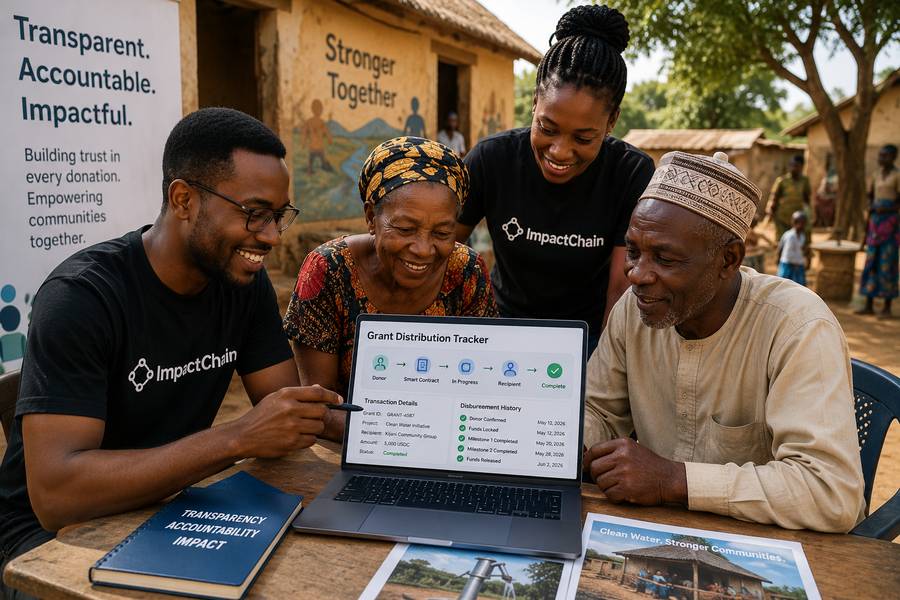
When a person donates to a cause or a foundation awards a grant, an act of trust quietly takes place that is rarely examined but is always present. The donor trusts that the money will reach the intended purpose, that it will not simply be lost to overhead and administration along the way, that the organization in the middle will distribute it wisely and honestly, and that the recipients themselves will use it as they promised. For most of the history of philanthropy and grant-making, this trust has been largely unverifiable, because the path that money takes from a donor’s hand to a project’s work passes through institutions whose internal workings are opaque. A donor writes a check and receives, at the very best, a general annual report and a thank-you letter, with little ability to confirm where the money actually went or to judge whether it was distributed fairly and efficiently. This opacity is not necessarily a sign of wrongdoing, but it is a persistent source of doubt that has shadowed charitable giving and grant distribution alike, and it has measurable consequences, since surveys repeatedly find that uncertainty about how donations are used is among the leading reasons people give to causes hesitate or give less than they otherwise might.
Web3, the term for the emerging set of technologies built on public blockchains, offers a different proposition. Because a blockchain is a shared, permanent, and publicly inspectable ledger, money that moves across it leaves a visible and unalterable trail, and the rules that govern its distribution can be written into transparent code that executes automatically. Applied to grants and philanthropic funding, this means a donor could in principle follow their contribution from the moment it is given, through whatever pooling and matching mechanisms allocate it, to the specific projects that receive it, all without relying on the word of an intermediary. The promise is a system in which the trust that grant distribution has always required is replaced, at least in part, by verifiable transparency, allowing anyone to see where funds come from, how they are allocated, and where they ultimately go.
This article examines how Web3 technologies are being used to coordinate philanthropic and public-goods funding with unprecedented transparency, written for a reader with no background in blockchain or grant-making. It explains the transparency problem that has long troubled traditional funding, the mechanisms by which blockchains enable clear tracking from donors to recipients, and the novel funding methods, such as quadratic and retroactive funding, that decentralized communities have pioneered. It weighs the genuine benefits and the real limitations of these approaches, and it grounds the discussion in documented platforms that have distributed substantial sums. The aim is to convey both the promise of more transparent, democratic, and efficient funding and the honest challenges that stand between that promise and its full realization.
Understanding Grant Distribution and the Transparency Problem
Grant distribution is the process by which funds are allocated from those who provide them to those who will use them for a particular purpose, and it sits at the heart of philanthropy, public funding, and the support of work that markets do not naturally reward. A grant is, in essence, a sum given to support a project or organization without the expectation of direct financial return, distinguishing it from an investment or a loan. The work that grants support is often what economists call a public good, something that benefits many people but that no individual has sufficient incentive to fund alone, such as open-source software, scientific research, community infrastructure, or environmental protection. Because such work does not generate profits that would attract ordinary investment, it depends on grant funding from foundations, governments, donors, and other sources willing to support it for its broader value rather than for personal gain.
The traditional machinery of grant distribution, while it has accomplished a great deal, suffers from a set of persistent weaknesses that center on opacity and inefficiency. The path that funds take typically runs through intermediary institutions, foundations, charities, and grant-making bodies, that collect money, decide how to allocate it, and disburse it to recipients, and the internal workings of these institutions are generally not visible to the donors or the public. A donor giving to a large organization usually cannot see how their specific contribution was used, what fraction was consumed by administration and overhead, how allocation decisions were made, or whether the chosen recipients actually delivered results. This opacity makes it difficult to hold institutions accountable, to compare their efficiency, or to verify that funds reached their intended purpose, and it leaves donors to rely on reputation and faith rather than evidence.
Beyond opacity, traditional grant distribution often carries significant friction and cost that reduce the funds reaching their ultimate purpose. Administrative overhead consumes a portion of every dollar, the application and review processes can be slow and burdensome, and the movement of money across borders and through financial intermediaries adds expense and delay. Small organizations and individuals, in particular, may find the application processes of major funders so demanding that they are effectively excluded, while the funders themselves struggle to evaluate the vast number of potential recipients and tend to concentrate funding on established, well-connected applicants. These frictions mean that a meaningful share of philanthropic resources is consumed by the machinery of distribution itself, and that the allocation of funds can be slow, centralized, and skewed toward those who are already visible to funders rather than those doing the most valuable work.
The deeper problem underlying all of these issues is one of trust and verification, the difficulty of confirming that a system handling other people’s money for the benefit of third parties is actually operating honestly and effectively. Donors must trust that their money is used as intended, recipients must trust that funds will arrive as promised, and the public must trust that the whole system serves its stated purpose rather than the interests of those who run it. In a world where this trust is frequently violated, through outright fraud, through quiet inefficiency, or through allocation that favors insiders, the absence of verifiable transparency is a genuine cost, eroding confidence in philanthropy and grant-making and making it harder for honest, effective organizations to distinguish themselves from the rest. It is precisely this trust and verification problem that Web3 technologies aim to address, by making the flow and allocation of funds transparent and verifiable in a way that traditional systems cannot match, and understanding the depth of the problem is the key to appreciating why a new approach has attracted such interest.
The funding of public goods deserves particular emphasis, because it is the domain where these problems bite hardest and where Web3 grant systems have concentrated their efforts. Public goods present what economists call a free-rider problem, in which everyone benefits from the work but each individual has an incentive to let others pay for it, so the work tends to be chronically underfunded relative to its true value to society. Open-source software offers a vivid example, since vast swaths of the digital economy depend on freely available code maintained by volunteers who capture almost none of the value their work creates, leaving critical infrastructure perpetually underfunded and at risk. Traditional grant-making has struggled to solve this because it relies on a few funders making centralized judgments about which public goods deserve support, a process that is slow, narrow, and prone to missing valuable but less visible work. The mechanisms that Web3 communities have developed are explicitly designed to attack the free-rider problem by aggregating many small contributions and amplifying them with matching funds, harnessing the dispersed knowledge of a whole community to identify and support the public goods that genuinely matter. This focus on public goods, and on the structural reasons they go underfunded, is central to understanding why the new funding mechanisms took the particular shapes they did.
How Web3 Enables Transparent Funding
Web3 technologies address the transparency problem through two complementary capabilities, the ability to record and track the flow of funds on a public, immutable ledger, and the ability to encode the rules of distribution into transparent, automatically executing code. Together these allow a grant system to operate in the open, where anyone can verify where money comes from, how it is allocated, and where it goes, without depending on the disclosures of a trusted intermediary. This represents a fundamental shift in how accountability is achieved, replacing trust in institutions with verification through technology, and it has enabled not only more transparent versions of traditional grant-making but entirely new mechanisms for allocating funds that would be difficult or impossible to implement in conventional systems.
The two capabilities work hand in hand, and the subsections that follow examine each in turn. The first is the foundational transparency that comes from conducting grant distribution on a blockchain, where the movement and disbursement of funds are recorded permanently and visibly and can be governed by smart contracts that execute the rules automatically. The second is the set of novel funding mechanisms, particularly quadratic funding and retroactive public goods funding, that decentralized communities have developed to allocate funds in more democratic and effective ways than traditional grant-making allows. Understanding both the transparency of the underlying infrastructure and the innovation of the allocation mechanisms is essential to grasping what Web3 brings to grant distribution.
On-Chain Tracking and Smart Contract Disbursement
The foundational capability that Web3 brings to grant distribution is the transparent, permanent recording of fund flows on a public blockchain, which makes the movement of money visible and verifiable to anyone. When grants are distributed on-chain, every transaction, from a donor’s initial contribution to the pooling of funds to the final disbursement to a recipient, is recorded on the shared ledger as a permanent entry that cannot be secretly altered or deleted. This creates an auditable trail that allows anyone to trace where funds originated, how they moved through the system, and where they ultimately landed, providing a level of transparency that traditional grant-making, with its opaque internal accounts, simply cannot offer. A donor can verify that their contribution entered the intended pool, observe how the allocation mechanism distributed it, and confirm that the funds reached the recipients, all by inspecting the public record rather than trusting a report.
This transparency is greatly amplified by smart contracts, the programs that run on blockchains and execute predefined rules automatically without requiring a trusted intermediary to carry them out. In a grant system built on smart contracts, the rules governing how funds are collected, allocated, and disbursed can be written into code that executes exactly as written, so that the distribution of funds follows transparent, predetermined logic rather than the discretionary and hidden decisions of an institution. A smart contract can hold pooled funds, apply a defined allocation formula to determine how much each recipient receives, and release the funds automatically when conditions are met, all in full public view. This removes much of the opportunity for funds to be misdirected, skimmed, or allocated through hidden favoritism, because the rules are visible in advance and the execution is verifiable after the fact, and it reduces the need for a trusted middleman whose honesty cannot be confirmed.
The combination of on-chain recording and smart contract execution also enables conditional and programmable disbursement that can improve accountability beyond mere transparency. Funds can be released in stages tied to verifiable milestones, held in escrow until conditions are satisfied, or returned if requirements are not met, with all of these arrangements encoded in transparent code rather than enforced through manual oversight. This programmability allows grant systems to build accountability directly into the mechanism of distribution, releasing money as recipients demonstrate progress rather than handing over a lump sum and hoping for the best. While the verification of real-world milestones introduces challenges that the technology alone cannot fully solve, the capacity to make disbursement conditional and automatic, governed by transparent rules and recorded permanently, represents a meaningful advance over traditional systems in which funds are typically released on the basis of trust and recovered, if at all, only through difficult after-the-fact enforcement. This foundation of transparent, programmable fund flow is what makes everything else that Web3 grant systems do possible.
Novel Funding Mechanisms: Quadratic and Retroactive
Beyond making existing grant processes more transparent, Web3 communities have pioneered genuinely novel mechanisms for allocating funds, and the most influential of these is quadratic funding, a method designed to allocate matching funds in a way that reflects the breadth of community support rather than the size of individual donations. In quadratic funding, a matching pool, often provided by a sponsor or foundation, is distributed among projects based on a formula that weighs the number of contributors more heavily than the total amount contributed, so that a project supported by many small donations receives more matching than one supported by a few large ones. The effect is to amplify the preferences of the broad community over those of wealthy individuals, giving ordinary people’s small contributions outsized influence in directing the matching funds, and thereby allocating money toward the projects that the most people genuinely care about rather than those favored by the few who can give the most.
The appeal of quadratic funding is that it offers a more democratic and arguably more accurate way of identifying which public goods deserve support, drawing on the wisdom of the crowd while using matching funds to correct for the tendency of public goods to be underfunded. Because each additional contributor counts for more than each additional dollar, the mechanism rewards projects that earn the support of many people, which serves as a signal of genuine, broad-based value, and it gives a community collective influence over how a large matching pool is spent. This approach has been deployed at significant scale, most prominently by Gitcoin, whose grants program has used quadratic funding to distribute many millions of dollars to thousands of projects, allowing communities of donors to direct matching funds toward open-source software, infrastructure, climate initiatives, and other public goods according to the breadth of their support rather than the depth of any single donor’s pockets.
A second major innovation is retroactive public goods funding, which inverts the usual logic of grants by rewarding work after it has proven valuable rather than funding it in advance based on promises. Traditional grant-making requires funders to predict which proposals will succeed, a notoriously difficult task, but retroactive funding instead waits to see what actually delivered value and then rewards those contributions, on the principle that it is easier to agree on what has been useful than to predict what will be. Under this model, a community allocates funds to projects and contributions that have already benefited the ecosystem, using the judgment of designated members or the community at large to assess impact in hindsight. The Optimism Collective has implemented this approach at scale through its rounds of retroactive public goods funding, distributing large quantities of tokens to reward work that supported its ecosystem, and the model has attracted wide interest as a way to fund public goods that aligns rewards with demonstrated results. Together, quadratic and retroactive funding represent a creative reimagining of how grants can be allocated, made practical by the transparent, programmable infrastructure of Web3, and they illustrate that the technology enables not just better versions of old systems but fundamentally new ways of coordinating support for valuable work.
It is worth understanding why these particular mechanisms became practical only with blockchain infrastructure, since variations of the underlying ideas had been discussed by economists long before. Quadratic funding, in particular, rests on a body of economic theory about how to optimally fund public goods, but implementing it requires collecting many small contributions, verifying that contributors are distinct individuals, applying a precise mathematical formula to determine matching, and disbursing the results transparently, all at a scale and cost that conventional systems could not manage. The combination of cheap global micropayments, programmable smart contracts that can execute the matching formula automatically, public ledgers that make the whole process auditable, and digital identity tools that attempt to verify uniqueness brought these theoretical mechanisms within practical reach for the first time. Retroactive funding similarly benefits from the ability to coordinate a community of evaluators and execute their collective judgment transparently through on-chain governance. The lesson is that Web3 did not invent the ideas behind these mechanisms so much as supply the infrastructure that made them operable at scale, turning elegant theory into working systems that distribute real money, which helps explain why a field long dominated by centralized foundations suddenly saw a burst of experimentation in how funding could be allocated.
The Technology and Governance Infrastructure
The transparent funding mechanisms described so far rest on a broader infrastructure of technology and governance that makes decentralized grant distribution possible, and understanding this infrastructure clarifies both how these systems operate and where their difficulties lie. At the organizational heart of many Web3 grant systems is the decentralized autonomous organization, or DAO, a structure in which a community collectively governs shared resources through transparent, on-chain rules and voting rather than through a traditional corporate hierarchy. A DAO can hold a treasury of funds, propose and decide on how to allocate them, and execute those decisions through smart contracts, allowing a distributed group of people to coordinate grant-making without a central authority. This governance model is what enables the democratic allocation of funds that distinguishes many Web3 grant systems, placing decisions in the hands of a community rather than a small board, and it provides the transparent decision-making layer that sits atop the transparent fund flows.
A critical and challenging component of this infrastructure is identity and the prevention of manipulation, because mechanisms like quadratic funding, which reward the number of contributors, are vulnerable to a particular kind of attack. If a single person can create many fake identities, each appearing to be a distinct contributor, they can manipulate a quadratic funding round to direct matching funds toward their own project, defeating the mechanism’s democratic intent. This is known as a sybil attack, and defending against it requires some way of establishing that each participant is a unique, genuine person without necessarily knowing their real-world identity, a difficult balance between resisting manipulation and preserving privacy and openness. Web3 grant systems have developed various tools to address this, including identity verification systems that aggregate signals to estimate whether an account is a real individual, and these defenses are essential to the integrity of community-driven funding, even though they remain an ongoing area of difficulty rather than a fully solved problem.
The treasury and fund management layer forms another essential part of the infrastructure, governing how pooled resources are held, protected, and deployed. Decentralized grant systems hold funds in on-chain treasuries, often controlled by smart contracts and governed by the community, which provides transparency about how much is held and how it is spent but also introduces challenges around security and the management of assets whose value can fluctuate. Because these treasuries are frequently denominated in cryptocurrencies whose prices are volatile, a grant program’s available resources can swing significantly with the market, complicating planning and potentially affecting the funds available to recipients. The management of these treasuries, including decisions about how to safeguard them, how to handle volatility, and how to ensure that funds are available when needed, is a substantial responsibility that decentralized communities must shoulder, and it requires both technical security to protect against theft and sound stewardship to preserve value.
Surrounding these core elements is a growing ecosystem of tooling that supports the practical operation of decentralized grant distribution, including platforms for running funding rounds, interfaces for donors and applicants, systems for proposing and voting on allocations, and mechanisms for reporting and verifying impact. This tooling has matured considerably, making it possible for communities to run sophisticated funding programs with quadratic or retroactive mechanisms without building everything from scratch, and it has lowered the barrier for organizations and ecosystems to adopt transparent, community-driven funding. The combination of DAO governance, identity and sybil resistance, treasury management, and operational tooling constitutes the machinery that turns the abstract promise of transparent grant distribution into working systems, and the continued development of this infrastructure, particularly in the difficult areas of identity and treasury management, will substantially determine how far and how reliably these approaches can scale. The sophistication of this supporting infrastructure is often invisible to participants but is what allows the visible mechanisms of transparent funding to function.
The matching pool itself deserves attention as a piece of the infrastructure, because it is what gives community contributions their amplified power and shapes the incentives of the whole system. In a quadratic funding round, the matching pool is typically supplied by a sponsor, a foundation, or an ecosystem treasury that wishes to support public goods but wants the community to direct where the money goes rather than choosing recipients itself. By committing a pool of funds to be distributed according to the quadratic formula, the sponsor effectively delegates allocation to the crowd, using its capital to multiply the impact of many small donations and to signal that it trusts the community’s collective judgment. This arrangement neatly aligns the interests of large funders, who want their money to do the most good, with the democratic ideal of community-directed allocation, and it explains why ecosystems with substantial treasuries have been eager to sponsor such rounds. The size and recurrence of these matching pools, often substantial and provided on a regular cadence, is a major determinant of how much a funding program can accomplish, and securing reliable matching sponsors is as important to a sustainable grant ecosystem as any technical component.
Impact measurement and reporting form a final, evolving piece of the infrastructure that attempts to bridge the gap between on-chain transparency and real-world results. Recognizing that a ledger can show where money went but not what it achieved, communities have begun developing standards and tools for recipients to report on their outcomes, for evaluators to assess impact, and for this information to be recorded alongside the financial data. These efforts aim to extend accountability beyond the financial flow toward the actual results of funded work, creating a fuller picture that combines verifiable disbursement with credible reporting on impact. The development of trustworthy impact measurement is widely regarded as one of the most important frontiers for the field, because it addresses the central limitation that transparency of money alone does not guarantee transparency of outcomes, and progress here will substantially determine whether Web3 grant systems can deliver not just visible spending but demonstrable good.
Benefits and Challenges Across Stakeholders
Web3 grant distribution produces distinct effects for the various parties involved, and a balanced assessment requires weighing its substantial benefits against its genuine limitations across these groups. Donors gain transparency and confidence, recipients gain access and faster funding, and communities gain democratic influence over how resources are allocated, yet these advantages come alongside risks of manipulation, the persistent gap between on-chain transparency and off-chain reality, the volatility of crypto assets, and barriers of accessibility and complexity. The technology offers real improvements over the opacity and friction of traditional grant-making, but it does not solve every problem and introduces some of its own, so a clear-eyed view must hold the promise and the limitations together.
The analysis below organizes these considerations by stakeholder and by category, first examining the benefits that flow to donors, recipients, and communities when these systems work well, then turning to the risks, limitations, and open challenges that determine whether those benefits are fully realized. Keeping these perspectives distinct helps move past both uncritical enthusiasm for a promising technology and reflexive skepticism toward anything associated with cryptocurrency, arriving at a grounded understanding of what Web3 grant distribution genuinely offers and what obstacles it has yet to overcome.
Benefits for Donors, Recipients, and Communities
For donors, the central benefit is transparency and the confidence it brings, the ability to verify that contributions are used as intended rather than relying on trust in an opaque institution. A donor to a Web3 grant system can trace their funds on the public ledger, see how the allocation mechanism distributed them, and confirm that they reached recipients, which provides a kind of accountability that traditional philanthropy rarely offers. This verifiable transparency can increase donor confidence and willingness to give, because it removes the doubt about whether money is being wasted or misdirected, and it allows donors to make more informed decisions by seeing the actual track record of how funds flow and what they support. For donors who have grown skeptical of charitable overhead and opacity, the capacity to follow their money from contribution to impact addresses a longstanding source of hesitation and offers a more trustworthy basis for giving.
There is also a meaningful benefit in how these systems engage donors beyond the act of giving money. In a quadratic funding round, a donor is not merely a source of funds but a participant whose small contribution helps direct a much larger matching pool, which gives even modest donors a sense of genuine influence over outcomes that traditional charity rarely provides. This participatory quality can deepen the connection between donors and the causes they support, turning passive giving into active engagement and fostering communities of people who collectively decide what to fund. The experience of contributing a small amount and watching it amplified by matching, in full public view, can be more satisfying and more motivating than writing a check into an opaque institution, and it can build lasting communities around the work being funded. This transformation of donors from passive funders into engaged participants is one of the more subtle but significant benefits of the model, because sustained philanthropy depends on people feeling that their giving matters, and a system that visibly amplifies and honors small contributions speaks directly to that need.
For recipients, the benefits center on expanded access, reduced friction, and faster funding, particularly for the individuals and small projects that traditional grant-making often overlooks. Web3 grant systems can lower the barriers that exclude smaller applicants, allowing a broader range of projects to seek and receive support without navigating the demanding application processes of major institutional funders, and mechanisms like quadratic funding can direct resources to projects with genuine community support that lack the connections to attract traditional grants. The disbursement of funds on-chain can also be faster and cheaper than traditional cross-border transfers, getting money to recipients more quickly and with less lost to fees and delays, which is especially valuable for recipients in places poorly served by conventional financial systems. These advantages can meaningfully widen the pool of work that gets funded, extending support to creators and projects that the established system would never reach.
For communities and the broader cause of supporting public goods, the benefits lie in the democratization of funding decisions and the more effective allocation of resources toward genuinely valued work. By giving communities collective influence over how matching funds are distributed, mechanisms like quadratic funding shift power from a small number of large funders toward the many people who care about the work, producing allocations that better reflect broad-based preferences and the actual value the community perceives. Retroactive funding, by rewarding demonstrated impact rather than promises, can improve the efficiency with which resources reach the work that truly matters, and the transparency of the whole system allows the community to learn what works and to hold the process accountable. This democratization addresses a deep limitation of traditional philanthropy, in which the priorities of a few wealthy funders or institutions disproportionately shape what gets supported, and it offers a vision of funding that is more participatory, more responsive to genuine community needs, and more aligned with the collective judgment of those the work is meant to serve.
Risks, Limitations, and Open Challenges
The most significant technical challenge is the vulnerability of community-driven mechanisms to manipulation, particularly the sybil attacks that threaten quadratic funding and any system that rewards the number of participants. Because creating fake identities on a blockchain can be cheap, a determined attacker may attempt to flood a funding round with sham accounts to capture matching funds, and defending against this requires identity and verification systems that are themselves imperfect and that involve difficult trade-offs between security, privacy, and openness. While these defenses have improved, sybil resistance remains an unsolved problem in its fullest form, and the integrity of community funding depends on continually staying ahead of those who would game it. This vulnerability is intrinsic to the democratic mechanisms that make Web3 grant distribution distinctive, meaning that the very features that give it value also create its most persistent security challenge.
A more fundamental limitation is the gap between on-chain transparency and off-chain reality, the fact that a blockchain can perfectly track where money goes but cannot verify what happens to it in the real world. A grant system can prove that funds reached a recipient’s account, but it cannot prove that the recipient actually did the work, used the money well, or delivered the promised impact, because these are facts about the physical and social world that lie beyond the ledger’s view. This means that the transparency Web3 provides, while genuine and valuable, addresses only part of the accountability problem, guaranteeing the integrity of the financial flow but not the integrity of the underlying work. Verifying real-world outcomes still requires human judgment, reporting, and the same kinds of trust and assessment that traditional systems rely on, and the temptation to assume that on-chain transparency solves accountability entirely is a genuine pitfall, since the hardest part of grant-making, knowing whether funded work actually achieved its purpose, remains as difficult as ever.
Additional challenges concern volatility, accessibility, complexity, and the broader environment in which these systems operate. Because Web3 grant systems typically handle cryptocurrencies, the volatility of those assets can cause the value of treasuries and grants to swing unpredictably, complicating planning for both funders and recipients and introducing financial risk that traditional, currency-denominated grants avoid. The complexity of the technology also poses a barrier, since participating in these systems requires a degree of technical knowledge and comfort with cryptocurrency that excludes many potential donors and recipients, potentially limiting the reach of systems that aspire to be more inclusive and creating a risk that they serve mainly those already fluent in the technology. There are also regulatory uncertainties around the treatment of crypto-based grants and donations, security risks from smart contract vulnerabilities and treasury theft, and the reputational shadow cast by fraud and speculation elsewhere in the cryptocurrency world. None of these challenges negates the real value of transparent, democratic grant distribution, but together they make clear that the technology is a powerful but partial solution, one that genuinely improves financial transparency and enables new funding models while leaving important problems unsolved and introducing new complexities that must be carefully managed for its benefits to reach the people and causes it aims to serve.
Real-World Implementations and Measured Outcomes
The promise of Web3 grant distribution is best evaluated through the platforms that have actually deployed it at scale, and three well-documented examples demonstrate how transparent, community-driven funding works in practice and what it has achieved. These cases span quadratic funding for public goods, retroactive funding for ecosystem contributions, and transparent direct giving for charitable causes, together illustrating the range of approaches and the substantial sums they have distributed. Each is grounded in real activity with documented figures, and together they show that transparent grant distribution has moved well beyond theory into systems that have channeled tens of millions of dollars to thousands of projects and recipients.
Gitcoin stands as the largest and longest-running deployment of quadratic funding and the most prominent example of Web3 grant distribution. Through its grants program, Gitcoin has used quadratic funding to allocate matching pools among thousands of projects based on the breadth of community support, with sponsors providing matching funds and communities of donors directing those funds through their many small contributions. The cumulative scale is substantial, with the program having distributed well over sixty million dollars to several thousand projects across open-source software, decentralized infrastructure, climate solutions, and community initiatives, a figure that grew toward sixty-seven million dollars and more than five thousand projects by 2025. Individual funding rounds illustrate the mechanism in action, such as a recent round that distributed over a million dollars through quadratic and retroactive funding combined, including hundreds of thousands of dollars in matching funds allocated across hundreds of projects and fueled by the contributions of thousands of unique donors. Gitcoin’s sustained operation demonstrates that quadratic funding can coordinate genuine community preferences to allocate significant resources transparently, and its scale makes it the definitive proof that the model works in practice. Equally important, Gitcoin has had to confront and respond to the practical difficulties of running such rounds, including defending against attempts to manipulate the matching through fake identities, and its ongoing investment in identity and sybil-resistance tooling has made it a testing ground for the very defenses on which community-driven funding depends, lessons that have informed the broader field as other ecosystems adopted similar mechanisms.
The Optimism Collective provides the leading example of retroactive public goods funding at scale, rewarding contributions after they have demonstrated value rather than funding them in advance. Through its rounds of retroactive public goods funding, Optimism has distributed large quantities of its tokens to projects and contributors that supported the development and adoption of its ecosystem, with the second round in early 2023 allocating ten million tokens and the third round in the fall of 2023 allocating thirty million tokens, together distributing forty million tokens across the two rounds. The program reflects a substantial long-term commitment, with a large reserve of the token’s total supply dedicated to public goods funding over time, and decisions about allocation made through a transparent process that assesses demonstrated impact. This implementation shows retroactive funding operating at meaningful scale, directing significant resources toward work that had already proven beneficial, and it has influenced the broader field as a model for funding public goods in a way that aligns rewards with results rather than relying on the difficult prediction of future success.
The world of transparent crypto philanthropy, including platforms such as Giveth, illustrates how blockchain’s transparency is applied to charitable giving more broadly. Giveth operates as a platform for transparent, low-fee crypto donations to charitable and public-good projects, using decentralized governance to involve donors in how funds are directed and providing an auditable on-chain trail of contributions, which embodies the application of Web3 transparency to direct philanthropy. The broader growth of crypto philanthropy provides context for the scale of this movement, with the donation platform The Giving Block reporting that crypto giving passed one hundred and twenty-five million dollars in cumulative donations and that over a thousand nonprofits joined to accept cryptocurrency in 2022 alone, even during a difficult year for crypto markets, with industry projections anticipating billions of dollars in crypto donations over the following decade. These developments show that the transparency and efficiency of blockchain-based giving, the auditable trail from donor to recipient and the reduction of intermediary friction, are being adopted not only within crypto-native communities but increasingly by mainstream charitable organizations. Taken together, these three implementations, spanning quadratic funding, retroactive funding, and transparent direct giving, demonstrate that Web3 grant distribution has achieved real scale and real impact, channeling substantial resources with a transparency that traditional systems cannot match, even as the challenges of verification and accessibility continue to be worked through.
Final Thoughts
Web3 grant distribution addresses a problem that has quietly burdened philanthropy and public funding for as long as they have existed, the difficulty of knowing whether money given for the benefit of others actually reaches its purpose and is allocated fairly and well. By conducting the flow and allocation of funds on transparent, permanent ledgers governed by visible code, these systems replace the trust that grant-making has always demanded with verification that anyone can perform, allowing donors to follow their contributions, communities to shape allocation decisions, and recipients to receive support through more open and often more democratic processes. The mechanisms that have emerged, particularly quadratic funding and retroactive public goods funding, represent not merely transparent versions of old systems but genuinely new ways of coordinating support for valuable work, and the substantial sums they have distributed demonstrate that these are functioning systems rather than speculative ideas.
The broader significance of this work extends into questions of inclusion and the distribution of influence that reach well beyond the mechanics of funding. Traditional philanthropy concentrates the power to decide what gets supported in the hands of a relatively small number of wealthy funders and institutions, whose priorities, however well-intentioned, may not reflect the genuine needs and judgments of the communities the funding is meant to serve. By giving ordinary people collective influence over how resources are allocated and by lowering the barriers that exclude smaller projects and creators, Web3 grant distribution offers a more participatory and inclusive model, one in which the breadth of community support, rather than the depth of a few donors’ pockets, can shape where money flows. This democratization of funding, combined with the ability to reach recipients in places poorly served by traditional financial systems, points toward a more equitable distribution of philanthropic resources and a fuller realization of the idea that those affected by funding decisions should have a voice in making them.
The honest assessment must hold this promise alongside the real limitations that remain unresolved. The transparency Web3 provides is genuine but partial, guaranteeing the integrity of financial flows while leaving the harder question of whether funded work actually delivers its intended impact as difficult as ever, dependent still on human judgment and the verification of off-chain reality. The democratic mechanisms that give these systems their distinctive value also create their most persistent vulnerabilities, particularly the threat of manipulation through fake identities, and the complexity and volatility of the underlying technology can exclude the very people such systems aspire to include. The intersection of financial technology and social responsibility is sharply present here, in the obligation to build systems that are not only transparent but genuinely accessible, that resist manipulation without sacrificing openness, and that pair the verifiability of fund flows with honest accountability for real-world results.
The most constructive view is that Web3 grant distribution represents a meaningful advance whose ultimate value depends on how thoughtfully its remaining challenges are addressed, capable of bringing unprecedented transparency and democratic participation to the funding of valuable work while never fully eliminating the need for human judgment about impact. As the infrastructure matures, as identity and verification systems improve, and as the tools become more accessible to people without technical expertise, the prospect of funding systems that are transparent, participatory, and effective moves closer to realization. The enduring promise lies in extending the means of philanthropic participation to more people, directing resources toward what communities genuinely value, and bringing accountability to a domain long shadowed by opacity, a worthwhile contribution to the broader project of funding the public goods on which a healthy society depends.
FAQs
- What is Web3 grant distribution?
Web3 grant distribution is the use of blockchain-based technologies to allocate philanthropic and public-goods funding transparently, recording the flow of funds on a public, permanent ledger and often governing distribution through smart contracts and community decision-making. It allows donors to trace their contributions from giving to final recipient, replaces opaque institutional processes with verifiable transparency, and enables novel allocation methods such as quadratic and retroactive funding. The goal is to make grant-making more transparent, democratic, and efficient than traditional systems that rely on trust in intermediaries. - Why is transparency a problem in traditional grant-making?
In traditional systems, funds pass through intermediary institutions whose internal workings are generally not visible to donors or the public. A donor usually cannot see how their specific contribution was used, what fraction went to overhead, how allocation decisions were made, or whether recipients delivered results. This opacity makes it hard to hold institutions accountable or verify that funds reached their intended purpose, leaving donors to rely on reputation and faith rather than evidence, which has long been a source of doubt in philanthropy and grant distribution. - How does a blockchain make funding transparent?
A blockchain is a shared, permanent, publicly inspectable ledger, so when grants are distributed on it, every transaction from a donor’s contribution to the final disbursement is recorded as an entry that cannot be secretly altered. This creates an auditable trail that anyone can follow to see where funds originated, how they moved, and where they landed. Smart contracts can further govern distribution through transparent, automatically executing rules, removing much of the opportunity for funds to be misdirected or allocated through hidden favoritism. - What is quadratic funding?
Quadratic funding is a method of allocating a matching pool among projects based on the breadth of community support rather than the size of donations. Its formula weighs the number of contributors more heavily than the total amount given, so a project supported by many small donations receives more matching than one supported by a few large ones. This amplifies the preferences of the broad community over wealthy individuals, directing matching funds toward the projects that the most people genuinely value. Gitcoin has used it to distribute many millions of dollars. - What is retroactive public goods funding?
Retroactive public goods funding rewards work after it has proven valuable rather than funding it in advance based on promises. Instead of requiring funders to predict which proposals will succeed, a difficult task, it waits to see what actually delivered value and then rewards those contributions, on the principle that it is easier to agree on what has been useful than to predict what will be. The Optimism Collective has implemented this at scale, distributing large quantities of tokens to reward contributions that supported its ecosystem. - What is a DAO and how does it relate to grants?
A DAO, or decentralized autonomous organization, is a structure in which a community collectively governs shared resources through transparent, on-chain rules and voting rather than a corporate hierarchy. In grant distribution, a DAO can hold a treasury, propose and decide how to allocate funds, and execute those decisions through smart contracts, allowing a distributed community to make grant-making decisions without a central authority. This governance model enables the democratic allocation that distinguishes many Web3 grant systems, placing decisions in the hands of a community rather than a small board. - What is a sybil attack and why does it matter?
A sybil attack is when one person creates many fake identities to manipulate a system. It matters greatly for mechanisms like quadratic funding that reward the number of contributors, because an attacker who can cheaply create sham accounts could flood a funding round to direct matching funds toward their own project, defeating the democratic intent. Defending against this requires identity verification systems that establish each participant is a unique person without necessarily knowing their real identity, a difficult balance, and sybil resistance remains an ongoing challenge rather than a fully solved problem. - Does blockchain transparency guarantee funds are used well?
No, and this is a key limitation. A blockchain can perfectly track where money goes but cannot verify what happens to it in the real world. A system can prove that funds reached a recipient but not that the recipient did the work, used the money wisely, or delivered the promised impact, because these are facts about the physical and social world beyond the ledger’s view. Verifying real-world outcomes still requires human judgment and reporting, so on-chain transparency solves the integrity of the financial flow but not the full accountability problem. - How much money has actually been distributed this way?
Substantial sums. Gitcoin’s grants program has distributed well over sixty million dollars to several thousand projects through quadratic funding, growing toward sixty-seven million dollars and more than five thousand projects by 2025. The Optimism Collective distributed forty million tokens across its second and third retroactive funding rounds in 2023. In the broader charitable space, the platform The Giving Block reported crypto giving passing one hundred and twenty-five million dollars cumulatively, with over a thousand nonprofits joining to accept crypto in 2022 alone. - What are the main risks of Web3 grant distribution?
Key risks include manipulation through sybil attacks on community-driven mechanisms, the gap between on-chain transparency and unverifiable off-chain outcomes, and the volatility of cryptocurrencies that can cause the value of treasuries and grants to swing unpredictably. The complexity of the technology can also exclude donors and recipients who lack technical expertise, undermining the goal of inclusion, and there are regulatory uncertainties, smart contract security risks, and the reputational shadow of fraud elsewhere in crypto. These do not negate the benefits but make the technology a powerful yet partial solution requiring careful management.