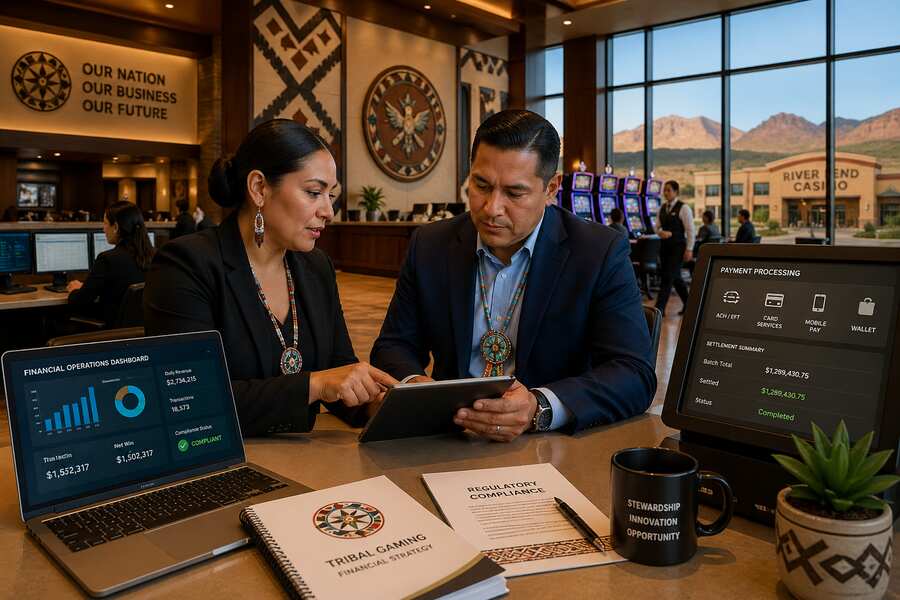
The tribal gaming industry stands at a pivotal inflection point. With gross gaming revenues reaching a record $43.9 billion in fiscal year 2024, a $2.0 billion increase over the prior year representing 4.6 percent growth, the 532 gaming operations owned by 243 federally recognized tribes across 29 states have cemented their position as one of the most consequential economic engines in Indian Country. That financial scale demands infrastructure to match. The days of cash-heavy gaming floors supported by manual compliance processes and siloed transaction systems are giving way to a new era of integrated financial technology that promises to reshape how tribal casinos operate, how patrons engage, and how sovereign nations exercise control over their economic futures.
What makes the tribal gaming fintech landscape fundamentally different from its commercial counterpart is the regulatory environment in which it operates. The Indian Gaming Regulatory Act of 1988 established a three-tiered system of governance involving federal oversight through the National Indian Gaming Commission, state involvement through negotiated Tribal-State compacts, and tribal self-regulation through Tribal Gaming Regulatory Authorities. This layered framework creates a compliance environment that generic commercial casino technology simply cannot serve without significant modification. Fintech solutions deployed in tribal gaming must navigate the intersection of federal Bank Secrecy Act requirements, NIGC minimum internal control standards, state compact obligations, and tribal sovereignty principles that assert a nation’s right to govern its own financial systems and data. The result is a technology procurement landscape where off-the-shelf solutions rarely work without substantial adaptation, and where the vendor’s understanding of sovereign governance matters as much as the product’s feature set.
The stakes of getting fintech right in this environment extend beyond operational efficiency. Tribal gaming revenues fund essential government services, healthcare programs, education initiatives, and infrastructure development across Indian Country. The NIGC’s mission explicitly frames gaming as a mechanism for promoting tribal economic development, self-sufficiency, and strong tribal governance. When a tribe invests in a cashless payment platform or deploys an automated compliance system, it is not simply upgrading its casino technology. It is strengthening the financial infrastructure that sustains its community, and the technology choices it makes carry implications for data sovereignty, regulatory compliance, patron trust, and long-term economic resilience.
This article examines the financial technology solutions engineered for this unique environment. From cashless payment platforms and digital wallets transforming the patron experience to regulatory technology tools automating anti-money laundering compliance, from cybersecurity frameworks protecting sovereign data to mobile gaming platforms extending the casino floor into hotel rooms and resort spaces, the fintech stack powering modern tribal gaming operations reflects both the industry’s enormous scale and its distinct governance requirements. Understanding this infrastructure is essential for anyone seeking to grasp how tribal nations are leveraging technology to strengthen their economic sovereignty while delivering world-class gaming experiences.
The Tribal Gaming Regulatory Landscape and Its Impact on Fintech Adoption
The regulatory architecture governing tribal gaming is unlike anything else in the American financial landscape. At its foundation sits the Indian Gaming Regulatory Act, which Congress enacted in 1988 to provide a legal framework that protects tribes as the primary beneficiaries of their gaming operations while maintaining the integrity of the gaming industry. IGRA created three classes of gaming, each with distinct regulatory implications for fintech deployment. Class I encompasses traditional tribal ceremonial games and falls exclusively under tribal jurisdiction. Class II includes bingo, pull tabs, and certain card games regulated primarily by tribal authorities with NIGC oversight. Class III covers everything else, including slot machines, table games, and sports betting, and requires both a Tribal-State compact and NIGC approval. This classification system has profound consequences for technology adoption because the regulatory pathway for deploying a cashless payment system on a Class II bingo floor differs substantially from implementing the same technology across a Class III slot operation.
The National Indian Gaming Commission provides federal oversight across this framework, regulating 532 gaming establishments operated by tribes across 29 states. The NIGC’s Compliance Division plays a direct role in shaping fintech requirements through its enforcement of Minimum Internal Control Standards, which establish baseline requirements for everything from accounting procedures to information technology security. In fiscal year 2024, the Compliance Division issued 11 Letters of Concern to address serious regulatory violations and provided formal regulatory compliance training at 75 events reaching over 16,800 attendees across nearly 300 training hours. These MICS requirements directly influence how fintech vendors design their products because every cashless transaction system, every digital wallet integration, and every automated reporting tool must operate within parameters that satisfy federal audit scrutiny. The NIGC’s Information Technology Vulnerability Assessment program further shapes the technology landscape by evaluating gaming operations’ cybersecurity posture and identifying weaknesses in network architecture, access controls, and data protection measures.
Tribal-State compacts add another regulatory layer that fintech solutions must accommodate. These negotiated agreements govern Class III gaming operations and often include specific provisions related to payment processing, patron data handling, revenue reporting, and technology standards. Because each compact is unique to the relationship between a specific tribe and state, fintech platforms serving tribal gaming must be adaptable enough to satisfy varying compact requirements across jurisdictions. A cashless payment system deployed at a tribal casino in Oklahoma may face different compact-driven reporting obligations than an identical system at a California tribal resort, even when both systems use identical underlying technology from the same vendor. This jurisdictional complexity is compounded by the role of Tribal Gaming Regulatory Authorities, the tribal agencies that serve as the primary regulators on the ground. TGRAs develop and enforce Tribal Internal Control Standards that often exceed federal MICS requirements, creating a regulatory floor that tribal fintech solutions must clear before addressing state and federal obligations. The practical effect for fintech vendors is that selling into the tribal gaming market requires a deep understanding of regulatory layering. A compliance automation tool that satisfies NIGC audit requirements may still fail to meet the enhanced internal controls that a specific TGRA has established, and a payment processing system that operates within one state’s compact framework may require reconfiguration to comply with compact provisions in another. This regulatory diversity is not a flaw in the system. It is an expression of the sovereign authority that IGRA was designed to protect, and the fintech solutions that succeed in this market are those that treat regulatory adaptability as a core feature rather than an afterthought.
Tribal Sovereignty and Financial Self-Determination
Tribal sovereignty is not merely a legal concept that fintech vendors must acknowledge in their compliance documentation. It is the foundational principle that shapes every technology decision a tribal gaming operation makes, from which vendors receive contracts to where patron data physically resides to how financial reporting systems are architected. When a tribe deploys a fintech platform, it is exercising sovereign authority over its economic infrastructure in much the same way that a nation-state exercises authority over its central banking system. This principle has practical consequences that distinguish tribal gaming fintech from any other segment of the financial technology market.
One of the most significant expressions of sovereignty in the fintech context is the ability of tribes to establish alternate technical standards under federal regulation. The framework established by 25 C.F.R. Part 547, which sets minimum technical standards for Class II gaming systems, includes a provision allowing tribes to submit alternate standards to the NIGC for approval. The Agua Caliente Band of Cahuilla Indians became the first tribe in the country to leverage this flexibility in 2018 when the NIGC approved their alternate standards for Class II mobile gaming on reservation lands in Southern California. The Agua Caliente Gaming Commission developed a comprehensive regulatory framework for mobile gaming that adapted best practices from prominent gaming jurisdictions such as Nevada and New Jersey, requiring state-of-the-art technology for geolocation verification, age verification, and identity authentication. The regulation, designated ACGC-053, now in its third revision as of March 2023, establishes detailed rules for Class II Mobile Devices, Class II Mobile Gaming Areas, and the secure wireless networks connecting them. This case demonstrates how tribal sovereignty enables innovation rather than constraining it, with tribes creating regulatory technology frameworks tailored to their specific jurisdictional needs rather than waiting for federal agencies to develop one-size-fits-all standards. The Choctaw Nation of Oklahoma followed a similar path in 2023, securing NIGC approval for its own alternate standards for Class II mobile gaming, and the commission has continued refining its process for evaluating alternate regulations with each subsequent tribal applicant. The result is an evolving library of tribally developed technical standards that collectively push the regulatory frontier of mobile gaming forward while keeping innovation anchored in sovereign authority.
Financial self-determination also manifests in how tribes structure vendor relationships for fintech procurement. Unlike commercial casino operators that typically evaluate technology vendors purely on cost, functionality, and integration capabilities, tribal gaming operations must weigh additional factors including data sovereignty implications, the vendor’s willingness to accommodate tribal regulatory authority, and the long-term impact on the tribe’s technological independence. A fintech vendor that requires patron data to be stored on servers outside tribal jurisdiction may offer superior functionality but pose unacceptable risks to sovereign control over sensitive financial information. Similarly, a vendor that insists on proprietary data formats or lock-in arrangements may undermine a tribe’s ability to switch providers or bring technology management in-house as its internal IT capabilities mature. This calculus drives many tribal gaming operations toward platform-agnostic solutions that allow them to retain control over their data architecture while integrating best-in-class fintech capabilities from multiple providers. The tension between technological advancement and sovereign control is a defining characteristic of fintech adoption in Indian Country, and the tribes that navigate it most effectively are those that treat technology procurement as an exercise in governance rather than simple purchasing.
Core Fintech Solutions Reshaping Tribal Casino Operations
The fintech transformation of tribal casino floors is anchored in several interconnected technology categories that work together to create a modern, digitized gaming experience. Cashless payment systems, digital wallets, mobile banking integrations, loyalty platform convergence, and automated compliance tools represent the core of this transformation. What distinguishes the tribal implementation of these technologies from their commercial counterparts is the requirement for deep integration across financial, regulatory, and patron-engagement systems while maintaining compliance with the layered oversight structure unique to Indian gaming. A cashless solution that works seamlessly at a commercial casino in Las Vegas may need to be re-architected to satisfy the TGRA requirements of a tribal operation in Oklahoma, while also accommodating the specific compact provisions governing that tribe’s Class III gaming activities. The market’s leading platforms have evolved from single-function tools into comprehensive ecosystems that bundle payments, loyalty, compliance, and analytics into unified solutions specifically designed for the complexities tribal operators face. This evolution reflects a maturing market that increasingly recognizes tribal gaming not as a subset of commercial gaming but as a distinct industry with its own regulatory logic and technology requirements.
Everi Holdings exemplifies this platform convergence approach through its BeOn mobile services platform, which the company has positioned as its flagship fintech offering for tribal gaming operators. BeOn integrates Everi’s CashClub Wallet digital payment technology with its Trilogy loyalty platform, RegTech compliance solutions, and marketing technology stack to deliver what the company describes as a full mobile experience across the casino footprint. The platform’s system-agnostic architecture allows it to integrate with existing casino management systems through more than 75 partner integrations, a critical feature for tribal operators running legacy infrastructure alongside newer digital systems. At the April 2025 Indian Gaming Tradeshow and Convention in San Diego, Everi showcased its latest BeOn advancement, Pay2Game, a cashless in-person payment solution that allows patrons to deposit funds directly from their bank accounts to slot machines using the company’s QuikTransfer technology. The significance for tribal operators extends beyond patron convenience. Pay2Game eliminates the need for players to create additional accounts or loyalty club memberships, reducing friction in the adoption curve that has historically slowed cashless gaming uptake across the industry.
The cashless gaming movement in tribal casinos gained early momentum through deployments like the one at Downstream Casino Resort in Quapaw, Oklahoma. Owned and operated by the Quapaw Nation, Downstream first piloted Global Payments Gaming Solutions’ VIP Mobility platform in June 2020 and launched the full deployment in January 2022, becoming one of the first tribal casinos to implement a comprehensive mobile cashless gaming solution. The property, one of four gaming facilities owned by the Quapaw Nation, features over 1,500 slot machines, table games, a poker room, a 374-room hotel, dining venues, and a golf course, making it a full-service resort destination serving a four-state region. VIP Mobility replaced traditional Ticket In-Ticket Out workflows with a digital system that allows patrons to create digital TITO tickets on their mobile devices, pair with any slot or table game via QR code scanning, and reload funds directly from their phones without leaving their seats. By harnessing Global Payments’ VIP Preferred functions including eCheck and Choice 4 deferred settlement capabilities, patrons can transfer funds from their VIP Preferred balances to their games with the touch of a screen. The deployment addressed a clear market signal identified by the American Gaming Association’s payments modernization research, which found that frequent casino customers spending more than $500 per visit preferred alternative payment options over cash. For Downstream’s management, the technology represented both a patron experience upgrade and an operational efficiency play that reduced cash-handling costs and cashier line bottlenecks across the property. The system’s cross-property functionality, extending the same payment account to hotel and restaurant transactions, demonstrated how fintech integration could unify the entire resort experience under a single digital platform.
Despite these advances, cashless adoption in tribal gaming remains in its early stages. Industry analysts have noted that tribal casinos are unlikely to reach the 60 percent adoption targets some predicted as early as 2022, with actual uptake moving more slowly than anticipated. Companies like Koin and Marker Trax, specialists in digital payments and digital credit alternatives for casinos, emphasize that early adopter cultivation is critical to building momentum. The strategy involves close collaboration between technology suppliers and casino operators to motivate initial users, demonstrate the benefits and convenience of cashless play, and transform those early adopters into advocates who influence broader patron adoption.
Anti-Money Laundering and RegTech Compliance Tools
The anti-money laundering compliance burden facing tribal gaming operations is substantial and growing more complex with every new fintech integration. Federal Bank Secrecy Act requirements mandate that casinos, including tribal operations, file Currency Transaction Reports for cash transactions exceeding $10,000, submit Suspicious Activity Reports when transactions appear potentially linked to money laundering or terrorist financing, and maintain comprehensive records of patron identification and transaction histories. The Financial Crimes Enforcement Network oversees these requirements at the federal level, while the NIGC enforces compliance through its audit and examination programs specific to Indian gaming. As digital payment systems multiply the channels through which money flows across a gaming floor, the volume and complexity of compliance monitoring increases proportionally. A patron who previously interacted with a single cash cage now generates transaction data across mobile wallets, digital TITO systems, table game buy-ins, food and beverage purchases, and hotel charges, all of which must be aggregated and analyzed for suspicious patterns. The shift from predominantly cash-based to multi-channel digital transactions does not eliminate AML risk; it transforms and in many respects intensifies the monitoring challenge by distributing transaction activity across more touchpoints and creating new patterns that compliance teams must learn to interpret.
Everi’s fourth-generation AML platform, Entegrity, represents the current state of the art in tribal gaming compliance technology. The platform automates the collection of transactional and patron data through a broad library of connectors compatible with existing casino systems, reducing the manual data gathering that historically consumed compliance teams. Entegrity’s newest modules, unveiled at the 2024 Global Gaming Expo and refined for the tribal market at IGA 2025, include Analytics Manager, which reduces the time AML professionals need to identify suspicious activity in their data and triage findings, and Incident Manager, which streamlines the documentation and resolution of compliance events. A Form Manager module handles tax form lifecycle management, from generation through IRS filing, integrating with existing Everi products like the JackpotXpress jackpot processing system. At the 2025 IGA show, Everi also showcased new integrations for its compliance platform with Veridocs and Thomson Reuters, enabling compliance professionals to authenticate patron documents and access public records data automatically, further reducing the manual burden of know-your-customer verification. For tribal operators, these tools are not optional luxuries. The NIGC’s enforcement posture demands rigorous compliance documentation, and the consequences of failure are significant. In a high-profile 2022 case involving the Catawba Nation, the NIGC identified 127 days of violations that could have resulted in $7.3 million in penalties per violation, underscoring the financial stakes of compliance failures. The Saskatchewan Indian Gaming Authority in Canada received a penalty in August 2025 from that country’s financial intelligence unit for failures related to suspicious transaction reporting and compliance policy development, illustrating that AML enforcement risk extends across the broader landscape of Indigenous gaming operations in North America.
The intersection of RegTech and tribal sovereignty creates an additional dimension that commercial casino compliance tools rarely address. Tribal gaming operations must satisfy federal AML requirements while maintaining sovereign control over their compliance processes and patron data. Platforms that centralize compliance data on servers outside tribal jurisdiction, or that require sharing raw patron information with third-party analytics providers, may satisfy BSA requirements while undermining the data sovereignty principles that tribal governments consider non-negotiable. The most effective RegTech solutions for the tribal market are those that allow compliance data to remain under tribal control while still generating the reports and audit trails that federal regulators require. This balance between regulatory compliance and sovereign data governance is a defining challenge that fintech vendors must solve to succeed in Indian Country.
Data Sovereignty and Cybersecurity in Tribal Gaming Fintech
The expansion of fintech infrastructure across tribal gaming operations has created a paradox that tribal leaders and IT professionals grapple with daily. Every new digital payment system, every mobile wallet integration, and every cloud-connected compliance platform enhances operational capability while simultaneously expanding the attack surface that cybercriminals can exploit. For tribal gaming operations, this challenge carries a sovereign dimension that commercial casinos do not face. When a data breach compromises patron information at a tribal casino, it does not merely create a corporate liability problem. It threatens the sovereign authority of a tribal nation to protect the people and data within its jurisdiction, and it can undermine the trust that sustains the economic relationship between a tribe and its gaming patrons.
The cybersecurity threat facing tribal gaming is not theoretical. Cyberattacks against tribal operations surged approximately 60 percent in 2023, according to industry reports presented at the TribalNet Conference and Tradeshow. The FBI’s Cyber Crime Division has specifically warned that ransomware groups often gain access to tribal casinos through third-party vendors, with attacks between 2022 and 2023 compromising casinos through gaming technology suppliers and encrypting both servers and patron data. The pattern of attacks has been consistent and devastating across multiple jurisdictions. In December 2023, the Eastern Shawnee Tribe’s Indigo Sky Casino and Outpost Casino in Oklahoma confirmed data breaches that exposed personal identifying information including names, driver’s license numbers, Social Security numbers, and medical information. In 2024, the Kewadin Casinos operated by the Sault Ste. Marie Tribe of Chippewa Indians in Michigan halted gaming operations after a data security incident impacted their systems. In early 2025, the Lower Sioux Indian Community in Minnesota experienced a cybersecurity incident attributed to the ransomware group RansomHub that hobbled casino operations and disrupted computer and phone systems across tribal administration, including health centers and businesses beyond the gaming floor.
The NIGC has responded to this threat landscape with specific guidance on server-based gaming network security, identifying vulnerabilities including open and uncontrolled network connections and insufficient auditing mechanisms. The commission’s Information Technology Vulnerability Assessment service provides high-level evaluations of a gaming operation’s IT security posture relative to its gaming systems, establishing a baseline for risk mitigation. The NIGC has also expanded its compliance training to address cybersecurity, with its training program reaching over 16,800 attendees across 75 events in fiscal year 2024, many of which included IT security and data protection components relevant to fintech deployments. However, federal guidance alone cannot address the scope of the challenge. The Department of Homeland Security recognized this gap when it announced the first-ever Tribal Cybersecurity Grant Program in July 2024, allocating over $18.2 million to 32 tribal governments through awards ranging from $17,000 to $2 million. Funded by the Bipartisan Infrastructure Law and jointly administered by FEMA and CISA, the program was designed to help tribal nations assess risks, implement solutions, and strengthen their cyber defenses. An additional $12.1 million in tribal cybersecurity grants was announced in August 2025, bringing total program funding to over $30 million. The demand far exceeded available resources, with 73 tribal governments submitting applications totaling more than $56 million against the initial $18.2 million allocation, underscoring the scale of unmet cybersecurity investment needs across Indian Country.
Data sovereignty in the fintech context extends beyond cybersecurity into fundamental questions about where patron data is stored, who has access to it, and which legal jurisdiction governs its use. When a tribal casino deploys a cloud-based cashless payment system, the patron transaction data flowing through that system may traverse servers located outside tribal lands, potentially subjecting it to state or federal data governance frameworks that conflict with tribal data sovereignty assertions. The complexity deepens when third-party vendors subcontract data processing or analytics functions to additional parties, creating data access chains that extend well beyond the tribal operator’s direct oversight. Forward-thinking tribal gaming operations are addressing this by negotiating vendor contracts that specify data residency requirements, limit third-party access to raw patron information, and establish tribal jurisdiction over data breach response protocols. Some tribes are investing in on-premises data infrastructure that keeps sensitive financial and patron data within the physical boundaries of tribal lands, accepting higher capital costs in exchange for greater sovereign control.
The organizational challenge of managing data sovereignty alongside cybersecurity and fintech innovation cannot be understated. Many tribal gaming operations lack dedicated chief information security officers, and IT departments that were originally staffed to maintain gaming machines and property management systems now find themselves responsible for managing digital payment infrastructure, cloud service agreements, AML analytics platforms, and mobile gaming architectures that generate orders of magnitude more data than traditional gaming systems. The Tribal-ISAC, an information sharing and analysis organization modeled on similar entities in the financial and healthcare sectors, has emerged as a resource for tribal gaming operations seeking to share threat intelligence and cybersecurity best practices. At the TribalNet Conference, cybersecurity professionals from tribes across the country have emphasized the importance of collaborative information sharing, noting that the gaming industry’s culture of operational secrecy often prevents tribes from learning from each other’s security incidents until the same attack vector is exploited multiple times. The calculus for tribal leaders weighing fintech expansion is straightforward but uncomfortable: the operational convenience of cloud-hosted fintech must be weighed against the sovereign implications of placing critical financial data under the de facto jurisdiction of the cloud provider’s data center location, and the pace of digital transformation must be balanced against the cybersecurity capacity the organization can realistically sustain.
Benefits and Challenges Across Key Stakeholders
The adoption of fintech infrastructure in tribal gaming creates ripple effects that extend far beyond the casino floor. Every stakeholder in the tribal gaming ecosystem, from tribal government leadership and casino management to front-line employees, gaming patrons, and the broader communities that depend on gaming revenues, experiences the consequences of financial technology deployment differently. Understanding these differentiated impacts is essential for tribal decision-makers evaluating fintech investments, because the same technology platform that delivers measurable operational efficiencies for casino management may create workforce disruption for employees or raise privacy concerns for patrons. The tribal gaming industry’s dual mandate of generating economic returns while serving community welfare adds a dimension to technology adoption decisions that purely commercial enterprises do not face. Every dollar spent on fintech infrastructure is a dollar that could alternatively fund tribal healthcare, education, or housing, making the return-on-investment calculation more consequential and the tolerance for failed implementations lower. A stakeholder-by-stakeholder analysis reveals both the compelling value propositions driving fintech adoption and the legitimate concerns that must be addressed for these technologies to achieve their potential within the unique governance structures of Indian gaming.
Tribal Governments and Casino Operators
For tribal governments, fintech infrastructure represents a mechanism for strengthening economic sovereignty through enhanced financial visibility and operational control. Integrated digital payment systems generate comprehensive transaction data that provides tribal leadership with granular insight into gaming revenue streams, patron spending patterns, and operational cost structures that were previously opaque or available only through time-delayed manual reporting. This real-time financial intelligence supports more informed resource allocation decisions, from capital expenditure planning to the distribution of gaming revenues toward tribal government services, education, healthcare, and infrastructure programs that IGRA mandates as primary beneficiaries of gaming proceeds. The compliance benefits are equally significant. Automated AML monitoring, digital audit trails, and integrated regulatory reporting reduce the risk of NIGC enforcement actions that can carry substantial financial penalties and reputational damage.
Casino operators experience fintech benefits primarily through operational efficiency gains and revenue enhancement. Cash handling is one of the most expensive operational functions in a gaming environment, requiring armored transport, counting room staffing, vault management, and the security infrastructure to protect physical currency across every touchpoint. Cashless payment systems reduce these costs while simultaneously increasing the speed at which patrons can fund their play, a metric that directly correlates with gaming revenue. Digital loyalty platforms integrated with payment systems enable operators to deliver targeted marketing offers in real time based on patron behavior, increasing the effectiveness of promotional spending and deepening the relationship between the property and its most valuable customers. The data generated by integrated fintech platforms also gives operators unprecedented visibility into patron journey analytics, revealing how guests move between gaming, dining, entertainment, and hotel touchpoints in ways that cash-based systems could never track. This intelligence supports revenue optimization strategies that go well beyond the gaming floor.
However, these benefits come with substantial challenges. The capital investment required to deploy integrated fintech platforms across a casino operation can be significant, particularly for the smaller tribal gaming operations that represent more than half of the industry’s 532 gaming facilities and individually generate less than $25 million in annual revenue. Legacy system integration is a persistent pain point, as many tribal casinos operate gaming management systems that predate the current generation of fintech platforms and require costly middleware or complete replacement to support digital payment flows. The timeline from contract signing to full deployment can stretch well beyond initial projections as integration challenges emerge, testing the patience of tribal leadership and casino management teams simultaneously. Vendor dependency is another concern, as the concentration of tribal gaming fintech among a small number of major providers creates supply chain risks and limits negotiating leverage for tribal operators. When a single vendor supplies the payment platform, loyalty system, AML compliance tools, and mobile gaming infrastructure, switching costs become prohibitive and the vendor’s business decisions can have outsized impacts on the operator’s technology roadmap.
Players, Employees, and Surrounding Communities
For gaming patrons, fintech infrastructure delivers tangible improvements in convenience, security, and engagement. Cashless payment systems eliminate the friction of visiting ATMs or cash cages, allowing players to fund and cash out their play from their mobile devices without interrupting their gaming session. Digital wallets that work across casino, hotel, dining, and entertainment touchpoints create a seamless resort experience that mirrors the integrated digital payment environments patrons experience in every other consumer context. Loyalty program integration with payment platforms enables real-time reward accumulation and redemption, replacing the delayed gratification of traditional loyalty programs with immediate, personalized engagement. Responsible gaming safeguards also benefit from fintech infrastructure, as digital payment systems enable patrons to set spending limits, track their gaming expenditures, and access self-exclusion tools more easily than cash-based systems allow. The transparency of digital transaction records gives patrons greater visibility into and control over their gaming behavior.
Casino employees face a more complex set of implications from fintech adoption. On the positive side, the automation of cash-handling processes, compliance documentation, and transaction monitoring reduces the manual workload that has historically burdened cage staff, count room teams, and compliance departments. These efficiency gains can free employees to focus on higher-value patron engagement activities that directly contribute to guest satisfaction and revenue generation. The evolution of the compliance analyst role is particularly notable. Where AML compliance once required teams to manually review transaction logs and compile suspicious activity reports from disparate data sources, platforms like Entegrity now automate data aggregation and flag potential issues for human review, transforming the compliance function from a labor-intensive clerical process into an analytical discipline. However, the digital transformation also demands new skill sets that current employees may not possess. Cash cage employees must learn to support digital wallet inquiries and troubleshoot mobile payment issues. Compliance staff must master new analytics platforms and automated reporting tools. IT teams face expanded responsibilities as the technology footprint of the gaming operation grows more complex, encompassing network security, mobile application management, cloud service oversight, and vendor integration maintenance alongside traditional gaming system administration. Tribal gaming operations that invest proactively in workforce training and development during fintech transitions tend to experience smoother adoption curves and better employee retention than those that treat training as an afterthought.
For tribal communities beyond the casino floor, fintech adoption carries implications for economic development and financial inclusion that extend to the core of tribal self-governance. Gaming revenues fund tribal government services, and the operational efficiencies and revenue enhancements that fintech delivers can increase the resources available for community programs including healthcare, education, housing, and elder care. IGRA mandates that tribes remain the primary beneficiaries of gaming activity, and the improved financial visibility that integrated fintech platforms provide helps tribal councils make more informed decisions about revenue allocation. The digital payment infrastructure deployed in casinos can also serve as a catalyst for broader financial inclusion initiatives in tribal communities where access to traditional banking services has historically been limited. Approximately one in six Native Americans lacks a bank account, a rate significantly higher than the national average, and the digital financial literacy developed through casino-based cashless payment systems may help bridge this gap by familiarizing community members with mobile payment technologies, digital wallets, and electronic fund transfers in a familiar and trusted environment.
The interconnected nature of these stakeholder impacts means that fintech deployment decisions in tribal gaming are never purely technical. They are governance decisions that reflect a tribe’s priorities around economic development, employee welfare, patron experience, and community benefit, all filtered through the sovereign authority that makes tribal gaming a unique institution in American economic life.
Emerging Trends and the Future of Tribal Gaming Fintech
The trajectory of fintech in tribal gaming is moving decisively beyond the casino floor and into a mobile-first paradigm that leverages tribal sovereignty to create gaming experiences unavailable through any other regulatory pathway. The most transformative development in this space is on-property mobile gaming, which allows patrons to play real-money casino games on their personal devices anywhere within a tribe’s authorized gaming footprint, including hotel rooms, restaurants, conference areas, and resort amenities. Everi’s Vi platform stands at the center of this trend, combining digital game content, cashless wallet technology, AML compliance tools, and loyalty platform integration into a single mobile solution. In January 2026, the Muscogee Nation in Oklahoma became the first confirmed deployment of Vi as a reservation-wide mobile gaming solution, launching a Class II mobile gaming app on both the App Store and Google Play with more than 30 Everi Class II titles available for play within the historic boundaries of the Muscogee Nation Reservation. Earlier, in April 2024, the Prairie Band Potawatomi Nation in Kansas signed an agreement to deploy Vi across the Prairie Band Casino and Resort property near Topeka. Vi’s architecture delivers gaming content through Everi’s proprietary Spark Remote Game Server, which houses both Class II and Class III iGaming libraries alongside aggregated content from third-party providers, offering patrons access to more than 130 game themes. The platform is GLI certified for both Class II and Class III gaming, providing the regulatory assurance tribal operators and their TGRAs require.
The legal doctrine enabling this mobile expansion has its own momentum. The server-location doctrine, which holds that a wager placed anywhere in a state is legally deemed to occur where the servers are physically located on tribal land, gained definitive judicial support when the U.S. Supreme Court declined to hear the West Flagler v. Haaland challenge to Florida’s Seminole compact. That decision effectively affirmed the framework under which Florida’s Seminole Tribe operates statewide mobile sports betting, with all wagers routed through servers on tribal land to preserve sovereign jurisdiction. The implications for tribal gaming fintech are enormous, because the server-location doctrine transforms the technology infrastructure sitting on tribal land from a local operational asset into a gateway for statewide digital commerce operating under tribal authority. The precedent has inspired legislative action elsewhere. In October 2025, Wisconsin lawmakers introduced legislation authorizing statewide online sports betting operated by federally recognized tribes, explicitly modeled on Florida’s compact framework. If enacted, Wisconsin’s approach could become a template for other states seeking to modernize their gaming markets while maintaining tribal control over gaming operations and revenue distribution. The Department of the Interior’s 2024 compact-review rule further clarified approval standards for Tribal-State Class III agreements involving mobile wagering, providing additional legal certainty for tribes and states pursuing digital gaming expansions within established regulatory frameworks.
Sports betting technology integration represents another frontier for tribal gaming fintech. As more states negotiate or renegotiate compacts to include sports wagering, tribal operators need fintech infrastructure that can handle the unique demands of sports betting, including real-time odds management, in-play wagering settlement, multi-state patron verification, and the enhanced AML monitoring that high-frequency, low-denomination transactions require. The convergence of sports betting with existing casino payment and loyalty systems creates opportunities for tribal operators to capture a new patron demographic that may not have previously engaged with traditional casino gaming, but it also demands fintech platforms capable of managing regulatory compliance across multiple product verticals simultaneously. The Everi platform’s integration of its Compliance AML solution directly into the Vi mobile gaming stack illustrates how vendors are designing for this multi-product compliance reality from the ground up rather than bolting sports betting compliance onto systems originally designed for slot and table game monitoring alone.
Artificial intelligence and machine learning are beginning to play a substantive role in this environment, particularly in the areas of patron behavior analytics, fraud detection, and compliance monitoring, where pattern recognition algorithms can process transaction volumes that would overwhelm human analysts. Everi’s Entegrity Analytics Manager module represents an early application of this approach, using data analytics to surface suspicious transaction patterns that might escape notice in traditional manual review processes. The potential applications extend beyond compliance into revenue optimization, where AI-driven patron analytics can identify spending patterns, predict patron preferences, and enable personalized marketing at a scale and speed that human marketing teams cannot match. For tribal operators, the promise of AI-driven fintech is efficiency and insight, but the risks include algorithmic bias in patron profiling, the opacity of machine learning decision-making in a regulatory environment that demands explainability, and the data governance implications of training AI models on patron behavioral data that tribes may consider sovereign assets. The integration of AI-driven analytics into tribal gaming fintech platforms is still in its early stages, but the trajectory points toward increasingly automated compliance and patron engagement systems that reduce operational costs while improving both regulatory outcomes and the player experience. The tribes that establish clear governance frameworks for AI use in their gaming operations now will be better positioned to adopt these technologies responsibly as they mature.
Final Thoughts
Financial technology infrastructure has become the connective tissue binding together the operational, regulatory, and economic functions of modern tribal gaming. What began as a straightforward digitization of cash-handling processes has evolved into a comprehensive technology layer that touches every aspect of how tribal casinos generate revenue, serve patrons, satisfy regulators, and ultimately deliver on the promise that the Indian Gaming Regulatory Act enshrined more than three decades ago: that tribal gaming exists first and foremost as a mechanism for tribal economic development, self-sufficiency, and strong tribal governments.
The transformative potential of this technology extends well beyond operational metrics like cash-handling cost reduction or compliance automation efficiency. At its most consequential, fintech infrastructure empowers tribal nations to exercise sovereign control over increasingly complex financial ecosystems in ways that previous generations of gaming technology never enabled. When a tribe deploys a mobile gaming platform under alternate technical standards it developed and secured NIGC approval for, it is not merely adopting a vendor’s product. It is legislating the rules of its own digital economy, defining the boundaries of its gaming geography through geofencing technology, establishing identity verification standards adapted to its community, and creating revenue streams that flow through infrastructure governed by tribal law. This is financial self-determination expressed through technology, and it represents a fundamentally different relationship between a gaming operator and its technology stack than what exists anywhere in the commercial casino industry.
The challenges ahead are significant and should not be minimized. The cybersecurity threat environment is escalating faster than many tribal operations can build defensive capacity, and the gap between available federal grant funding and actual tribal cybersecurity needs remains vast. Cashless gaming adoption, while accelerating, still faces cultural resistance from patrons who prefer the tactile familiarity of cash-based play and from operators wary of the capital investment required to modernize legacy systems. Data sovereignty questions will grow more complex as cloud-based fintech platforms become more sophisticated and the lines between tribal, state, and federal data jurisdiction become harder to delineate. Smaller tribal gaming operations, which collectively represent the majority of the industry’s facilities even as they account for a modest share of total revenue, face structural barriers to fintech adoption including limited IT staffing, constrained capital budgets, and less negotiating leverage with technology vendors.
These challenges exist within a broader context that gives reason for measured optimism. The $43.9 billion tribal gaming industry is not standing still. It is actively investing in the technology infrastructure needed to sustain its growth, protect its patrons, and strengthen the sovereignty of the nations that operate it. The emergence of integrated fintech platforms that bundle payments, compliance, loyalty, and mobile gaming into cohesive ecosystems reflects a market that increasingly understands the unique needs of tribal operators. Federal programs like the Tribal Cybersecurity Grant Program, however modestly funded relative to demand, signal recognition that the digital infrastructure supporting tribal economic development deserves dedicated support. Legislative frameworks like the server-location doctrine and emerging state models for tribal mobile wagering suggest a regulatory environment that is adapting, however unevenly, to the realities of digital gaming under tribal sovereignty. The tribes that navigate this landscape most effectively will be those that treat fintech not as a vendor category but as a governance priority, applying the same sovereign authority and strategic deliberation to their technology infrastructure that they bring to every other dimension of tribal self-governance.
FAQs
- What is the Indian Gaming Regulatory Act, and how does it affect fintech in tribal casinos? The Indian Gaming Regulatory Act of 1988 is the federal law that provides the legal framework for gaming on tribal lands. It created the National Indian Gaming Commission and established three classes of gaming, each with different regulatory requirements. IGRA affects fintech by requiring that all financial technology deployed in tribal casinos must comply with federal oversight standards, tribal internal controls, and in the case of Class III gaming, the provisions of negotiated Tribal-State compacts. This multi-layered regulatory environment means that fintech solutions designed for commercial casinos often require significant adaptation to serve tribal operations.
- What are the main barriers to cashless gaming adoption in tribal casinos? The primary barriers include the substantial capital investment required to upgrade legacy gaming management systems, patron resistance from customers who prefer traditional cash-based play, integration complexity when connecting new digital payment platforms with existing casino infrastructure, and the regulatory burden of ensuring cashless systems comply with NIGC minimum internal control standards and BSA requirements. Smaller tribal gaming operations face additional challenges including limited IT staffing and constrained technology budgets.
- How do tribal data sovereignty principles affect fintech deployment? Tribal data sovereignty asserts that tribal nations have the right to control data generated within their jurisdiction, including patron financial information and gaming transaction records. This principle influences fintech deployment by requiring vendors to address questions about where data is stored, who has access to it, and which legal framework governs its use. Some tribes negotiate contractual data residency requirements or invest in on-premises infrastructure to keep sensitive data within tribal lands rather than relying on cloud-hosted solutions that may place data under external jurisdictions.
- What AML compliance requirements apply to tribal gaming operations? Tribal casinos must comply with the federal Bank Secrecy Act, which requires filing Currency Transaction Reports for cash transactions exceeding $10,000, submitting Suspicious Activity Reports when transactions appear potentially linked to illicit activity, and maintaining comprehensive records of patron identification and transaction histories. The NIGC enforces these requirements through audits and compliance examinations, and RegTech platforms like Everi’s Entegrity automate the data collection, analysis, and reporting processes needed to satisfy these obligations.
- What is the difference between Class II and Class III gaming technology? Class II gaming covers bingo, pull tabs, and certain card games, and is regulated primarily by tribal authorities with NIGC oversight. Class III covers slot machines, table games, and sports betting, and requires a Tribal-State compact. The technology distinction matters because Class II gaming allows tribes to develop alternate technical standards under 25 C.F.R. Part 547, enabling innovations like mobile gaming without negotiating compact amendments with state governments. Class III technology deployments typically face additional state regulatory requirements specified in compact agreements.
- How are tribal casinos addressing cybersecurity threats? Tribal casinos are addressing cybersecurity through a combination of federal grant funding, third-party security partnerships, employee training, and infrastructure investments. The DHS Tribal Cybersecurity Grant Program has allocated over $30 million to help tribes assess and mitigate cyber risks. Many operations are adopting managed detection and response services, conducting regular vulnerability assessments, implementing zero-trust network architectures, and focusing specifically on securing third-party vendor access points, which the FBI has identified as a primary attack vector for ransomware targeting tribal casinos.
- How do responsible gaming features integrate with tribal fintech platforms? Digital payment systems enable responsible gaming features that are difficult to implement in cash-based environments. These include patron-set deposit and spending limits, real-time transaction tracking that gives players visibility into their gaming expenditures, time-based session alerts, and streamlined access to self-exclusion programs. The transparency of digital transaction records provides both patrons and casino operators with tools to monitor and manage gaming behavior more effectively than cash-only environments allow.
- What should tribal operators consider when selecting fintech vendors? Tribal operators should evaluate vendors based on system-agnostic architecture that integrates with existing casino management systems, compliance with NIGC minimum internal control standards and BSA requirements, data sovereignty accommodations including storage location and access controls, the vendor’s experience with the unique regulatory requirements of tribal gaming, scalability across multiple properties if applicable, and the total cost of ownership including implementation, training, and ongoing support. The vendor’s willingness to structure contracts that respect tribal sovereign authority over data and operations is a critical differentiator.
- What is on-property mobile gaming, and how does it expand tribal gaming? On-property mobile gaming allows patrons to play real-money casino games on their personal smartphones or tablets within a tribe’s authorized gaming footprint, which can include areas beyond the casino floor such as hotel rooms, restaurants, and resort amenities. Platforms like Everi’s Vi use geolocation technology to ensure play occurs only within approved areas on tribal lands. This technology extends gaming revenue opportunities without requiring additional floor space or gaming machines and is enabled by tribal sovereignty and the alternate technical standards framework under federal regulation.
- What is the server-location doctrine, and why does it matter for tribal gaming? The server-location doctrine holds that a wager placed anywhere in a state is legally deemed to occur at the physical location of the servers processing the bet. When those servers sit on tribal land, wagers placed statewide remain under tribal jurisdiction. The U.S. Supreme Court’s decision not to hear the challenge to Florida’s Seminole compact effectively validated this approach, opening the door for tribes to operate statewide mobile sports betting and online gaming while maintaining sovereign control. States like Wisconsin have introduced legislation based on this framework, potentially creating a template for tribal digital gaming expansion nationwide.