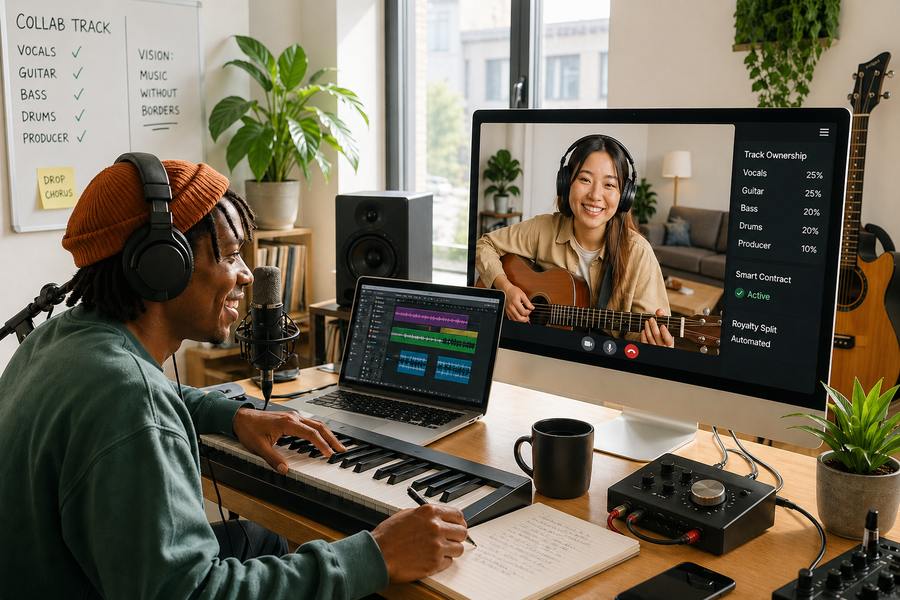
The modern music industry operates on a paradox. Technology has made it cheaper and faster than ever to create a song, yet the infrastructure behind ownership, credit, and compensation remains rooted in systems designed for a pre-digital era. When two or more musicians collaborate on a track, they enter a tangled web of verbal agreements, split sheets, performing rights organization registrations, and distributor configurations that can take months to finalize and years to dispute. A vocalist in Lagos who lays down a hook for a producer in Berlin may never see a royalty statement that accurately reflects the creative contribution, and even when the paperwork is perfect, payments can take twelve to eighteen months to arrive through the traditional collection society pipeline. These frictions discourage collaboration, concentrate power among intermediaries, and disproportionately affect independent and emerging artists who lack the legal and administrative resources of major label rosters.
The problem extends beyond individual inconvenience into systemic inequity. According to industry data, independent artists and labels collectively generated more than five billion dollars from Spotify alone in 2024, yet the mechanics of how that revenue flows to individual contributors remain opaque and slow for the vast majority of creators. When a track involves multiple collaborators across different territories, each registered with different collection societies and paid through different distributor pipelines, the reconciliation challenge becomes exponential. Credits are lost, splits are miscommunicated, and the administrative cost of tracking down missing royalties can exceed the royalties themselves. For emerging artists without management infrastructure, these frictions represent not just financial loss but creative discouragement, a reason to avoid collaboration rather than embrace it.
Web3 technologies present a fundamentally different architecture for how collaborative music can be created, tracked, owned, and monetized. At its core, Web3 refers to a suite of decentralized protocols built on blockchain networks, including smart contracts, token standards, decentralized file storage, and digital identity systems. When applied to music production, these tools allow collaborators to encode their agreements directly into code, register contributions immutably on a public ledger, and receive payments automatically the moment revenue is generated. The promise is not merely incremental improvement but structural transformation, replacing the opaque, intermediary-heavy pipeline with transparent, programmable, and trustless infrastructure that works for a songwriter in Nairobi the same way it works for a producer in Nashville.
This article examines how Web3 solutions are reshaping collaborative music production from the ground up. It begins with the foundational technology stack that makes decentralized music infrastructure possible, then surveys the platforms where musicians are already collaborating and minting work on-chain. From there, it explores the mechanics of tokenized ownership and automated royalty splitting before analyzing the benefits and challenges these tools present to different stakeholders across the music industry. The discussion closes with a look at emerging trends that will define the next chapter of decentralized music creation and the practical hurdles that must be overcome before mainstream adoption becomes a reality.
Understanding Web3 Music Infrastructure
Web3 music infrastructure is best understood as a layered technology stack, with each layer solving a specific problem that traditional music systems handle poorly or not at all. At the base sits a blockchain network, a distributed ledger maintained by a global set of nodes that records transactions in an immutable, chronological chain. For music applications, the blockchain serves as the authoritative registry of who created what, when, and under what terms. Unlike a centralized database controlled by a single platform or organization, a blockchain cannot be altered or censored by any single party, which means that a record of creative contribution, once written, persists permanently and can be verified by anyone with an internet connection.
Above the blockchain layer sits decentralized file storage, which addresses the practical challenge of hosting audio files without relying on a single company’s servers. Protocols such as the InterPlanetary File System and Arweave allow musicians to store stems, masters, and project files across a distributed network of storage nodes. Each file receives a unique content identifier, a cryptographic hash derived from the file’s contents, which means the address of the file is inseparable from the file itself. If anyone alters even a single byte, the hash changes, making tampering immediately detectable. For collaborative music production, this creates a verifiable chain of custody for every audio asset, from the first demo recording to the final master.
Token standards provide the mechanism by which creative contributions are represented as digital assets on the blockchain. The ERC-721 standard, commonly associated with non-fungible tokens, allows for the creation of unique, indivisible assets that can represent a single recording or composition. The ERC-1155 standard enables both fungible and non-fungible tokens within a single contract, which is particularly useful for music releases that involve multiple editions of the same track or fractional ownership shares. These standards matter for collaborative production because they allow the ownership structure of a recording to be expressed directly in the asset itself rather than in a separate, disconnected database. A song minted as an ERC-1155 token can encode the identities and shares of every contributor at the moment of creation, and that information remains embedded in the asset as it moves between wallets, marketplaces, and platforms.
Digital identity systems complete the infrastructure stack by providing musicians with persistent, verifiable identities that function across all platforms and applications within the Web3 ecosystem. Ethereum Name Service domains allow artists to replace cryptographic wallet addresses with human-readable names, making it easier for collaborators and fans to identify and transact with them. Decentralized identifiers go further by enabling musicians to maintain portable reputation records, including their on-chain collaboration history, contribution credits, and revenue earned, that they control rather than any single platform. Together with blockchain ledgers, decentralized storage, and token standards, these identity systems allow every participant in a collaborative session to be recognized, credited, and compensated through a unified, interoperable infrastructure layer that does not depend on any single platform remaining in business.
Smart Contracts and On-Chain Rights Management
Smart contracts are the programmable agreements that bind Web3 music infrastructure together. In the context of collaborative music production, a smart contract is a self-executing piece of code deployed on a blockchain that encodes the terms of a collaboration, including each contributor’s ownership percentage, the conditions under which revenue is distributed, and the licensing terms under which the work can be used. Once deployed, these terms are enforced automatically by the network itself, removing the need for a trusted intermediary to oversee compliance.
The practical implications for rights management are significant. In the traditional workflow, a collaboration agreement begins as a conversation, becomes a split sheet, gets registered with one or more performing rights organizations, and then must be accurately reflected across every digital service provider that distributes the recording. Each handoff introduces opportunities for error, delay, and disagreement. A smart contract collapses this sequence into a single, verifiable transaction. When collaborators agree on their respective shares and deploy the contract, the ownership percentages become part of the blockchain’s permanent record. Any platform or service that queries the contract receives the same, authoritative answer about who owns what, eliminating the discrepancies that arise when different databases hold different versions of the same split.
The open-source protocol 0xSplits, now known simply as Splits, illustrates how this works in practice. Each Split is a payable smart contract that continuously divides incoming funds among recipients according to preset ownership percentages. The protocol is entirely free to use, non-upgradable, and deployed across multiple blockchain networks including Ethereum, Optimism, Base, and Polygon. When a music NFT sale or streaming royalty payment flows into a Split contract, the funds are automatically allocated to each collaborator’s balance based on the percentages encoded at creation. Recipients can withdraw their share at any time, from any device, without waiting for a quarterly statement or reconciling with a third-party administrator. The protocol supports both ETH and ERC-20 tokens, meaning that payments denominated in stablecoins like USDC flow through the same infrastructure as cryptocurrency payments. For collaborative music projects with contributors in multiple countries and currency zones, this flexibility eliminates the need for separate payment processing arrangements for each participant.
The protocol has been integrated into major NFT platforms and creative tools, including Transient Labs, where it has powered revenue distribution for projects generating over one million dollars in sales. It was also a core piece of infrastructure for projects such as Songcamp’s Camp Chaos, where it enabled equitable revenue distribution among seventy-seven collaborators across multiple countries. The composability of the Splits protocol means that splits can receive funds from and send funds to any Ethereum account, including other splits, creating complex but automated revenue routing that would require significant legal and administrative overhead in the traditional music industry.
The combination of immutable contribution records, automated rights enforcement, and transparent revenue flow represents a meaningful departure from the status quo. Rather than relying on trust between parties and accuracy across disconnected databases, smart contract-based rights management shifts the foundation to cryptographic verification and programmable logic, creating an infrastructure layer where the agreement and its enforcement are one and the same.
Decentralized Platforms for Collaborative Music Production
The theoretical benefits of Web3 music infrastructure become tangible through the platforms where musicians are actively creating, publishing, and collaborating. These range from fully decentralized protocols that operate without any central authority to hybrid tools that layer blockchain functionality on top of familiar production workflows. What unites them is a shared commitment to eliminating the gatekeepers and intermediaries that have historically controlled access to distribution, monetization, and rights management in the music industry.
Audius stands as one of the most prominent decentralized music platforms, operating as a community-owned streaming and discovery network built on a combination of Ethereum and Solana blockchain infrastructure. Founded in 2018, the platform has attracted millions of monthly users and surpassed two hundred and fifty million total streams, establishing itself as one of the largest crypto applications ever built. The platform facilitates direct payments between fans and artists using USDC stablecoins, removing the currency conversion friction that complicates cross-border payouts. Fans can seamlessly use credit cards to pay artists, with the payments converting to USDC that artists and rights holders can then convert to any currency of their choice. In September 2024, Audius expanded its marketplace from private beta to full public access, allowing any artist worldwide to set their own terms and pricing for their music. As part of this expansion, the platform implemented a ten percent community treasury fee on every payment, with proceeds directed by on-chain governance.
The platform has attracted notable artists including Skrillex, deadmau5, Disclosure, Zedd, Dillon Francis, and Diplo, while also building institutional partnerships that bridge the decentralized and traditional music ecosystems. Audius forged licensing agreements with all four major performing rights organizations in the United States, including ASCAP, BMI, SESAC, and GMR, creating a bridge between its on-chain infrastructure and the traditional rights collection ecosystem. Independent labels such as DistroKid, EMPIRE, Ninja Tune, Merge Records, Anjunadeep, and Circus Records have signed distribution agreements with the platform, and a licensing pact with Kobalt, one of the world’s largest independent music publishers, was announced in 2024. These partnerships signal growing institutional comfort with decentralized distribution channels and demonstrate that Web3 platforms can operate within rather than against existing industry structures. The platform also launched a rewards program distributing approximately three million dollars worth of AUDIO tokens to its most engaged artists and fans, creating direct financial incentives for platform participation.
Sound.xyz takes a different approach by focusing on music NFTs as a mechanism for direct artist-to-fan economic relationships. Co-founded in 2021 by David Greenstein, a former Atlantic Records intern and Pandora product manager, the platform allows artists to upload tracks, set their own prices, and sell limited edition collections while retaining full ownership of their masters and publishing rights. The economic model is built on the premise that a smaller number of deeply engaged fans willing to pay meaningful amounts for music can generate more revenue for artists than millions of passive streams. The platform’s early results supported this thesis. Sound.xyz’s inaugural Listening Party feature saw seven songs from independent artists sell out in less than a minute each, generating revenue for the artists equivalent to twenty-one million streams on traditional platforms. Independent artist Daniel Allan reported earning eleven thousand dollars in seconds from a single track release. By mid-2023, approximately five hundred artists had uploaded roughly sixteen hundred songs to the platform, generating five and a half million dollars in direct payouts, a figure achieved with zero marketing spend.
The platform introduced co-release functionality that enables multiple artists to collaborate on a single release with automated revenue sharing, contributing to a notable rise in collaborative NFT projects across the broader music NFT market. This feature is particularly significant for collaborative production because it allows every contributor to a track to be encoded into the release’s smart contract at the moment of publication, ensuring that primary sales revenue and any secondary market activity are split automatically according to predetermined terms. Sound.xyz operates on both Ethereum and the Optimism Layer 2 network, using the IPFS protocol for decentralized audio storage and providing each artist with their own branded minting contract rather than a generic platform-wide token. The platform charges zero listing fees, differentiating itself from traditional NFT marketplaces that typically charge two and a half percent or more, and raised twenty million dollars in Series A funding led by Andreessen Horowitz with participation from artists including Snoop Dogg, OneRepublic frontman Ryan Tedder, and producer Tay Keith.
Arpeggi Labs, backed by a16z crypto and advised by artists including Steve Aoki and Wyclef Jean, represents perhaps the most ambitious attempt to embed blockchain directly into the music creation process itself. Arpeggi Studio is an in-browser digital audio workstation where musicians compose, sample, remix, and mint songs as on-chain assets. Every sound uploaded to the platform is registered in ARP, a decentralized music registry protocol that publishes a record of authorship to the blockchain and adds the audio to an open, CC0-licensed sample library. When an artist remixes or samples another creator’s work, the attribution chain is automatically maintained on-chain, creating a transparent genealogy of creative influence that would be impossible to replicate in traditional production environments.
Real-Time Co-Creation and Blockchain-Based Version Control
One of the most challenging aspects of remote music collaboration is managing the iterative nature of the creative process. A single song may go through dozens of versions as producers exchange stems, vocalists record alternate takes, and mix engineers refine the balance. In the traditional workflow, these iterations live on hard drives, cloud storage folders, and email threads, with no authoritative record of who contributed what and when. Disputes about creative contribution often arise not from bad faith but from the simple inability to reconstruct the history of a session after the fact.
Blockchain-based version control addresses this problem by anchoring each creative contribution to an immutable, timestamped record. When a musician uploads a stem, records a vocal take, or modifies a mix, the action can be registered on-chain with a content-addressable hash that uniquely identifies the audio file. Because the hash is derived from the file’s contents, any alteration to the audio produces a different hash, making it impossible to retroactively modify a contribution without detection. This creates an auditable trail of every creative decision in a track’s development, from the first beat loop to the final master. The timestamp attached to each on-chain registration provides an additional layer of protection, establishing a verifiable chronology of contributions that can serve as evidence in the event of a dispute about who originated a particular musical idea or arrangement.
The concept of content-addressable storage is central to this architecture. Traditional file storage systems identify files by their location, a path on a server or a URL on the web, which means the same address can point to different content over time if someone replaces the file. Content-addressable systems identify files by their contents, using cryptographic hashing to generate a unique fingerprint for each piece of data. This distinction matters profoundly for collaborative music because it guarantees that the stem a producer uploaded on Tuesday is provably identical to the stem a vocalist downloaded on Thursday. There is no possibility of silent substitution, accidental overwriting, or versioning confusion because each version of every file has its own unique, verifiable identifier.
Platforms such as Arpeggi Studio demonstrate this concept by maintaining a complete on-chain record of every sample, loop, and remix relationship within their ecosystem. When a producer builds a beat using three different samples from three different creators, the resulting song’s metadata automatically references the source material and its original authors. This chain of provenance extends indefinitely, meaning that a sample created by one artist, remixed by a second, and incorporated into a final track by a third all maintain their attribution links regardless of how many layers of creation sit between them. The practical effect is a system where creative credit is not negotiated after the fact but recorded as the work happens, transforming the metadata layer from an administrative afterthought into a real-time record of artistic collaboration.
The integration of decentralized storage protocols strengthens this architecture further. When stems and project files are stored on IPFS or Arweave, they exist independently of any single platform’s infrastructure. If Arpeggi Studio were to shut down tomorrow, the audio files and their associated metadata would remain accessible through any IPFS gateway, and the on-chain records of authorship and contribution would persist on the blockchain indefinitely. This permanence stands in stark contrast to the traditional production environment, where the closure of a cloud storage service or the loss of a hard drive can erase the only evidence of a collaborator’s contribution.
Ownership Tracking and Automated Royalty Splitting
Ownership in collaborative music has always been complex, but the traditional infrastructure for managing it has not kept pace with the increasingly distributed and international nature of modern production. A single track might involve a songwriter in one country, a producer in another, a featured vocalist working through a different publisher, and a mix engineer operating as a freelancer with no institutional affiliation. Each of these contributors may be registered with different performing rights organizations, distribute through different aggregators, and receive payments in different currencies on different timelines. The result is a fragmented ownership landscape where no single database contains the complete, accurate picture of who owns what. Industry analysts have long identified bad metadata as one of the music industry’s most persistent and costly problems, with estimates suggesting that billions of dollars in royalties go uncollected or are misallocated each year due to incomplete or inaccurate ownership information.
Tokenized ownership offers a unified alternative. When a collaborative recording is minted as a blockchain-based asset, the metadata embedded in the token can include every contributor’s identity, role, and ownership percentage. This metadata travels with the asset wherever it goes, whether it is listed on a music NFT marketplace, licensed for a film synchronization, or streamed through a decentralized platform. Because the token is the single source of truth, there is no possibility of conflicting split sheets, outdated registrations, or miscommunicated percentages across different systems. The information is on-chain, publicly verifiable, and immutable from the moment the token is created. This represents a paradigm shift from the current model, where ownership data is entered separately into multiple disconnected databases and each entry point introduces the possibility of human error, omission, or deliberate manipulation.
Royal, the platform founded by electronic artist 3LAU and JD Ross in 2021, pioneered the concept of Limited Digital Assets that represent fractional ownership of a song’s streaming royalties. In one of the platform’s most notable early cases, rapper Nas offered fans the opportunity to purchase tokens representing small royalty slices of his songs, with holders receiving proportional payouts based on actual streaming performance. By January 2023, the platform had facilitated seven and a half million dollars in music rights trades across one hundred and eleven countries, with artists distributing over one hundred and fifty-six thousand dollars in royalties to collectors and raising two and a half million dollars directly through token sales. While Royal shifted its focus in April 2024 toward on-chain data infrastructure and AI-driven music tools, the model it popularized demonstrated that tokenized ownership could function as both a funding mechanism and a transparent compensation system for collaborative work.
Programmable Revenue Distribution Models
The automation of royalty distribution represents one of the most practically transformative applications of smart contracts in collaborative music. In the traditional pipeline, revenue from streaming, downloads, and licensing passes through a chain of intermediaries, including digital service providers, distributors, labels, publishers, and collection societies, each taking their cut and introducing processing delays. By the time a payment reaches the end creator, twelve to eighteen months may have elapsed, and the amount may bear little resemblance to what the artist expected based on their contractual share. For collaborative works involving multiple contributors, the delay compounds because each participant’s share must be calculated, verified, and routed through potentially different collection pathways. The result is an industry where the gap between value creation and value receipt is measured not in days or weeks but in quarters and years.
Smart contract-based distribution eliminates most of these intermediaries by programming the payout logic directly into the revenue-receiving contract. When funds arrive at a Split contract or similar protocol, the code executes the distribution automatically based on the percentages defined at creation. There is no queue, no processing window, and no manual reconciliation. The producer who contributed forty percent of a track receives forty percent of every payment the moment it is distributed, whether that payment is one dollar or one hundred thousand dollars. This near-instant settlement is particularly significant for international collaborators, who traditionally face additional delays and fees associated with cross-border bank transfers and currency conversion.
The sophistication of these distribution models continues to evolve beyond simple percentage splits. The Splits protocol’s Waterfall contract type allows collaborators to define sequential payout priorities. For example, a collaborator who fronted the mixing and mastering costs could be configured to receive the first two thousand dollars of revenue before the remaining funds are divided among all contributors. This mirrors the recoupment structures common in traditional record deals but executes them transparently and automatically. Vesting modules add another layer, releasing funds to mutable splits over defined time periods to incentivize ongoing contributions to a project. Stablecoin-denominated payouts, such as those facilitated by Audius through USDC, further reduce friction by allowing international collaborators to receive compensation in a dollar-pegged digital currency that can be converted to local fiat without the fees and delays of traditional correspondent banking networks.
Songcamp’s Camp Chaos project provides one of the most instructive real-world demonstrations of programmable revenue distribution in collaborative music. In 2022, seventy-seven artists from around the world, including forty-five musicians, nine visual artists, six engineers, five radio producers, three economists, two lore masters, and seven operatives, participated in an eight-week experiment that produced forty-five songs released as an NFT collection of over twenty thousand unique tokens. The project was structured as five thousand NFT packs, each containing four randomized songs, which collectors could choose to keep sealed or burn to reveal the individual song tokens inside. Revenue from the project was divided into four defined streams, with thirty percent flowing back to the Songcamp treasury and the remaining seventy percent distributed to participants through a combination of self-selection, peer evaluation via the Coordinape tool, and a holdback mechanism determined by the project’s economics team.
The distribution infrastructure was built on 0xSplits’ Liquid Splits, a novel contract type that represents ownership shares as transferable NFTs, allowing participants to sell or transfer their revenue share to others. This was a critical innovation because it recognized that contributions to a large-scale collaborative project are not equal and that the fairest way to allocate value is through a combination of self-assessment and peer recognition rather than arbitrary equal division. Every two weeks, participants evaluated their own contribution level and were simultaneously evaluated by their peers through Coordinape, a tool that distributes tokens based on who each participant believes contributed the most value. The resulting distribution of one million internal CHAOS tokens determined each participant’s proportional share of the Liquid Split, which would receive revenue from all future NFT sales and secondary market activity.
The project drove over five hundred ETH in total NFT sales across Songcamp’s three camps, with revenues splitting instantaneously among all participating artists without any manual payment processing. The Camp Chaos model demonstrated several principles that are broadly applicable to Web3 music collaboration. It showed that large groups of strangers can collaborate effectively using blockchain-based coordination infrastructure. It proved that revenue distribution can be automated and equitable without requiring a central authority to make allocation decisions. And it established that the creative output of a decentralized collective can generate meaningful economic value, with early camps raising approximately thirty-four thousand dollars and one hundred thousand dollars respectively before Camp Chaos scaled the model dramatically.
Benefits and Challenges for Music Industry Stakeholders
The emergence of Web3 collaboration tools affects every participant in the music value chain differently, and a nuanced understanding of these impacts requires examining benefits and challenges through the lens of each stakeholder group. The technology does not arrive in a vacuum but enters an ecosystem with deeply entrenched relationships, revenue models, and power structures that have been decades in the making.
For independent artists and songwriters, Web3 collaboration platforms offer a degree of creative and economic sovereignty that has been historically difficult to achieve without label support. The ability to encode ownership terms into a smart contract before any creative work begins eliminates the ambiguity that often plagues informal collaborations, where handshake agreements about splits can unravel when a track gains unexpected traction. Platforms like Sound.xyz enable artists to retain one hundred percent of their earnings and full ownership of their master recordings and publishing rights, a proposition that stands in contrast to traditional label deals where artists may surrender a significant portion of both. The near-instant settlement of smart contract payments means that a producer in Lagos does not have to wait eighteen months for a royalty check to clear through multiple intermediaries and banking systems. The global, permissionless nature of blockchain networks also removes geographic barriers to collaboration, allowing musicians in underserved markets to participate in the same economic infrastructure as their counterparts in established music industry hubs.
The challenges facing independent artists are equally real, however. Onboarding complexity remains the most significant barrier to adoption. Many musicians have no prior experience with cryptocurrency wallets, gas fees, blockchain transactions, or the vocabulary of Web3. Despite efforts by platforms like Audius and Sound.xyz to abstract away technical complexity through email-based signup and credit card payments, the underlying infrastructure still requires a learning curve that can be intimidating for non-technical creators. Gas fees on networks like Ethereum, though significantly reduced by Layer 2 solutions such as Optimism and Polygon, can still represent a meaningful cost for artists minting work or deploying smart contracts, particularly for those in lower-income regions. There is also the question of discoverability. Decentralized platforms have not yet developed the algorithmic recommendation engines and curated playlists that drive discovery on mainstream services like Spotify and Apple Music, meaning that artists who move their work on-chain may sacrifice visibility in exchange for economic empowerment.
Producers, session musicians, and mix engineers occupy a particularly interesting position in the Web3 music landscape. These contributors are often the least visible participants in a collaboration despite their substantial creative input, and their compensation frequently depends on one-time flat fees rather than ongoing royalty participation. Smart contract-based split agreements change this dynamic by making it straightforward to include any contributor, regardless of their role, in the ongoing revenue stream from a recording. A session guitarist who contributes a riff to a track can be encoded into the split contract and receive their percentage of every future payment automatically, without needing to negotiate a separate backend deal or rely on the lead artist’s goodwill. This shift toward automatic, permanent, and transparent compensation has the potential to redefine economic relationships within collaborative production teams.
For producers and engineers, however, the transition also introduces uncertainty around the legal enforceability of smart contract agreements. While a smart contract can enforce the distribution of funds according to its programmed logic, the question of whether that distribution constitutes a legally binding royalty agreement varies by jurisdiction. In many countries, music copyright law has not been updated to address blockchain-based ownership records, and the relationship between an on-chain split and a traditional copyright registration remains ambiguous. Producers who rely on smart contracts alone, without complementary off-chain legal agreements, may find themselves in a gray area if a dispute requires resolution through traditional courts.
Labels and publishers face the most complex calculus when evaluating Web3 collaboration tools. On one hand, tokenized ownership and automated royalty distribution could dramatically reduce the administrative overhead associated with managing catalogs of collaborative works. The reconciliation of split sheets, the correction of metadata errors, and the processing of international royalty payments represent significant operational costs for labels and publishers, and smart contract automation could eliminate much of this burden. On the other hand, these same tools threaten to disintermediate the very functions that justify a label’s or publisher’s share of revenue. If artists can encode their own split agreements, distribute their work through decentralized platforms, and receive payment directly from fans and licensees, the value proposition of a traditional label contract becomes harder to articulate. The data supports the disintermediation concern. Platforms like Sound.xyz have demonstrated that individual artists can generate revenue equivalent to millions of streams on traditional platforms through direct NFT sales to relatively small but dedicated fan bases, and Audius’s direct payment model bypasses the distributor entirely.
Some forward-thinking labels have begun exploring hybrid approaches, using blockchain infrastructure for back-end rights management while maintaining their A&R, marketing, and promotional capabilities as the primary value they offer artists. This hybrid model acknowledges that the functions labels perform are not uniformly threatened by Web3. Discovery, curation, marketing investment, and access to synchronization licensing networks remain valuable services that are not easily replicated by a smart contract. The labels and publishers most likely to thrive in a Web3 environment are those that reposition themselves as service providers whose value is additive rather than extractive, offering capabilities that complement rather than depend on control over distribution and payment infrastructure.
Streaming platforms and digital service providers confront a different set of implications. The growth of decentralized alternatives like Audius introduces competitive pressure to the attention-based economics of traditional streaming, where per-stream payouts average fractions of a cent. The direct payment models emerging in Web3, where a single fan can pay five, ten, or one hundred dollars for a release rather than generating a few dollars over thousands of streams, suggest an alternative economic paradigm that could complement or eventually challenge the subscription model. The interoperability challenge is significant, though. For Web3 royalty systems to function at scale, on-chain ownership records would need to be recognized and honored by major DSPs, which currently rely on their own proprietary databases and those of established rights management organizations. Bridging this gap between decentralized and centralized infrastructure remains one of the most consequential unresolved problems in Web3 music.
The experience of Audius in securing licensing agreements with ASCAP, BMI, SESAC, and GMR during 2024 represents a meaningful step toward bridging these two worlds. By establishing formal relationships with the organizations that control access to the vast majority of commercially released music, Audius demonstrated that decentralized platforms can operate within the existing regulatory framework rather than outside it. The rapper MadeinTYO’s experience on the platform illustrates how these bridges work in practice. He sold beats through Audius and invited his fanbase to create songs using his stems, ultimately selecting a winner and flying them to Tokyo for a collaborative studio session. This kind of fan engagement, combining on-chain commerce with real-world creative collaboration, exemplifies the hybrid model that is most likely to drive broader adoption.
The model suggests that the future of Web3 music may not be a wholesale replacement of traditional infrastructure but rather a layered integration where blockchain provides the transparency and automation layer while existing institutions continue to serve functions that benefit from human judgment, relationship management, and legal expertise. The stakeholders who will benefit most are those who approach these tools not as a binary choice between old and new systems but as an opportunity to combine the strengths of both, using smart contracts for what they do well, namely transparent enforcement and automated execution, while relying on human institutions for what they do well, including curation, dispute resolution, and relationship-driven business development.
The Future of Decentralized Music Production
Several emerging trends suggest that the current generation of Web3 music tools represents an early chapter in a much larger transformation. The integration of artificial intelligence with on-chain music creation is perhaps the most consequential near-term development. AI-assisted composition tools can generate melodies, harmonies, and arrangements that musicians then refine and personalize, but the question of creative attribution becomes exponentially more complex when an algorithm contributes alongside human collaborators. Blockchain-based provenance systems could provide the attribution infrastructure needed to track both human and machine contributions transparently, creating a clear record of which elements of a track were composed by a person and which were suggested by a model. This distinction will become increasingly important as regulatory frameworks and industry standards evolve to address AI-generated content.
Cross-chain interoperability represents another frontier. Today, a music NFT minted on Ethereum exists in a different ecosystem than one created on Solana or Polygon, and transferring assets between chains requires bridges that introduce complexity and risk. As cross-chain protocols mature, musicians will be able to collaborate across different blockchain networks seamlessly, minting a beat on one chain, adding a vocal on another, and distributing the finished track across all of them without manual bridging. This interoperability extends to the revenue layer as well, enabling split contracts that can receive and distribute payments from multiple chains simultaneously.
DAO-governed record labels are already demonstrating an alternative organizational model for collaborative music. Rather than concentrating decision-making authority in a small executive team, a DAO distributes governance rights among token holders, who may include artists, producers, fans, and investors. Songcamp’s evolution from a songwriting camp to what it describes as a headless band network illustrates this trajectory, where the collective itself becomes the artist and the organizational structure is determined by on-chain governance rather than corporate hierarchy. The project’s three camps, from the thirteen-participant Camp Genesis to the seventy-seven-person Camp Chaos, have been featured in Billboard, TIME, and other major outlets, and have driven over five hundred ETH in NFT sales with revenues splitting instantaneously among all participating artists. These experiments demonstrate that large-scale creative collaboration can function without traditional hierarchical management, using blockchain-based coordination tools like Coordinape for peer evaluation and Liquid Splits for equitable revenue distribution. While these experiments remain relatively small in scale compared to the broader music industry, they offer a blueprint for how collaborative music production could be organized around shared ownership and democratic decision-making rather than traditional top-down management.
Mainstream adoption, however, hinges on several practical developments that are still in progress. User experience must continue to improve until interacting with a Web3 music platform feels no different from using Spotify or SoundCloud. The music NFT market, valued at approximately two point eight five billion dollars in 2024 and projected to grow substantially through the end of the decade, will only reach its potential if the technical barriers to entry are reduced to near zero. Industry-wide metadata standards need to emerge so that on-chain ownership records can interoperate with the databases maintained by collection societies and DSPs. Regulatory clarity is needed in multiple jurisdictions regarding the legal status of smart contract agreements, the classification of music tokens under securities law, and the tax treatment of cryptocurrency-denominated royalty payments. Research indicates that nearly half of artists lack blockchain knowledge and a similar proportion of fans find NFT wallet onboarding confusing, underscoring that the technology gap remains the most significant obstacle to broader adoption. Until these foundational issues are resolved, Web3 music tools will likely remain the province of early adopters and technically adventurous creators rather than the default infrastructure for the broader industry.
Final Thoughts
Web3 solutions for collaborative music production represent something more fundamental than a new set of tools for an old industry. They embody a structural reimagining of how creative work is attributed, owned, and compensated, shifting the foundation from trust in intermediaries to verification through code. The smart contracts that split revenue, the blockchain records that preserve contribution history, and the decentralized storage protocols that ensure audio files persist beyond the lifespan of any single company collectively form an infrastructure layer that prioritizes the creator in ways the traditional music industry has struggled to achieve across decades of reform efforts.
The implications extend well beyond the recording studio. For musicians in developing economies who have been systematically excluded from global music revenue flows by banking infrastructure limitations and intermediary costs, stablecoin-denominated smart contract payments offer a direct path to fair compensation. A vocalist in Accra can now participate in the same split contract as a producer in Los Angeles, receive the same instantaneous settlement, and exercise the same degree of control over their creative and economic rights. This is not an abstract promise but a functioning reality on platforms like Audius, where USDC payments bypass the correspondent banking networks that have historically extracted fees and introduced delays at every international boundary. The potential for financial inclusion in the music industry, where the vast majority of global creative talent resides outside the handful of markets that dominate traditional revenue flows, is perhaps the most consequential long-term impact of Web3 adoption.
The tension between decentralization ideals and practical adoption realities deserves honest acknowledgment. Smart contracts execute flawlessly according to their programmed logic, but music is made by human beings whose relationships, intentions, and contributions do not always reduce neatly to percentages and wallet addresses. Disputes will arise that no on-chain mechanism can resolve, and the absence of clear legal frameworks in many jurisdictions means that the enforceability of smart contract-based agreements remains an open question. The onboarding challenge is real as well. Asking a guitarist to set up a cryptocurrency wallet before laying down a solo is an additional barrier in an already competitive creative marketplace, and until Web3 tools achieve the invisible simplicity of the best consumer technology, adoption will remain concentrated among the technically curious rather than the musically gifted.
The intersection of technology and social responsibility emerges clearly in this landscape. Platforms that give artists direct economic relationships with their audiences, tools that make creative attribution automatic rather than optional, and infrastructure that operates without gatekeepers or geographic restrictions all represent a vision of the music industry where the value created by collaboration flows back to the people who created it. The significance of this shift extends beyond economics into the realm of creative culture. When musicians know that their contributions will be recorded, credited, and compensated fairly regardless of their bargaining power or institutional affiliation, the calculus of collaboration changes. Artists who might have hesitated to share a stem, contribute a verse, or co-produce a track with a stranger across the world gain confidence that their creative investment is protected by infrastructure rather than dependent on trust alone. The projects profiled in this article, from Songcamp’s headless band experiments to Audius’s licensing partnerships with traditional rights organizations, demonstrate that this vision is neither purely theoretical nor hopelessly idealistic. It is being built, tested, and refined by communities of musicians and engineers who believe that the infrastructure of creative collaboration should serve the creators, not the other way around. The path from early experiments to industry standard will be neither straight nor short, but the direction of travel is clear, and the artists who engage with these tools today are laying the groundwork for a more equitable creative economy.
FAQs
- What is Web3 music collaboration, and how does it differ from traditional remote collaboration? Web3 music collaboration uses blockchain technology, smart contracts, and decentralized storage to enable musicians to work together remotely while maintaining transparent, immutable records of each contributor’s creative input and ownership share. Unlike traditional remote collaboration, where split sheets and verbal agreements are the norm, Web3 collaboration encodes ownership terms into self-executing smart contracts that automatically enforce revenue distribution, eliminating the need for intermediaries to manage payments and resolve disputes.
- How do smart contracts handle royalty splits for collaborative music? Smart contracts are programmed with each collaborator’s wallet address and ownership percentage at the time of deployment. When revenue flows into the contract from NFT sales, streaming royalties, or licensing fees, the funds are automatically divided according to these preset percentages and made available for each recipient to withdraw. Protocols like 0xSplits make this process free to use and available across multiple blockchain networks, requiring only the cost of network gas fees to create and distribute.
- Which platforms currently support Web3 music collaboration? Several platforms serve different aspects of Web3 music collaboration. Audius operates as a decentralized streaming and discovery platform with direct artist-to-fan payments. Sound.xyz enables collaborative NFT releases with automated revenue sharing. Arpeggi Studio provides an in-browser digital audio workstation where musicians can compose, sample, remix, and mint music directly on-chain with automatic attribution tracking. Each platform emphasizes different parts of the collaboration and monetization workflow.
- What are the costs involved in using Web3 music collaboration tools? Costs vary by platform and blockchain network. Many platforms like Audius and Arpeggi Studio are free to use for basic functions such as uploading and streaming. Minting music NFTs or deploying smart contracts incurs gas fees, which depend on network congestion and the blockchain being used. Layer 2 networks like Optimism and Polygon have significantly reduced these costs, often to fractions of a dollar per transaction, making on-chain music creation accessible even to artists with limited budgets.
- Are smart contract-based collaboration agreements legally enforceable? The legal enforceability of smart contracts varies by jurisdiction and is an evolving area of law. While a smart contract can automatically execute the distribution of funds according to its programmed terms, courts in many countries have not yet established clear precedents on whether on-chain agreements satisfy the requirements of traditional contract law. Many practitioners recommend pairing smart contracts with conventional off-chain legal agreements to ensure enforceability in the event of a dispute that requires judicial resolution.
- How are disputes resolved in Web3 music collaborations? Dispute resolution in Web3 music collaborations is still maturing as an infrastructure layer. Some platforms are developing on-chain arbitration systems where community members review evidence and render decisions. Others rely on the immutability of blockchain records as evidence in traditional legal proceedings. The transparent nature of on-chain contribution history, where every creative input is timestamped and verifiable, can significantly simplify the process of establishing who contributed what, even if the dispute itself is resolved through conventional legal channels.
- Can Web3 royalty systems work alongside traditional performing rights organizations? Yes, and several projects are actively building bridges between the two systems. Audius secured licensing agreements with ASCAP, BMI, SESAC, and GMR in 2024, demonstrating that decentralized platforms can operate within the traditional rights collection framework. The long-term vision for many Web3 music projects involves interoperability, where on-chain ownership records can be recognized and honored by existing collection societies and digital service providers, rather than replacement of the traditional system entirely.
- What environmental considerations apply to blockchain-based music collaboration? The environmental impact of blockchain technology has decreased substantially since Ethereum transitioned from a proof-of-work to a proof-of-stake consensus mechanism in September 2022, reducing the network’s energy consumption by approximately ninety-nine percent. Most Web3 music platforms operate on Ethereum or its Layer 2 networks, meaning their environmental footprint is now comparable to that of traditional cloud computing infrastructure. Artists concerned about sustainability should verify which consensus mechanism underlies the blockchain their platform of choice uses.
- How can a non-technical musician get started with Web3 music collaboration? The simplest entry point is to create an account on a platform like Audius or Sound.xyz, both of which support email-based registration and credit card payments without requiring prior cryptocurrency knowledge. From there, musicians can explore uploading tracks, participating in collaborative releases, and setting up simple split contracts using user-friendly interfaces. Many platforms provide guided onboarding, and the Web3 music community maintains active forums and social channels where newcomers can find support and educational resources.
- What happens to my on-chain music if a Web3 platform shuts down? One of the key advantages of decentralized architecture is that on-chain assets persist independently of any single platform. If a music NFT is minted on the Ethereum blockchain and the audio file is stored on IPFS or Arweave, both the ownership record and the audio file remain accessible through other interfaces and gateways even if the original platform ceases operations. Smart contract-based split agreements continue to function as well, since the contract code lives on the blockchain and executes independently of any company’s servers or infrastructure.