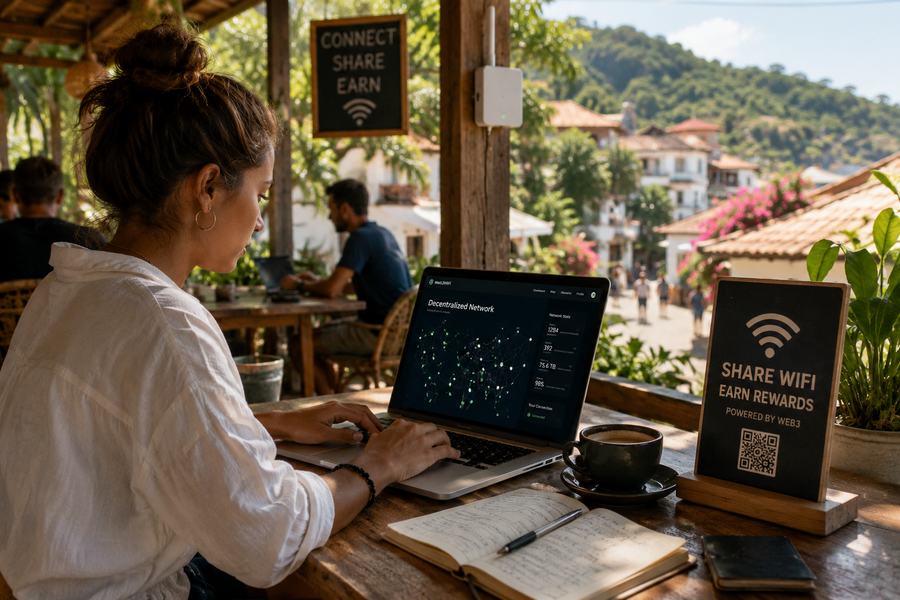
Reliable internet access has quietly become as essential to daily life as electricity, yet ownership of the infrastructure that delivers it remains remarkably concentrated. A handful of telecommunications giants own the towers, the fiber, and the spectrum licenses that connect billions of devices, while roughly a third of the world’s population still lacks consistent internet access. In Latin America, fewer than half of households have a home broadband connection. In rural pockets of wealthy countries, coverage gaps persist because the unit economics of laying fiber or building cell towers in low-density areas simply do not pencil out for shareholder-driven carriers carrying significant debt loads.
A different model has been taking shape over the past several years, one that turns this top-down infrastructure problem into a bottom-up coordination problem. Instead of waiting for a corporation to decide that a neighborhood is profitable enough to deserve service, individuals and small businesses can buy a wireless hotspot, plug it into existing internet service, and earn cryptocurrency tokens in exchange for the coverage they provide. The blockchain underneath verifies that the hotspot is real and that it is genuinely serving traffic. Subscribers connect through these community-deployed nodes the same way they would connect to any commercial WiFi network, with their devices automatically authenticating and roaming between thousands of independently owned access points.
This approach falls under a broader category called Decentralized Physical Infrastructure Networks, or DePIN, which has emerged as one of the most concrete real-world applications of blockchain technology. As of September 2025, market trackers identified nearly 250 DePIN projects with a combined market capitalization above nineteen billion dollars, up from roughly five billion a year earlier. Capital flowing into the sector exceeded seven hundred million dollars between January 2024 and July 2025 across more than one hundred sixty funded startups, signaling that institutional investors increasingly view community-built infrastructure as a viable alternative to traditional carrier buildouts rather than a speculative curiosity.
Within DePIN, decentralized wireless networks have attracted particular attention because connectivity is a universal need with a massive existing market. Wireless infrastructure represents a trillion-dollar annual industry, and the addressable market for community-coordinated alternatives spans both consumer mobile data and the enterprise systems that handle carrier offloading. Several Web3 wireless networks have moved well past pilot stage. Some serve hundreds of thousands of paying subscribers, some have signed commercial roaming agreements with major telecommunications companies, and a few have developed governance and tokenomic models sophisticated enough to operate without breaking under the weight of millions of daily users.
This article walks through how these networks function in practice, what makes them technically distinct from traditional WiFi infrastructure, and how the leading protocols are deploying real coverage at scale today. The discussion is grounded in the operational realities of projects that have published verifiable production metrics through 2024 and 2025, not in marketing claims or speculative roadmaps. The goal is a working understanding of the moving parts so that the broader thesis becomes legible: blockchain coordination is making it economically viable for ordinary people to own and operate pieces of the wireless infrastructure that, until recently, only large corporations could afford to build.
Understanding Decentralized WiFi and the DePIN Framework
Decentralized Physical Infrastructure Networks are blockchain-based systems that use token rewards to coordinate the deployment and operation of real-world hardware. Where most blockchain applications operate purely in the digital realm of finance, governance, or digital collectibles, DePIN networks attach the blockchain to physical equipment and pay the people who run that equipment based on verifiable measurements of the work it performs. A weather sensor that submits accurate atmospheric data earns tokens. A storage server that holds files reliably earns tokens. A wireless hotspot that provides connectivity to mobile devices earns tokens. The blockchain plays the role of a transparent ledger that records contributions and a programmable settlement layer that distributes rewards according to rules encoded in smart contracts.
To appreciate why this matters for wireless networks specifically, it helps to understand the structural problem with the traditional model. Building wireless infrastructure is enormously capital intensive. Cell towers cost hundreds of thousands of dollars each, fiber backhaul runs tens of thousands of dollars per mile, and spectrum licenses for cellular bands run into the billions for nationwide allocations. These costs require carriers to operate at significant scale, which means they can only justify deployments in markets dense enough to generate sufficient subscriber revenue. Even then, legacy carriers in the United States carry substantial debt that limits their ability to invest in network upgrades, and surplus capital tends to flow back to shareholders rather than into new coverage. The result is a system where the people most in need of better connectivity are usually the last to receive it.
The decentralized wireless model inverts this dynamic. Rather than concentrating ownership in a few well-capitalized companies, the network distributes ownership across thousands or millions of small operators who each contribute a piece of the overall coverage. A coffee shop owner plugs a wireless miner into the back room. A homeowner mounts an access point on the roof. A small internet service provider in a town that has been underserved for decades takes on a few dozen hotspots and starts earning tokens for the bandwidth its customers consume. The economic argument is straightforward: the people deploying infrastructure are also the people most familiar with where coverage is needed, and they bear the deployment cost directly rather than waiting for corporate approval.
Four distinct roles structure a typical decentralized WiFi ecosystem. Hardware operators, sometimes called hosts or hotspot owners, deploy the physical equipment and provide the underlying connectivity. Subscribers and end users consume the network’s service, either as primary customers buying a mobile plan or as roaming guests passing through coverage zones. Validators and oracles handle the technical work of verifying that operators are doing what they claim and translating those observations into reward distributions. Protocol governance, often handled through a decentralized autonomous organization, sets the rules that determine how rewards are calculated, how new features get implemented, and how disputes are resolved. Each role has its own incentive structure, and the durability of any given network depends on how cleanly these incentives align.
This article focuses specifically on WiFi-based decentralized wireless networks, though the boundaries between different wireless protocols have blurred considerably in practice. The Helium Network, for example, began with LoRaWAN coverage for low-power Internet of Things devices, pivoted toward CBRS cellular for a period, and ultimately concentrated its mobile strategy around WiFi hotspots that integrate easily with existing routers and consumer hardware. Other networks specialize in WiFi from the start, building products that turn ordinary commercial routers into network nodes through software extensions and decentralized identity protocols. The common thread is the use of WiFi spectrum, which is unlicensed and globally available, to provide last-mile connectivity that can be deployed without spectrum auctions or carrier negotiations.
Several factors have converged to make this model viable now in a way it was not even three years ago. Blockchain scalability has improved dramatically with the rise of high-throughput Layer 1 networks like Solana, which can process the thousands of transactions per second needed to coordinate hardware payouts at scale. Wireless standards organizations have produced cross-network roaming protocols that let user devices authenticate seamlessly across independently owned hotspots without manual login. Consumer hardware has become cheap enough that a competent WiFi router costs less than a hundred dollars retail, while specialized DePIN miners run a few hundred dollars and can pay for themselves within a year or two depending on the network. The combination has lowered the barrier to participation enough that a meaningful number of ordinary people now find it worthwhile to contribute coverage to networks they do not personally own.
Core Technical Components of a Web3 WiFi Network
Three technical pillars hold a decentralized WiFi network together. The first is cryptographic verification that hotspots are doing what they claim, because without trustworthy proof, the entire reward system collapses into fraud. The second is a token model that channels rewards to operators in proportion to genuine service provided while remaining sustainable as the network grows beyond its initial speculative phase. The third is a roaming and mesh architecture that lets user devices flow seamlessly across thousands of independently owned access points without manual configuration or repeated authentication.
These pillars sound abstract in isolation, but each addresses a specific problem that would otherwise prevent the network from functioning at scale. Verification prevents bad actors from spinning up fake hotspots to drain rewards. Token mechanics ensure that the economic incentives stay aligned with real-world usage as conditions change. Roaming architecture turns thousands of separately owned routers into something that feels, from the user’s perspective, like a single coherent wireless service. Removing any one of these elements would break the model, and the engineering depth required to get all three right is a significant reason the field has only matured in the past few years.
Walking through each pillar in turn provides a working mental model of how these systems operate under the hood. The technical details vary across networks, but the underlying problems are universal, and the solutions converge on a similar set of cryptographic and economic primitives. A reader who understands these three components will be able to evaluate any new decentralized wireless protocol on its merits rather than relying on marketing claims about decentralization or community ownership.
Proof of Coverage and Network Verification
Proof of Coverage is the cryptographic mechanism that verifies a wireless hotspot is genuinely located where it claims to be and is actually providing the wireless service it reports. The mechanism originated with the Helium Network and has since become a foundational design pattern across decentralized wireless protocols. The basic flow works through cryptographically signed beacons. A hotspot periodically broadcasts a multi-layer encrypted data packet that nearby hotspots, acting as witnesses, can partially decrypt to verify its origin. Each witness records the time of arrival and signal strength of the beacon, signs a receipt confirming the observation, and publishes that receipt to the blockchain. The network uses the collection of receipts from geographically proximate witnesses to confirm that the broadcasting hotspot is genuinely radiating from the location it claims.
Several layers of anti-gaming protection sit on top of this core design. Helium hotspots ship with hardware-embedded elliptic curve cryptography keys that uniquely identify each device at the silicon level, making it computationally infeasible to spoof a hotspot’s identity by copying its software configuration to another piece of hardware. Helium’s Proof of Coverage system requires hotspots to beacon every six hours and gathers attestations from roughly a dozen nearby witnesses per beacon, which makes location spoofing through signal manipulation extremely difficult because an attacker would need to compromise many independent devices in the target geography. Additional oracles assign reward multipliers based on urbanization, traffic density, and land type, which discourages clustering of hotspots in empty areas where they would generate little real service.
Different networks have implemented variants of this approach optimized for their specific deployment goals. Some networks emphasize Proof of Location, which focuses specifically on verifying geographic placement. Others lean on Proof of Uptime, which rewards consistent availability above raw coverage area. Networks oriented toward data-heavy services often supplement coverage proofs with measurements of actual bandwidth served, paying operators based on traffic volume rather than just presence in a location. The common purpose across all these variants is the same: without verifiable proofs, Sybil attacks where a single bad actor creates many fake nodes would drain the token rewards pool and destroy the economic foundation of the network. The sophistication of a network’s verification system is often the most reliable indicator of whether it will survive contact with adversarial real-world conditions.
Token Incentives and Hardware Coordination
Token mechanics in decentralized wireless networks typically split into two complementary roles. One token, often called the reward token, gets issued to hotspot operators based on the coverage and data they provide. A second instrument, sometimes called a data credit or burn token, gets purchased and consumed by subscribers when they use the network. The interaction between issuance on one side and burning on the other creates the economic loop that ties operator rewards to genuine subscriber demand. Helium uses HNT as its single reward token after consolidating its previously fragmented multi-token system through Helium Improvement Proposal 138 in early 2025, while Data Credits priced at a fixed one one-hundred-thousandth of a dollar serve as the burn instrument that consumers pay when transferring data through the network.
The Helium Network introduced an approach called lazy claiming that solves a specific scaling problem with reward distribution. In a naive implementation, the blockchain would need to send a reward transaction to every hotspot operator every day, which for a network with hundreds of thousands of active devices would mean prohibitive transaction fees. Helium’s lazy claim system instead tracks each hotspot’s accumulated earnings off-chain through oracles, with the blockchain only recording withdrawals when operators choose to claim their rewards. The Solana case study on Helium documents that this reduces transaction costs to approximately seven cents per year for an operator who claims daily. After the network migrated from its proprietary Layer 1 blockchain to Solana in April 2023, throughput improved from roughly ten transactions per second to over sixteen hundred, which made the entire reward distribution model viable at consumer scale.
Hardware coordination splits between two broad models with different tradeoffs. Some networks require operators to purchase dedicated proprietary hardware, which gives tighter quality control and consistent performance but introduces supply chain complexity and a higher upfront cost barrier. Other networks support a bring-your-own-device approach where operators install custom firmware onto commercially available routers, turning existing hardware into network nodes. The Wayru Network ships its proprietary WayruOS firmware that converts compatible third-party routers into Wayru hotspots, alongside its own dedicated Wayru Hotspot devices priced around three hundred dollars. Helium pursued a hybrid path by launching Helium Plus in mid-2025, which lets businesses and public WiFi providers join the network using their existing enterprise-grade routers without buying new hardware. By the end of 2024, a significant portion of Helium’s mobile hotspots were already converted devices rather than purpose-built miners, accelerating network growth at lower deployment cost. The flexibility of the hardware model often determines how quickly a network can scale its operator base.
Mesh Networking and Roaming Architecture
The user experience of decentralized wireless depends on a layer of roaming and authentication infrastructure that turns thousands of independently owned hotspots into something that behaves like a single coherent network. The most important standard in this space is OpenRoaming, an initiative of the Wireless Broadband Alliance that uses verifiable digital credentials to authenticate users seamlessly across participating WiFi networks without requiring repeated logins or password sharing. When a device with valid OpenRoaming credentials enters a participating hotspot’s coverage area, the authentication happens automatically through the credential exchange, and the user gets connected without seeing a captive portal. Roam, one of the largest Web3 wireless networks, has built its entire product strategy around OpenRoaming, becoming the only Web3 identity provider among the fifteen-corporate alliance that supports the standard, with coverage extending to over four million OpenRoaming-available WiFi hotspots across more than one hundred ninety countries.
Decentralized identifiers and verifiable credentials provide the cryptographic foundation that makes seamless roaming possible without sacrificing user privacy. A decentralized identifier is a user-controlled identity record that does not depend on any single central authority for issuance or verification. Verifiable credentials are signed attestations attached to those identifiers, typically used to confirm authorization to access network resources without revealing personally identifiable information. The combination lets a user authenticate to thousands of different hotspots owned by thousands of different operators without ever sharing a password or relying on a centralized identity provider. This represents an improvement over the traditional public WiFi experience, where users either share passwords openly or sign into walled-garden hotspot networks that track and monetize their behavior.
Carrier offload partnerships extend the model further by routing traffic from traditional cellular subscribers through decentralized hotspots when coverage is available. Helium Mobile operates as a Mobile Virtual Network Operator that blends T-Mobile’s nationwide cellular coverage with community-deployed Helium hotspots, with subscribers automatically connecting to Helium hotspots when in range and switching back to T-Mobile when they are not. The same offload model now serves AT&T, Movistar in Mexico, Google Orion, and Wefi subscribers through commercial agreements that pay Helium for each gigabyte transferred. The blockchain handles settlement between the network and each carrier partner at far higher granularity and lower friction than traditional inter-carrier billing systems allow. Taken together, these three technical pillars produce a wireless service that feels ordinary to end users while running on top of a coordination architecture fundamentally different from anything legacy telecommunications has deployed.
Leading Protocols Building Decentralized Wireless Today
The decentralized wireless field has consolidated around a small number of protocols that have moved beyond pilot stage into measurable production deployments. Market trackers identify roughly two hundred fifty active DePIN projects globally as of late 2025, with WiFi-focused networks taking distinct strategic positions. Some pursue global coverage from day one, leveraging open standards to integrate with existing public hotspots. Others target underserved regions where traditional ISP economics fail, building local networks tailored to specific geographies. A few operate primarily as carrier offload platforms, monetizing community hardware by reselling capacity to traditional telecommunications companies. The three networks profiled here have been selected because each occupies a distinct strategic position, each has publicly documented operational metrics from 2024 and 2025, and together they illustrate the range of approaches the sector has produced.
Verifiable scale is the threshold that separates serious decentralized wireless protocols from speculative whitepapers. Subscriber counts, hotspot counts, data offload volume, and carrier partnerships are the operational metrics that matter, and projects that publish quarterly reports through third-party research firms like Messari provide the clearest window into how these networks are actually performing. Each of the case studies below cites specific dated metrics from credible sources to ground the discussion in operational reality.
The three protocols differ meaningfully in their target markets, hardware models, and relationships with traditional telecommunications carriers. Helium has become the most institutionally validated of the group, operating as a mobile carrier in the United States with major roaming partnerships. Roam has built the largest network by node count, focused on seamless global roaming layered over existing infrastructure rather than building dedicated hotspots from scratch. Wayru has pursued a regional specialist strategy concentrated on Latin American markets where traditional broadband penetration remains low and the case for community-owned infrastructure is most compelling.
Helium Network: From IoT Pioneer to Mobile Carrier
The Helium Network launched in 2019 as a low-power wireless network for Internet of Things devices, providing LoRaWAN coverage that let sensors and connected devices transmit small amounts of data at low cost. The network ran on its own proprietary Layer 1 blockchain in its earliest years, with hotspot operators rewarded in HNT tokens for the coverage they provided. By 2022, growth had stretched the original blockchain beyond its capacity, and the community approved Helium Improvement Proposal 70 to migrate to Solana, completing the migration in April 2023. The move increased throughput dramatically and made it possible to handle the data volumes that the network’s later mobile push would require. Through 2024, the network pivoted away from CBRS cellular hardware toward WiFi hotspots, which integrate more easily with existing routers and consumer equipment.
Helium Mobile, the consumer-facing mobile service operated by Nova Labs, has grown into the largest decentralized wireless deployment by subscriber count. According to Messari’s State of Helium reports, the network ended Q4 2024 with over one hundred twenty-four thousand cumulative subscribers, reached over four hundred sixty-one thousand registered accounts by the end of Q3 2025 with average daily users of one and two-tenths million, and surpassed five hundred forty-one thousand subscribers by mid-November 2025 with daily active user peaks approaching two million. Helium Mobile’s unlimited plan at thirty dollars per month sits well below the three-figure plans typical of American telecom, and a free tier introduced in February 2025 provides three gigabytes of monthly data in exchange for anonymized location sharing that helps the network identify coverage gaps. A kids plan called Sprout launched in June 2025 at five dollars per month with no location sharing required. The hotspot count grew to one hundred fifteen thousand seven hundred fifty by the end of Q3 2025 when converted third-party routers were included, an eighteen percent quarter-over-quarter increase.
Helium has signed commercial roaming and offload agreements with major carriers that validate the model at the telecommunications industry level. A partnership with Telefónica’s Movistar in Mexico, announced in Q1 2025, brought Helium coverage to over two million Movistar subscribers. AT&T joined the offload program in April 2025, allowing AT&T subscribers to roam onto Helium’s network across the United States and using Helium’s real-time coverage quality metrics. Additional partners include T-Mobile (which provides cellular fallback for Helium Mobile itself), Google Orion, and Wefi. Data offload volumes grew five hundred fifty-five percent quarter-over-quarter in Q4 2024 to five hundred seventy-six terabytes, with cumulative all-time data transferred surpassing three thousand six hundred forty-four terabytes by the end of Q1 2025. The Helium Plus product, soft-launched in Q2 2025 and formally announced on July 31, 2025, lets businesses and public WiFi providers join the network by updating their existing routers, dramatically lowering the barrier to operator participation. A fifty-million-dollar Helium Foundation grant program targets strategic coverage expansion, with the initial focus on New York City.
Not every chapter of the Helium story has been positive. On January 17, 2025, the United States Securities and Exchange Commission filed a complaint against Nova Labs alleging that the company conducted unregistered securities sales through its hotspot devices and misled investors regarding high-profile partnerships. The complaint represents an unresolved regulatory risk that anyone deploying capital into the network should weigh carefully. The case underscores that decentralized infrastructure operating in the United States faces real regulatory scrutiny, and the eventual outcome will likely shape the legal frameworks under which similar networks operate going forward.
Roam: Open Wireless Roaming at Global Scale
Roam, originally launched at the end of 2021 under the name MetaBlox, rebranded and migrated to Solana in April 2024. The project has taken a distinctly different approach from Helium by focusing on global wireless roaming layered over existing infrastructure rather than building a dedicated hotspot network from scratch. Rather than asking operators to deploy entirely new hardware, Roam integrates with the OpenRoaming standard maintained by the Wireless Broadband Alliance, giving users seamless access to over four million existing public WiFi hotspots across more than one hundred ninety countries. Roam is the only Web3 identity provider among the fifteen-corporate alliance that supports OpenRoaming, putting it in the same standards body as major telecommunications companies.
By node count, Roam has become the largest decentralized wireless network in the world. According to DePINScan tracking data, Roam surpassed one million self-built nodes globally on December 3, 2024, and consistently held the number one ranking on the DePINScan hardware node leaderboard through 2025. Messari’s 2024 DePIN State Report identified Roam as one of only five DePIN projects globally with over one million active hardware nodes. By early 2025, the network had reached approximately three million WiFi nodes and over two and a half million registered users, with users growing from seven hundred fifty thousand to one and a half million in fifty days following the launch of the Roam eSIM product. The Roam app logs nearly nine hundred thousand check-ins daily, providing a continuous signal of real user activity.
The Roam token had its formal token generation event on March 6, 2025, listing simultaneously on twelve cryptocurrency exchanges including Bybit and Bitget with first-day trading volume of one hundred twenty million dollars. The economic model uses a dual-deflationary mechanism with burn pools tied to network activity, designed to align long-term token value with real network usage rather than supply-side inflation. Roam’s hardware lineup includes the Rainier MAX60 router and Baker MAX30 access point launched in January 2024, with the Rainier MAX60 supporting Wi-Fi 6 speeds up to nine and a half gigabits per second, two hundred simultaneous device connections, and decentralized application support. The project received funding from Samsung Next in Q1 2024 following earlier rounds led by Anagram and Volt Capital with participation from Comma3 Ventures, IoTeX, and other DePIN-focused investors.
The privacy architecture at Roam relies on decentralized identifiers and verifiable credentials, which let users authenticate to roaming partners without revealing personally identifiable information or relying on a centralized identity provider. This design has become increasingly relevant as data privacy regulations like the European Union’s General Data Protection Regulation tighten globally, and it represents a meaningful technical differentiation from traditional public WiFi networks that often monetize user behavior through centralized authentication systems. Roam’s combination of standards-based interoperability, extensive geographic coverage, and privacy-preserving identity infrastructure has positioned it as a complementary layer that works alongside both traditional carriers and other decentralized wireless networks.
Wayru: Bridging the Digital Divide in Latin America
Wayru, incorporated in 2021 and headquartered in Florida, has pursued a regional specialist strategy concentrated on underserved markets in Latin America and the United States. The project launched its first hotspots in Quito and Guayaquil, the two largest cities in Ecuador, with a thesis that decentralized infrastructure can serve markets where traditional internet service provider economics fail due to high deployment costs, long contract requirements, and poor coverage in lower-income neighborhoods. Wayru raised one and ninety-six hundredths million dollars in a seed round led by Borderless Capital in May 2022, with backing from Algorand, and has since expanded its ecosystem through migrations to IoTeX and a partnership with the peaq blockchain network.
The network’s operational metrics, disclosed through the peaq partnership announcement in 2024, indicate over two hundred fifty thousand unique users across Latin America and the United States, with more than three million gigabytes of data consumed in the prior year and over five hundred community hotspots deployed at the time of the announcement. Wayru has built strategic partnerships with the United Nations on bridging digital divides and signed agreements making Helium Deploy the exclusive North American distributor of Wayru hardware, which extends the project’s reach into the broader Helium ecosystem. The Wayru token operates as a utility token serving as the medium of exchange for network access and operator rewards, with token economics designed to incentivize active community participation rather than passive speculation.
Wayru’s hardware strategy mirrors the broader industry trend toward flexible deployment models. The project offers three distinct deployment paths. A dedicated Wayru WiFi miner can be purchased directly for around three hundred dollars and deployed in homes, coffee shops, salons, and other commercial locations. Any compatible third-party router can be converted into a Wayru bring-your-own-device hotspot through the proprietary WayruOS firmware, eliminating the need to purchase new hardware. Passpoint-compatible devices can be configured as data-only nodes for narrower use cases. All three paths generate token rewards based on uptime and user connections, with the AirBlocks model allowing operators to stake into specific geographic territories and earn royalties from consumer subscriptions over a five-year period.
The strategic logic behind Wayru’s regional focus carries implications for the broader decentralized wireless sector. Latin America is home to significant underserved populations where less than half of households have home internet access due to expensive services, poor coverage, and unattractive long-term contracts from incumbent providers. Community-coordinated infrastructure can address these markets at a fraction of traditional deployment costs because the capital investment is distributed across many small operators rather than concentrated in a single corporate balance sheet. Wayru’s experience demonstrates that the decentralized model works as a targeted regional intervention, providing a template that other projects could adapt for similarly underserved markets in Africa, Southeast Asia, and rural parts of developed economies.
Across all three case studies, the common pattern is that operational scale validates the underlying technical and economic model. Helium has translated its decentralized architecture into the largest decentralized mobile carrier in the United States with major roaming partnerships. Roam has built the largest network by node count and become the dominant standards-based roaming layer in the DePIN sector. Wayru has demonstrated that the model works as a regional specialist serving markets that traditional carriers underserve. These deployments together provide concrete evidence that blockchain-coordinated wireless infrastructure has moved beyond proof of concept into measurable production reality.
Benefits for Operators, Subscribers, and Carriers
The value proposition of decentralized wireless networks splits cleanly across three stakeholder groups whose incentives, while distinct, ultimately reinforce each other in ways that traditional telecommunications models cannot easily replicate. Hotspot operators capture economic upside from infrastructure ownership that has historically been the exclusive province of large corporations. Subscribers gain access to dramatically lower pricing and better roaming experiences than legacy carriers typically offer. Telecommunications carriers and enterprise partners get coverage extension and capital efficiency improvements that improve their own economics without requiring new tower construction or spectrum purchases.
These three stakeholder groups operate in something closer to a flywheel than a traditional supply chain. More operators produce more coverage, which attracts more subscribers, which generates more data revenue, which makes operator rewards more sustainable, which attracts more operators. Carriers entering the network expand the addressable subscriber base further, which deepens the economic case for operator participation in the regions where carrier offload demand is highest. The compounding effect is difficult to engineer top-down, which is part of why decentralized models have become competitive with corporate buildouts in dense urban markets where roaming and offload demand are concentrated.
The discussion below works through each stakeholder group in turn, drawing on specific operational data from the case studies above to ground the abstract benefits in concrete numbers. The pattern that emerges is that decentralized wireless does not necessarily replace traditional carriers but rather creates a parallel infrastructure layer that complements them, with each stakeholder group capturing value that would have been impossible under the legacy model.
For hotspot operators and hosts, the most immediate benefit is the ability to monetize otherwise idle bandwidth and physical space. A coffee shop with an existing internet connection can install a hotspot and earn token rewards from the foot traffic that connects to it, turning what was previously a pure expense into a small revenue line. A homeowner who already pays for high-speed internet can extend that connection into a neighborhood-scale resource that pays back. The economics work best in moderate-density urban and suburban environments where traffic is consistent enough to generate meaningful rewards without expensive deployment. Lower equipment costs through bring-your-own-device firmware models reduce the capital barrier to participation, with networks like Wayru and Helium Plus supporting conversion of existing commercial routers into network nodes. Token holdings also confer governance participation rights through decentralized autonomous organization voting, giving operators a voice in how the network evolves and exposure to the appreciation of an infrastructure asset class historically inaccessible to retail participants.
For subscribers and end users, the value proposition centers on pricing, roaming experience, and privacy. Helium Mobile’s thirty-dollar monthly unlimited plan undercuts the three-figure plans typical of American telecom by a substantial margin, and the free three-gigabyte tier introduced in February 2025 widened access further. Cloud Points, the rewards Helium Mobile subscribers earn for sharing anonymized location data, can be redeemed for eGift cards or donated to nonprofit organizations, providing direct economic value back to users in exchange for data that helps optimize coverage. Roam’s eSIM gave users access to free roaming data across one hundred ninety countries without traditional roaming charges, and its OpenRoaming integration eliminated the friction of repeated logins across public WiFi hotspots. The decentralized identifier architecture used by Roam and similar networks also represents a privacy improvement over traditional public WiFi, where users either share passwords openly or sign into walled-garden networks that track and monetize their behavior.
For telecommunications carriers and enterprise partners, decentralized wireless networks provide a way to extend coverage and reduce capital expenditure without building owned infrastructure. Carrier offload arrangements pay decentralized networks a per-gigabyte rate to absorb subscriber traffic when those subscribers are in areas with decentralized network coverage, reducing congestion on the carrier’s owned network and improving service quality in dense urban environments. Helium offloaded five hundred seventy-six terabytes of data in Q4 2024 alone, a five hundred fifty-five percent quarter-over-quarter increase, and has signed offload agreements with T-Mobile, AT&T, Telefónica’s Movistar, Google Orion, and Wefi. The real-time coverage quality metrics that decentralized networks provide give carriers visibility into where their own coverage is weakest and where decentralized partners can fill gaps. The model also provides resilience benefits in areas prone to extreme weather, with Helium hotspots in hurricane-prone Florida providing connectivity alternatives when traditional cell towers go down.
Across all three stakeholder groups, the underlying network effect dynamics produce compounding benefits that strengthen over time as more participants join. Each additional operator improves coverage density, which improves subscriber experience, which increases data volume, which improves operator economics, which attracts more operators. Carrier partnerships layer additional revenue on top of the consumer subscriber base, and enterprise WiFi conversion programs like Helium Plus pull existing commercial infrastructure into the network without requiring new hardware purchases. The system as a whole functions as a coordination mechanism that captures value from infrastructure that would otherwise sit idle, redistributing it across the participants who contribute to making the network useful.
Challenges and Limitations Facing Decentralized WiFi
Despite the operational scale that leading decentralized wireless networks have achieved, the sector faces meaningful challenges that anyone considering participation as an operator, subscriber, or investor should weigh carefully. The major risk categories fall into three groups. Technical and operational hurdles include the engineering difficulty of scaling proof systems, ensuring sufficient network density, and competing with alternative connectivity options. Economic and tokenomic challenges include the historical mismatch between token issuance and real network usage, reward halvings that erode operator unit economics, and the difficulty of transitioning from emissions-funded growth to fee-based revenue. Regulatory and compliance risks include unresolved legal questions about token classification, active enforcement actions against major networks, and unclear frameworks for cross-border operation.
These risks are not necessarily fatal to the model, but they are real and active. Some of them will resolve favorably over time as the technology matures and regulatory clarity emerges. Others may require fundamental changes to network designs that could disadvantage current participants. The history of technology infrastructure is littered with examples of promising models that failed not because the technology was wrong but because the surrounding economic, regulatory, or competitive environment did not develop in the expected direction. Honest assessment of these risks is part of responsible engagement with the sector.
The discussion below works through each risk category in turn, citing specific examples from current network operations to illustrate how the abstract challenges manifest in concrete terms. The intent is to provide a clear-eyed view of where the model currently stands rather than either uncritical enthusiasm or reflexive skepticism.
On the technical and operational side, several persistent challenges constrain how quickly and broadly decentralized wireless can scale. Proof of Coverage gaming remains a continuous arms race, with sophisticated actors finding new ways to spoof location or fabricate witness reports, and networks must invest steadily in detection systems to stay ahead. Ensuring sufficient node density for reliable service is harder than it sounds because operators naturally cluster in areas with good economics and avoid areas where rewards are thin, even when those areas have the most genuine coverage need. Latency in mesh-routed paths can degrade user experience for latency-sensitive applications like video calling, and the patchwork nature of community-deployed coverage produces variable quality compared with the more uniform service of professionally engineered cellular networks. Rural coverage faces direct competition from satellite alternatives like Starlink, which can deliver service to remote areas without requiring any local hardware deployment, and the economics of that competition favor satellite in low-density geographies where decentralized hotspots cannot reach critical mass.
Economic and tokenomic sustainability presents arguably the largest open question for the sector. Most decentralized wireless networks have rewarded operators more from token emissions than from real subscriber revenue during their growth phases, which works only as long as token prices hold up and new operators continue joining at rates that support the existing reward pool. Helium’s third Halving under Helium Improvement Proposal 20 cut annual HNT emissions from fifteen million to seven and a half million tokens, a substantial reduction in the reward rate that operators face. Token price volatility can undermine the economic case for new operators considering hardware investments that may take a year or two to pay back. The transition from emissions-funded growth to fee-based revenue is the central challenge facing the sector, and the networks that successfully navigate it will be those that have built genuine subscriber bases and carrier partnerships rather than relying on speculative interest. The growing share of Helium’s reward pool tied to real data transfer rather than passive coverage represents progress in this direction, but the model is not yet fully proven across a full economic cycle.
Regulatory and compliance risks are increasingly material as decentralized wireless networks have grown into telecommunications-scale operations. The Securities and Exchange Commission’s January 17, 2025 complaint against Nova Labs, the company behind Helium, alleges that hotspot sales constituted unregistered securities offerings and that the company misled investors about partnerships with companies including Lime and Salesforce that were later disputed. The case remains active and represents the most significant regulatory action against a major decentralized wireless network. Beyond securities classification, networks operating in multiple jurisdictions face unclear frameworks for token classification, General Data Protection Regulation compliance for handling consumer location and traffic data, Know Your Customer and Anti-Money Laundering obligations for token transactions, and spectrum licensing requirements where applicable. Operators participating in these networks should understand that the legal frameworks under which they are operating are not fully settled and that adverse outcomes in pending cases could materially affect the value of their participation.
Each of these challenges is solvable in principle but requires sustained engineering, governance, and policy work that the sector is only now beginning to undertake at the level of seriousness the problems demand. The networks that emerge as durable infrastructure layers over the coming years will likely be those that have invested heavily in verification systems robust enough to survive adversarial conditions, tokenomic models stable enough to support long-term operator commitment, and regulatory engagement deep enough to shape the frameworks under which they ultimately operate. Acknowledging that this work is incomplete does not diminish what these networks have already accomplished, but it does temper any conclusion that the sector has fully reached the production-grade infrastructure status its most enthusiastic advocates sometimes claim.
Final Thoughts
Wireless connectivity has become as foundational to modern economic life as electricity, transportation, or potable water, yet the ownership of the rails that deliver it remains concentrated in a handful of capital-intensive corporations operating under regulatory frameworks designed for an earlier era. Decentralized wireless networks represent a serious attempt to unbundle that ownership, redistributing it across the many small operators who collectively make the infrastructure work and creating an economic stake in connectivity for the people who, until now, have been only its consumers. The shift is not merely technical. It is a rearrangement of who benefits from the operation of essential public-facing infrastructure.
The broader societal implications extend well beyond the technical novelty of blockchain-coordinated coverage. Digital inclusion in regions where traditional internet service provider economics fail represents a meaningful welfare gain, with networks like Wayru demonstrating that affordable connectivity can reach Latin American markets where less than half of households currently have home broadband. Resilience benefits during natural disasters and infrastructure failures matter because decentralized hotspots distributed across a region do not share the single-point-of-failure characteristics of centralized cell towers, and Helium hotspots in hurricane-prone Florida have already shown what alternative coverage looks like when traditional infrastructure goes offline. Financial inclusion through infrastructure ownership offers ordinary people exposure to an appreciating asset class that has historically been available only to institutional investors with the capital to acquire telecommunications infrastructure directly.
The intersection of technology and social responsibility runs deep in this model. Mass adoption requires the underlying technology to disappear into existing systems rather than demanding that users understand the mechanics that make it work. Helium Mobile subscribers pay with credit cards rather than cryptocurrency, and the burning of tokens to settle their data usage happens invisibly in the background. Roam users get free eSIM data through ordinary app interactions, with the decentralized identifier infrastructure operating beneath conscious notice. This abstraction is not a flaw or a hiding of the architecture but a feature, because it lets the benefits of decentralized infrastructure reach people who have no interest in the underlying blockchain machinery. Connectivity is what they need, and the system delivers it.
Looking across the operational data from networks profiled in this article, what stands out is that decentralized wireless has moved from speculative experiment to verifiable infrastructure with millions of users, commercial partnerships with major telecommunications companies, and the kind of operational scale that traditional carriers must now reckon with as a real competitive force. The trajectory from a few thousand IoT hotspots in 2020 to networks now serving over a million daily active users represents the kind of compounding growth that infrastructure technologies rarely produce in such short timeframes. At the same time, the path from current operational scale to long-term economic sustainability remains incomplete, with open questions about tokenomic durability, regulatory frameworks, and competition from satellite and other alternative connectivity options all unresolved.
The deeper story is that infrastructure ownership itself is being unbundled. For most of the modern era, the question of who owned the wireless rails was settled by the same logic that settled who owned the railroads and the power grid: whoever had enough capital to build the network controlled it. Blockchain-coordinated infrastructure proposes a different settlement, one where ownership distributes across thousands of participants who each contribute a small piece and share in the collective value. Whether this proposal produces durable institutions that survive multiple economic cycles or represents a transitional phase that eventually consolidates back into more traditional corporate control remains an open question. What seems clear is that the experiment has become too operationally significant to dismiss.
FAQs
- What is decentralized WiFi, and how is it different from traditional WiFi?
Decentralized WiFi is a wireless network where the hotspots are owned and operated by many independent individuals and businesses rather than by a single telecommunications company, with blockchain-based token rewards used to coordinate the deployment and compensate operators for the coverage they provide. Traditional WiFi infrastructure is owned by a relatively small number of corporations that build cell towers, lay fiber, and manage networks centrally. Decentralized WiFi distributes ownership and the economic upside across thousands of small operators while still presenting a unified service experience to subscribers through standards like OpenRoaming. - How does someone earn tokens by running a hotspot?
Operators install a wireless hotspot or convert an existing router using compatible firmware, register the device on the network’s blockchain, and begin providing coverage in their location. The network verifies that the hotspot is genuinely present and serving traffic through a mechanism such as Proof of Coverage, then distributes token rewards based on the coverage area provided, the data served to subscribers, and other factors specific to the network. Rewards typically accumulate continuously and can be claimed on-chain when the operator wants to access them. - Is deploying a decentralized WiFi hotspot profitable today?
Profitability depends heavily on location, network choice, hardware costs, token prices, and how the network’s reward schedule has evolved over time. Some operators in dense urban locations with good traffic generate meaningful monthly returns, while others in low-traffic areas earn very little. Reward halvings like Helium Improvement Proposal 20 reduce emissions over time, which means current returns may differ from historical results. Prospective operators should research the specific network they are considering with current data rather than relying on older projections. - Which decentralized wireless networks are the largest by users and nodes?
By subscriber count, Helium Mobile has become the largest, with over five hundred forty-one thousand subscribers and daily active users approaching two million as of mid-November 2025. By hardware node count, Roam has held the number one ranking on DePINScan since December 2024, with approximately three million WiFi nodes and over two and a half million users across more than one hundred ninety countries. Smaller specialist networks like Wayru focus on regional markets, serving over two hundred fifty thousand users primarily in Latin America and the United States. - How does Proof of Coverage prevent fraud?
Proof of Coverage uses cryptographically signed beacons broadcast by hotspots and witnessed by nearby network nodes, with each witness recording the time of arrival and signal strength and publishing signed receipts to the blockchain. Hardware-embedded cryptographic keys identify each device uniquely at the silicon level, making spoofing difficult, and density-based reward multipliers discourage clustering of hotspots in unpopulated areas. The system makes it computationally expensive for a single bad actor to fake coverage at scale. - What hardware do I need to participate as an operator?
Requirements vary by network. Some networks like Helium offer dedicated hotspot devices that operators purchase, while others including Helium Plus and Wayru’s bring-your-own-device program allow operators to install custom firmware on commercially available routers. Costs typically range from a few hundred dollars for entry-level dedicated hardware to little or no additional hardware cost when using a compatible router that the operator already owns. Operators also need a reliable internet connection that the hotspot can use as backhaul for the coverage it provides. - Do subscribers need to understand cryptocurrency to use these networks?
Generally no. Helium Mobile subscribers pay their monthly bill with a credit card, and the underlying token mechanics happen invisibly in the background. Roam users access free eSIM data through an ordinary mobile app interface without managing tokens directly. Wayru subscribers can purchase prepaid WiFi plans through standard payment methods. The networks have deliberately abstracted the blockchain mechanics away from the subscriber experience, with cryptocurrency knowledge primarily relevant for operators who participate in the reward side of the system. - What happens to my data and privacy on a decentralized WiFi network?
The decentralized identifier and verifiable credential architectures used by networks like Roam authenticate users without sharing personally identifiable information with hotspot operators or central authorities. Helium Mobile’s Cloud Points program does involve sharing anonymized location data with the network in exchange for rewards, though this is opt-in for paid tiers and the data is anonymized before sharing. Privacy practices vary across networks and tiers, so users should review the specific policies of any service they consider. - How does decentralized WiFi compare to Starlink and other satellite alternatives?
Decentralized WiFi networks compete most effectively in dense urban and suburban environments where hotspot deployment is economically viable and roaming demand is concentrated. Satellite alternatives like Starlink have significant advantages in rural and remote areas where population density is too low to support meaningful hotspot deployment, because satellite coverage does not require any local hardware beyond a small ground terminal. The two approaches are likely complementary in many markets rather than directly competitive, with decentralized WiFi serving urban offload demand and satellite serving the long tail of remote geography. - What regulatory risks should operators and subscribers be aware of?
The Securities and Exchange Commission filed a complaint against Nova Labs, the company behind the Helium Network, on January 17, 2025, alleging unregistered securities sales tied to hotspot devices and misrepresentation of partnerships. The case is unresolved at the time of writing and represents the most material regulatory action against a major decentralized wireless network. Beyond securities classification, operators and subscribers should be aware of unclear frameworks for token classification, data privacy obligations under regulations like GDPR, and potential telecommunications licensing requirements that vary by jurisdiction. Consulting current legal guidance is advisable before deploying significant capital.