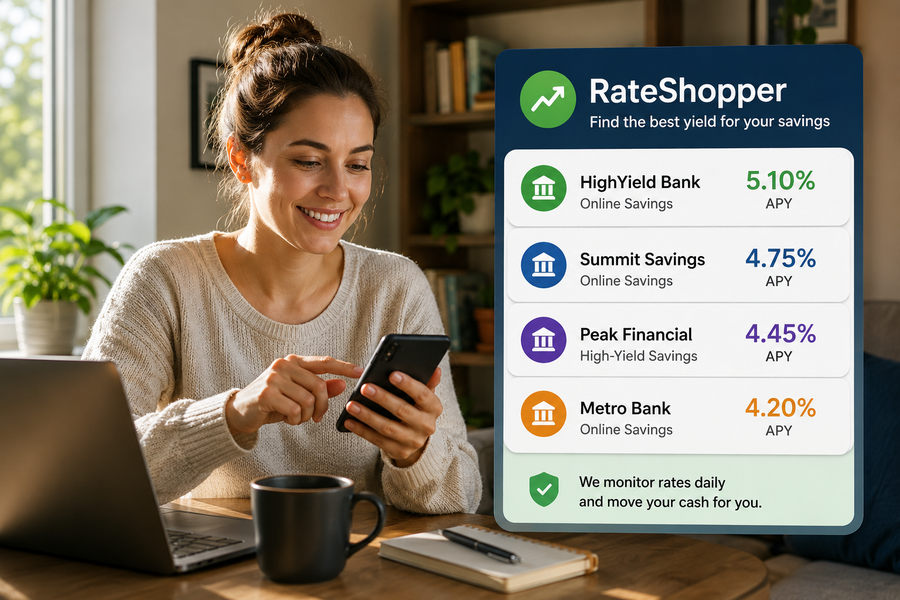
For most of the past two decades, the interest rate paid on a typical savings account was so close to zero that comparing one bank’s yield to another’s felt like a pointless exercise, the difference between one hundredth of a percent and two hundredths of a percent amounting to a few dollars a year on even a substantial balance, and so an entire generation of savers grew accustomed to simply leaving their cash wherever it happened to sit. That assumption broke down as benchmark interest rates rose sharply in 2022 and 2023, and even as the Federal Reserve began cutting its benchmark rate again in the autumn of 2024, a wide and persistent gap opened between the paltry yields still offered by many brick-and-mortar banks, often a few hundredths of a percent, and the substantially higher yields available at online banks, money market funds, and specialized cash-management platforms, some of which continued paying well above three percent even after more than a year of rate cuts. Suddenly the question of where idle cash actually sits stopped being trivial, and a whole category of technology emerged to answer it automatically.
Rate-shopping apps, sometimes called automated cash-management platforms or yield-optimization tools, promise to solve this problem without requiring the saver to do the comparison shopping themselves, monitoring the rates offered across a network of partner banks and moving deposits toward whichever institution is paying the most at any given moment. Rather than asking a person to research a dozen online banks, open new accounts, and manually shuffle money between them whenever a better rate appears, these platforms link to a saver’s existing accounts and handle the optimization in the background, promising the yield of a diligent rate shopper without the tedium that diligence usually requires. The pitch is compelling precisely because the alternative, doing this comparison manually and repeatedly, is exactly the kind of chore most people abandon after the first attempt, letting their cash drift back to whatever account is easiest rather than whichever pays the most.
Yet the automation that makes rate-shopping apps convenient also introduces its own set of complications, from the fees some platforms charge for their optimization service to the practical reality that spreading money across many banks can mean spreading it across many tax forms, many login credentials, and many relationships to monitor, and it is far from obvious that the incremental yield gained is always worth the account sprawl that results. A saver who moves ten thousand dollars from an account paying half a percent to one paying four percent gains meaningfully, but a saver who ends up with deposits scattered across six different banks to capture a marginal improvement in yield may find that the complexity outweighs the benefit, particularly once fees, tax reporting, and the cognitive burden of tracking it all are considered.
This is not merely a theoretical trade-off, since it mirrors a tension that runs through much of modern personal-finance technology, the recurring promise that software can outperform human habit and attention if only the saver is willing to hand over a degree of control. Rate-shopping apps sit squarely in this tradition, alongside robo-advisors that automate investment allocation and budgeting apps that automate expense tracking, and the same questions that apply to those categories, whether the automation genuinely serves the user’s interest, whether the fees charged are proportionate to the value delivered, and whether the complexity introduced behind a simple-looking interface is worth accepting, apply with equal force here. Readers who have weighed those trade-offs before in other corners of financial technology will recognize the shape of the argument even as the specific mechanics of bank rate comparison are new to them.
This article examines what rate-shopping apps actually do, how the automated optimization works behind the scenes, which platforms have emerged as leaders in the category, what chasing yield actually costs beyond the fees on a statement, who genuinely benefits from this kind of automation, and how the shifting interest rate environment shapes the calculus, aiming to give readers a clear-eyed basis for deciding whether automated yield chasing belongs in their own financial life.
What Rate-Shopping Apps Actually Do
At the most basic level, a rate-shopping app is a piece of financial technology that monitors the interest rates offered by a network of partner banks and automatically redirects a saver’s idle cash toward whichever bank or combination of banks is currently paying the highest available yield, repeating this comparison on an ongoing basis so that the saver’s money keeps migrating toward better rates as the market shifts. This distinguishes the category from a simple high-yield savings account, which offers a single rate at a single institution that the saver must periodically check and compare against competitors on their own, and it distinguishes it as well from a basic budgeting app that merely displays account balances without taking any action to improve the return those balances earn. The defining feature of a rate-shopping platform is the automation of the comparison and the movement, not merely the visibility into where money is sitting.
The practical experience of using such a platform typically begins with linking one or more existing bank or brokerage accounts, after which the platform’s software begins tracking the rates available at a roster of partner banks it has vetted and onboarded, banks that have agreed to accept deposits routed through the platform in exchange for the deposits themselves, which the banks can then lend out or otherwise deploy. When the platform identifies that a partner bank is offering a materially better rate than where the saver’s cash currently sits, it initiates a transfer, moving some or all of the balance to capture the improved yield, and this process repeats on a recurring schedule, whether daily, weekly, or in response to a rate change announced by one of the network banks. The saver, in principle, does nothing beyond the initial setup, letting the software handle a task that would otherwise require manually opening accounts at multiple banks and tracking their rates by hand.
A second distinguishing feature of many rate-shopping platforms, and one that appeals particularly to savers with balances well above the standard deposit insurance limit, is that spreading funds across multiple partner banks can extend the protection of federal deposit insurance considerably further than a single account at a single bank would allow, since each separate insured institution provides its own coverage up to the standard limit. This means that a saver with several hundred thousand dollars in cash, an amount that would leave a meaningful portion uninsured if left in one account at one bank, can in principle have that entire sum protected by spreading it across enough separately chartered banks, a feature that some platforms market as heavily as the yield optimization itself. For savers and their advisors managing substantial cash positions, this insurance-maximizing function is often as important a reason to use these platforms as the pursuit of a marginally better interest rate.
It is worth being precise about what these platforms are not, because the category is sometimes confused with adjacent products that serve different purposes. A rate-shopping app is not a robo-advisor building an investment portfolio, though some cash-management platforms are offered by the same companies that also provide robo-advisory services, nor is it a bill-pay or budgeting tool, even though many platforms bundle spending features alongside the core cash-optimization function. The defining service is specifically the automated movement of idle, uninvested cash toward better-yielding, typically FDIC-insured deposit accounts, a comparatively narrow but genuinely useful function that has grown into a meaningful segment of the broader financial-technology industry as savers have become more attentive to what their cash is actually earning.
The rise of this category also reflects a change in how ordinary savers have come to think about cash itself, moving away from the older habit of treating a checking or savings account as a passive holding pen and toward a more active mindset in which idle cash is expected to be working, at least in the modest sense of earning a competitive interest rate, much as an investment portfolio is expected to be allocated sensibly rather than left in whatever mix a broker happened to assign years earlier. Financial commentators and consumer advocates spent much of the high-rate period following 2022 urging savers to check what their existing bank was actually paying, often revealing gaps of three or four percentage points between a legacy bank’s savings rate and the best available online alternative, and rate-shopping apps emerged in large part as the automated, low-effort answer to advice that many savers found sensible in principle but tedious to act on repeatedly by hand.
How Automated Cash Optimization Works Behind the Scenes
Understanding what happens after a saver links an account and opts into automated rate optimization requires looking at the infrastructure that most rate-shopping platforms rely on, infrastructure that in many cases predates the consumer-facing apps themselves and that was originally built to help banks manage large deposit relationships rather than to help individual savers chase yield. At the center of this infrastructure sits a network of partner banks that have agreed to accept deposits sourced through the platform, along with the technology that tracks each bank’s current rate, calculates where a given saver’s funds should be allocated to maximize yield or insurance coverage or both, and executes the transfers needed to keep the allocation current as conditions change.
The rate-scanning function operates continuously or near-continuously in the background, with the platform’s software polling the rates published by each bank in its network, sometimes daily and sometimes more frequently, and comparing them against where each user’s cash currently sits, a task that would be tedious and error-prone if done by hand across even a handful of banks but that software can perform effortlessly across dozens. When the software identifies a materially better rate available elsewhere in the network, or when a bank the saver currently uses lowers its rate relative to competitors, it flags the account for rebalancing, and depending on the platform’s design either executes the transfer automatically or presents the saver with a recommendation to approve, a design choice that varies meaningfully between platforms aimed at self-directed retail savers and those built for use by financial advisors managing client accounts.
The mechanics of the actual transfer typically rely on the automated clearing house system, the same electronic network that underlies direct deposit and most bill payments in the United States, moving funds from an account at one partner bank to an account at another over a period of one to a few business days, which means the optimization is not instantaneous but occurs on a cadence that still captures most of the benefit of chasing the best available rate without requiring same-day settlement. Because these transfers move through standard banking rails rather than anything exotic, the underlying process is neither novel nor especially risky from a technical standpoint, and the platforms’ real innovation lies less in the mechanics of moving money, which banks have done for decades, than in the software layer that decides when and where to move it and in the negotiated relationships with partner banks that make a wide array of destination accounts available to a single linked platform.
A further behind-the-scenes function that many platforms perform is the aggregation of what would otherwise be many separate banking relationships into a single dashboard, so that even though a saver’s cash may be physically held across five or six different institutions, they see one consolidated view of their total balance, their blended yield, and their overall insurance coverage, sparing them from having to log into multiple bank websites to understand their own financial position. This aggregation function is not merely a convenience but a genuine part of what makes the underlying complexity of a multi-bank strategy tolerable for an ordinary saver, since the whole point of automating rate-shopping is to deliver the benefit of spreading cash across many banks without imposing the burden of monitoring many banks individually, and a platform that failed to provide this consolidated visibility would undercut its own value proposition. The summary picture that emerges from these mechanics is one in which a layer of specialized software sits atop an otherwise unremarkable banking infrastructure, adding intelligence and automation to a process, comparing rates and moving deposits, that any saver could in theory perform manually but that few have the patience or attention to sustain.
Sweep Networks, FDIC Coverage, and the Multi-Bank Model
The insurance-maximizing capability that many rate-shopping platforms advertise rests on a specific piece of financial infrastructure known as a deposit sweep network, a system originally developed to help banks and brokerages manage large cash balances by distributing them across many separate FDIC-insured institutions, with each institution’s share kept below the standard insurance limit so that the depositor’s total funds remain fully covered even though no single bank could insure the whole amount on its own. These networks, operated by intermediary firms that maintain relationships with hundreds of banks across the country, allow a platform to place a saver’s deposit not at one bank but as a series of smaller deposits at many banks simultaneously, with the intermediary handling the accounting so that the saver still experiences the arrangement as a single account even though the underlying funds are legally held in dozens of separate institutions.
The standard federal deposit insurance limit protects up to two hundred fifty thousand dollars per depositor per insured bank for each ownership category, a threshold that a saver with modest savings will rarely approach but that becomes a genuine constraint for anyone holding a large cash cushion, the proceeds of a home sale, an inheritance, or a business’s operating reserves, all of which can easily exceed the limit if left in a single account. By distributing the same total balance across, for example, ten different banks within a sweep network, each holding a portion below the insurance threshold, a saver can in principle extend full FDIC protection to several million dollars in cash while still experiencing the deposits as a single, unified account managed through one dashboard, a capability that would be extraordinarily cumbersome to replicate by manually opening and monitoring ten separate bank relationships.
The rates offered within these multi-bank networks are not uniform across all participating institutions, and this is precisely where the yield-optimization function of a rate-shopping platform intersects with the insurance-maximizing function, since the software must decide not only how to spread a balance across enough banks to maintain full coverage but also which specific banks within the eligible set are currently paying the most competitive rate, a dual objective that pure insurance-focused sweep programs, historically used mainly by banks and brokerages for compliance purposes rather than yield-seeking, did not always optimize for. The more sophisticated consumer-facing rate-shopping platforms layer their own rate-comparison logic on top of the underlying sweep infrastructure, using the network’s reach to satisfy the insurance objective while applying their own algorithms to steer the marginal dollar toward the bank paying the best rate among the eligible options, delivering both benefits simultaneously rather than treating them as separate problems.
It is worth noting that this multi-bank model, while it maximizes insurance coverage and can capture attractive yields, does introduce the very account sprawl that critics of rate-shopping apps point to as the category’s central drawback, since a saver whose seven-figure cash balance is spread across a dozen banks will, depending on the platform’s design, potentially receive tax documents from each of those institutions and will be relying on the sweep network’s record-keeping and the platform’s own solvency and reliability to keep the arrangement coherent. The multi-bank sweep model that enables both broader insurance coverage and rate optimization is genuinely valuable infrastructure, but it is infrastructure with trade-offs, trading the simplicity of a single bank relationship for the combined benefits of higher coverage and better yield, a trade that makes sense for some savers and considerably less sense for others, a question examined more fully later in this article.
The Platforms Leading the Rate-Shopping Movement
The rate-shopping category includes a range of platforms that differ meaningfully in their target audience, their business model, and the degree of automation they apply, and surveying the more established names in the space gives a concrete sense of how the category has developed. Some platforms are built primarily for financial advisors to use on behalf of their clients, embedding cash optimization into a broader wealth-management relationship, while others are aimed directly at individual savers who set up an account and manage it themselves, and this distinction shapes everything from the fee structure to the interface design to the degree of manual control the end user retains over which banks their money moves between.
Among the advisor-focused platforms, MaxMyInterest has positioned itself as a tool that financial advisors recommend to clients holding substantial cash balances, linking a client’s existing checking or brokerage account to a curated network of high-yield banks and using a proprietary algorithm to allocate funds across them with the dual goals of maximizing yield and extending FDIC coverage, a service the company charges for through a modest quarterly fee assessed on the cash under management rather than a percentage-of-assets fee more typical of investment management. The platform has been reviewed extensively within the financial-planning industry, including detailed coverage from the widely read financial-planning publication run by Michael Kitces, which has examined how the service fits into an advisor’s broader cash-management recommendations for clients who might otherwise leave substantial sums earning next to nothing in a brokerage sweep account.
Flourish, a company that built its cash-management product specifically for registered investment advisors to offer their clients, represents a different but related model, in which the advisor rather than the individual saver is the primary customer relationship, and Flourish Cash is offered as a turnkey capability that advisory firms can extend to their clients without having to build banking relationships of their own. On the more consumer-facing side of the category, Wealthfront built its Cash Account as a complement to its automated investment management service, allowing users who might already be comfortable with algorithmic portfolio management to apply a similar logic to their uninvested cash, earning a competitive yield through the company’s network of partner banks while retaining the ability to move money seamlessly into their investment accounts when they are ready to invest rather than merely save. Meanwhile, marketplace-style platforms such as Raisin, which absorbed the earlier SaveBetter brand after a 2023 rebrand, take a somewhat different approach, functioning less as an automated optimizer that moves money on its own and more as a curated marketplace where a saver can browse and open accounts at a range of partner banks and credit unions from a single portal, placing more of the comparison-shopping decision in the saver’s own hands even while simplifying the mechanics of opening and funding each account.
Across this range of platforms, a common thread is the reliance on a network of partner banks willing to accept deposits sourced through a third-party technology layer, banks that benefit from an inexpensive channel for gathering deposits even as they compete against each other on the rate they are willing to pay to attract the platform’s users, a competitive dynamic that is itself a meaningful part of why these platforms are able to offer rates that often exceed what a saver would find by walking into a single bank branch. The differences between the platforms, in whether they serve advisors or individuals directly, in how much automation versus manual choice they offer, and in how they charge for their service, matter enormously to which one, if any, makes sense for a particular saver, but the shared premise across all of them is that a software layer applied to the otherwise mundane task of comparing bank interest rates can capture value that most savers would otherwise leave on the table.
Case Studies in Automated Yield Optimization
The growth trajectories of several of these platforms offer verifiable evidence of how significant automated cash optimization has become as a category rather than a niche curiosity. Wealthfront launched its Cash Account in February 2019, and the product’s early traction was rapid enough to draw notice well beyond the fintech press, with the company announcing that it had gathered one billion dollars in deposits within just a few months of launch, a pace that allowed Wealthfront to negotiate better terms with its partner banks and pass some of that benefit back to depositors in the form of a higher advertised rate. The trajectory continued over the following years, and by November 2023 the company disclosed that it oversaw more than fifty billion dollars in total client assets across more than seven hundred thousand clients, with Cash Account holders alone earning nearly seven hundred million dollars in interest during 2023, a figure the company highlighted specifically as evidence that its cash product was delivering meaningful, measurable value rather than a marginal improvement over letting money sit idle.
Flourish, the cash-management platform built for financial advisors rather than directly for retail savers, provides a second documented growth trajectory from the advisor side of the category. The company announced in May 2024 that its cash-management product had surpassed five billion dollars in assets under custody, with just under eight hundred registered investment advisory firms using the platform to manage cash for their clients at that point, and by December of the same year, the company reported that it had grown further still, surpassing six billion dollars in assets under custody with more than nine hundred advisory firms on the platform, a jump of roughly one billion dollars and more than one hundred additional firms within about seven months. This growth is notable because it reflects adoption not by individual savers directly but by the advisory industry itself, suggesting that professional financial advisors, who have every incentive to find the most efficient home for a client’s idle cash, increasingly view automated multi-bank cash platforms as a standard part of prudent cash management rather than an experimental add-on.
MaxMyInterest offers a third, more granular illustration of how these platforms actually operate rather than a headline growth figure, since its published fee structure and rate disclosures give a concrete sense of the economics involved: the platform has charged a quarterly fee calculated as a small percentage, on the order of four one-hundredths of one percent, of the cash balance under management, subject to a minimum quarterly charge that the company has disclosed is waived for clients who come through a participating financial advisor, while the underlying partner banks in its network have in recent periods offered rates in the mid-three percent range, a spread of several percentage points above what many brick-and-mortar institutions pay on comparable balances.
The marketplace model represented by Raisin offers a useful point of contrast to these more fully automated platforms, since rather than moving a saver’s money on their behalf, Raisin, which absorbed the SaveBetter brand it had operated in the United States following a 2023 rebrand, instead lets a saver browse rates from its network of partner banks and credit unions and open individual savings accounts or certificates of deposit directly, consolidating what would otherwise be a series of separate applications into a single sign-on and funding process. This model trades away some of the hands-off automation that defines platforms like Wealthfront or MaxMyInterest in exchange for giving the saver more direct choice over which specific institution and product, whether a standard savings account or a fixed-term certificate of deposit, holds their money, illustrating that automated rate-shopping is not a single uniform approach but a spectrum running from fully automated multi-bank optimization at one end to assisted, saver-directed comparison shopping at the other.
Taken together, these examples, a consumer-facing platform whose cash product grew from a standing start to tens of billions of dollars in barely more than four years, an advisor-facing platform that added a billion dollars in custodied cash assets in a matter of months, a fee-transparent optimizer whose published economics show a meaningful and durable rate advantage over conventional banking, and a marketplace model that extends the same underlying idea to savers who prefer more direct control, demonstrate that automated rate-shopping has moved well past the proof-of-concept stage into a genuinely significant and continuously growing corner of consumer and advisory finance.
The Real Cost of Chasing Yield: Fees, Friction, and Account Sprawl
The yield advantage that rate-shopping platforms advertise is real, but it is rarely the entire picture, and a fair accounting of what automated cash optimization actually costs a saver must look beyond the headline interest rate to the fees, the friction, and the sheer proliferation of relationships that the strategy can generate. Some platforms charge directly for their optimization service, typically through a small percentage fee assessed quarterly or annually on the cash balance under management, a charge that, while modest in percentage terms, still eats into the yield advantage the platform is supposed to be capturing and that a saver comparing platforms needs to weigh against the after-fee rate rather than the headline rate alone. A platform charging a few basis points a quarter on a large cash balance may still leave the saver meaningfully ahead of a brick-and-mortar bank paying next to nothing, but the fee is a real cost that reduces the net benefit and that not every saver may notice unless they read the fine print closely.
Beyond any explicit fee, the friction inherent in maintaining relationships with multiple banks imposes a cost that is harder to quantify but no less real, since each additional bank in a saver’s multi-bank arrangement is, from the perspective of tax reporting, a separate institution that will issue its own interest-income statement at the end of the year, meaning a saver whose cash is spread across eight or ten partner banks within a sweep network may receive eight or ten separate tax documents to gather and reconcile when preparing their return, a modest but genuine increase in complexity compared with a single form from a single bank. Likewise, even when a platform’s dashboard aggregates the saver’s overall position into one convenient view, the underlying reality is that the saver has become a customer of numerous separate financial institutions, each with its own customer-service line, its own fraud-monitoring systems, its own account agreements, and its own potential for the kind of individual account freeze or administrative hiccup that, while rare at any single bank, becomes statistically more likely to affect at least one relationship out of many the more banks are involved.
Account sprawl of this kind also raises a subtler question about the saver’s own attention and oversight, because the entire premise of automated rate-shopping is that the software, not the saver, is doing the monitoring, which means the saver is placing a significant amount of trust in a piece of financial technology to correctly track rates, correctly execute transfers, and correctly maintain the insurance-maximizing allocation across many accounts the saver may rarely examine individually. A saver who has fully delegated this oversight to an app may not notice for some time if a transfer fails, if a partner bank’s rate quietly falls out of competitiveness without triggering a rebalance, or if the platform itself experiences a technical or business disruption, risks that are generally low with established, well-capitalized platforms but that are not zero and that differ meaningfully from the risk profile of simply keeping cash in one well-known bank the saver checks personally.
There is also an opportunity cost worth naming plainly, which is the time and attention that setting up and monitoring a multi-bank rate-shopping arrangement requires even when the platform automates most of the ongoing work, since linking accounts, verifying identity at each new partner bank, and periodically reviewing that the arrangement is still functioning as intended all take some effort on the front end and some vigilance on an ongoing basis. For a saver with a modest emergency fund of a few thousand dollars, the absolute dollar improvement in interest earned from optimal rate-shopping compared with simply choosing one solid online bank and leaving the money there may be small enough that the added complexity, the extra accounts, the extra login credentials, the extra tax forms, is simply not worth the marginal gain, a calculation that changes considerably, as later sections explore, once the cash balance involved grows large enough that even a fraction of a percentage point of additional yield translates into a meaningful number of dollars.
Weighing the Benefits and Drawbacks by Type of Saver
Whether the benefits of automated rate-shopping outweigh its costs depends heavily on who is asking the question, since the calculus differs substantially between an ordinary retail saver managing a personal emergency fund, a financial advisor managing cash on behalf of many clients, and a small business or nonprofit that must keep a large operating reserve safely accessible, and examining each of these stakeholders in turn clarifies why a single verdict on rate-shopping apps would be misleading. For the retail saver with a relatively modest cash balance, perhaps a few thousand to a few tens of thousands of dollars set aside as an emergency fund or short-term savings goal, the benefit of automated rate optimization is real but often modest in absolute terms, since even a full percentage point of additional yield on twenty thousand dollars amounts to only a few hundred dollars a year, an amount that may or may not justify the added complexity of a multi-bank arrangement depending on how much the saver values simplicity versus incremental return. For this group, a single well-chosen online savings account, opened once and left alone, frequently captures the great majority of the available benefit without any of the account-sprawl costs that a fully automated multi-bank platform introduces, making the case for a dedicated rate-shopping app weaker the smaller the balance involved.
For the saver with a substantially larger cash position, however, whether from the proceeds of a home sale, a business sale, an inheritance, or simply years of disciplined saving well beyond what the standard deposit insurance limit covers at a single bank, the calculus shifts considerably, because at that scale both the dollar value of a rate advantage and the importance of extending insurance coverage across multiple institutions become significant enough to justify real attention. A saver holding a million dollars in cash who captures even a modest yield improvement over a base rate of near zero, while also gaining full deposit insurance coverage that a single account could never provide, is realizing tens of thousands of dollars in annual benefit and meaningful protection against loss, a combination substantial enough that the fees and friction of a rate-shopping platform become a comparatively minor consideration by comparison. This is precisely the population that advisor-facing platforms like Flourish and MaxMyInterest have targeted most directly, recognizing that clients with substantial liquid cash reserves are the ones for whom professional-grade cash optimization delivers the clearest return.
Financial advisors themselves constitute a distinct stakeholder group with their own set of considerations, since an advisor who recommends or implements a rate-shopping platform on behalf of clients is not merely chasing yield for its own sake but is fulfilling a fiduciary-adjacent obligation to ensure that a client’s cash, often sitting in a low-yielding brokerage sweep account by default, is not needlessly costing the client money relative to readily available alternatives. For advisors, the growth of platforms built specifically for their use, evidenced by the billions of dollars in assets and hundreds of advisory firms that have adopted tools like Flourish, reflects a recognition within the profession that overlooking cash management, treating it as an afterthought compared with investment allocation, has become a genuine service gap that competitors and increasingly clients themselves are quick to notice, particularly once online rate comparisons became a routine part of how informed clients evaluate their own finances.
Small businesses and nonprofit organizations represent a final and somewhat distinct category, since these entities frequently hold operating reserves considerably larger than what any individual deposit insurance limit would cover, need that cash to remain highly liquid and accessible for payroll and operating expenses, and often lack the internal financial staff to manually manage relationships across a dozen banks even if doing so manually would otherwise make sense. For an organization in this position, a rate-shopping platform that combines yield optimization with automatic multi-bank insurance coverage can solve two problems at once, providing both a better return on idle operating cash and a level of deposit protection that would otherwise require a treasury function well beyond what a small organization typically maintains, making the value proposition for this stakeholder group frequently even clearer than for an individual saver of comparable means.
The retiree drawing down savings represents one more useful lens through which to view this stakeholder question, since a household living off accumulated savings often keeps a larger cushion of cash than a younger saver still earning a steady paycheck, both to cover near-term living expenses and to avoid selling investments during a market downturn, meaning the balances involved frequently sit in the range where the benefits of rate-shopping become significant. For this group, the combination of a meaningfully better yield on a cushion that may run into the hundreds of thousands of dollars and the added deposit-insurance protection that a multi-bank arrangement provides can represent a genuinely material improvement in financial security, particularly for a household that no longer has employment income to fall back on if an emergency requires drawing on that reserve unexpectedly.
Across all these groups, the pattern that emerges is consistent: the case for automated rate-shopping strengthens as the cash balance grows, as the stakes of both yield and insurance coverage increase, and as the saver’s own capacity or willingness to do comparison shopping manually diminishes, while the case weakens for savers with modest balances who would likely capture most of the available benefit from a single well-chosen account without any need for automation at all.
The Federal Reserve, Rate Cycles, and What It Means for Automated Savers
The value proposition of any rate-shopping platform is inseparable from the broader interest rate environment set in large part by the Federal Reserve, since the entire premise of chasing a better yield only matters if there is a meaningful gap to chase in the first place, and understanding how that gap has evolved in recent years helps explain both why these platforms grew so quickly and why their usefulness is likely to persist even as the rate cycle turns. The Federal Reserve raised its benchmark rate aggressively during 2022 and 2023 to combat inflation, pushing yields at online banks and money-market funds to levels not seen in roughly two decades, and it was during this period that automated cash-optimization platforms saw some of their most rapid growth, since the dollar value of finding a better rate had suddenly become large enough for ordinary savers to notice and act on.
The Federal Reserve then began a rate-cutting cycle in September 2024, the first reduction in its benchmark rate since the aggressive hiking campaign of the prior two years, and continued cutting through 2025, with the cumulative reduction reaching roughly one and three-quarters percentage points by the time of a sixth cut reported in December 2025, before the central bank held its benchmark rate steady through the first half of 2026. A natural assumption might be that as the Fed cuts rates, the advantage of shopping around for a better savings yield would shrink correspondingly, since all rates should in theory fall together, but the actual pattern observed in the market has been more favorable to rate-shoppers than that assumption would suggest, because banks do not pass along Fed rate changes uniformly or symmetrically.
Reporting on the online savings market found that even after the Federal Reserve’s benchmark rate had fallen by roughly one and a half percentage points from its peak, the average yield offered by major online high-yield savings accounts had fallen by only around eighty-three basis points, considerably less than the full decline in the Fed’s benchmark rate, meaning the online banks that rate-shopping platforms rely on as partners retained much of their rate advantage even well into the cutting cycle. This asymmetry reflects a broader and well-documented pattern in how deposit rates respond to Fed policy, in which online banks, competing aggressively for deposits and lacking the extensive branch networks that give traditional banks other ways to retain customers, tend to pass through a large share, often cited as somewhere between seventy and ninety percent, of any Fed rate change in either direction, while large traditional banks with big, sticky deposit bases tend to be slow to raise the rates they pay when the Fed hikes and comparatively quick to cut when the Fed lowers rates, an asymmetry that works to the advantage of anyone willing to move their cash away from a legacy institution and toward a more competitive one.
The practical implication for automated rate-shopping is that the spread between what a saver earns by leaving cash parked at a traditional bank and what the same saver could earn through an optimized, multi-bank arrangement has proven durable across the recent rate cycle rather than disappearing as rates came down, and reporting well into 2026 continued to identify online savings options paying yields in excess of four percent even as the Fed held its benchmark rate steady, evidence that a meaningful gap between the best available yields and the yields still on offer at conventional banks persists regardless of which direction the broader rate cycle is moving. This durability matters considerably for anyone weighing whether a rate-shopping platform is worth adopting only during periods of unusually high rates or whether it represents a more permanent improvement in how cash is managed, and the evidence from the 2024 through 2026 cutting cycle suggests the latter, since the underlying behavioral pattern, sluggish traditional banks and aggressive online competitors, appears to hold regardless of where the Fed’s benchmark rate happens to sit at a given moment, meaning the case for automated rate optimization does not evaporate simply because the broader rate environment has cooled from its 2023 peak.
Final Thoughts
The rise of automated rate-shopping platforms reflects something broader than a passing fintech trend tied to a single unusual period of high interest rates, revealing instead a durable mismatch between what banks are technically capable of paying depositors and what many of them actually choose to pay absent competitive pressure, a mismatch that software applied consistently and tirelessly is now well suited to exploit on behalf of ordinary savers who would never sustain that vigilance on their own. The technology at the heart of these platforms is not especially exotic, relying on standard banking rails, established deposit-insurance frameworks, and comparison logic that a patient human could in principle replicate by hand, but the value delivered comes precisely from removing the need for that patience, automating a task that is simple in concept yet tedious enough in practice that most people, quite reasonably, never get around to doing it consistently.
The financial-inclusion dimension of this technology deserves genuine attention alongside its convenience, because the savers who benefit least from the traditional banking relationship, those without the time, financial literacy, or confidence to compare institutions and negotiate better terms, are often the same savers for whom a meaningful boost in savings yield could matter most, and an automated platform that captures that boost without requiring specialized financial knowledge extends a benefit historically available mainly to the financially sophisticated. At the same time, the platforms that have grown fastest, judged by the case studies examined earlier, have tended to serve savers and advisory clients who already had significant assets, suggesting that meaningful work remains in extending accessible cash optimization to savers with more modest balances.
The tension between automation and vigilance that runs through this article is worth confronting directly rather than resolving too neatly in either direction, because while it is true that delegating cash management to software relieves the saver of an ongoing chore, it is equally true that any delegation of this kind requires a baseline of trust in the platform’s reliability, security, and continued alignment with the saver’s interests, trust that is generally well placed with established, well-capitalized providers but that nonetheless represents a real shift in how a saver relates to their own money, away from direct, hands-on awareness and toward reliance on an intermediary layer the saver did not build and cannot fully audit. The account sprawl that results from spreading deposits across many partner banks is the most tangible expression of this trade-off, a structural cost that buys both yield and insurance coverage but that asks the saver to accept a more complicated financial life in exchange.
Looking across the evidence assembled here, the honest takeaway is neither that everyone should rush to adopt a rate-shopping app nor that the entire category is an overengineered solution to a minor inconvenience, but rather that the case strengthens or weakens in a fairly predictable way depending on the saver’s own circumstances, growing compelling as cash balances rise past the point where insurance coverage and yield differences translate into thousands rather than dozens of dollars, and growing weaker as balances shrink toward the range where a single well-chosen account captures most of the available benefit. The broader significance of automated cash optimization lies less in any single platform’s growth numbers than in what the category represents: a recognition that deposit interest has become a genuinely competitive, actively contested feature of modern banking, and that software can help ordinary savers participate in that competition without becoming rate-shopping experts themselves.
FAQs
- What exactly is a rate-shopping app?
It is a financial-technology platform that links to a saver’s existing bank or brokerage accounts and automatically moves idle cash toward whichever partner bank in its network is currently paying the highest interest rate, repeating this comparison on an ongoing basis so the saver does not have to research and switch banks manually. - How is a rate-shopping app different from just opening a high-yield savings account?
A high-yield savings account offers one rate at one bank that you must periodically compare against competitors yourself. A rate-shopping app automates that comparison across many banks and moves your money for you, and many also spread deposits across multiple banks to extend FDIC insurance coverage beyond what a single account provides. - How do these platforms actually move my money between banks?
Transfers typically move through the standard automated clearing house system, the same network used for direct deposit and bill payments, which usually takes one to a few business days. The platform’s software continuously compares rates across its partner banks and initiates a transfer whenever a materially better rate becomes available. - Can spreading my cash across multiple banks really increase my FDIC insurance coverage?
Yes. Standard FDIC insurance covers up to two hundred fifty thousand dollars per depositor per bank per ownership category. By using a sweep network that distributes your balance across many separately chartered banks, each holding an amount below that limit, a platform can extend full insurance coverage to a much larger total balance while you still see it as one consolidated account. - Do rate-shopping apps charge fees?
Some do. For example, MaxMyInterest charges a quarterly fee calculated as a small percentage of the cash balance under management, subject to a minimum that is often waived for clients who come through a participating financial advisor. Fees vary by platform, so it is worth checking whether the after-fee yield still beats simpler alternatives. - Which platforms are considered leaders in this category?
Notable examples include Wealthfront, whose Cash Account gathered one billion dollars in deposits within months of its 2019 launch and, by November 2023, was part of a company overseeing more than fifty billion dollars in client assets; Flourish, an advisor-focused platform that surpassed six billion dollars in assets under custody with over nine hundred advisory firms by December 2024; and MaxMyInterest, an advisor-oriented yield and FDIC-optimization tool. - What is account sprawl, and why does it matter?
Account sprawl refers to the complexity that builds up when your cash is spread across many separate banks, including multiple tax documents at year-end, multiple sets of login credentials, and multiple institutions to monitor. It is the main hidden cost of chasing yield, and it can outweigh the benefit for savers with smaller balances. - Is chasing yield still worth it now that the Federal Reserve has been cutting rates?
Often yes, because online banks have not cut their rates as much as the Fed has cut its benchmark rate. Reporting has shown online savings yields falling by considerably less than the Fed’s roughly one-and-three-quarter-point cumulative reduction through late 2025, meaning a meaningful gap between conventional and competitive rates has persisted even as the broader rate cycle has cooled. - Who benefits most from using a rate-shopping app?
Savers with cash balances well above typical emergency-fund levels, particularly those approaching or exceeding the standard deposit insurance limit, tend to benefit most, since both the dollar value of a better rate and the importance of expanded insurance coverage grow with the size of the balance. Financial advisors managing client cash and organizations holding large operating reserves also frequently see clear value. - Should someone with a small emergency fund bother with a rate-shopping app?
Not necessarily. For a balance of a few thousand to a few tens of thousands of dollars, the dollar improvement from optimal rate-shopping is often modest, and simply choosing one solid, well-reviewed online savings account and leaving it alone frequently captures most of the available benefit without the added complexity of a multi-bank arrangement.