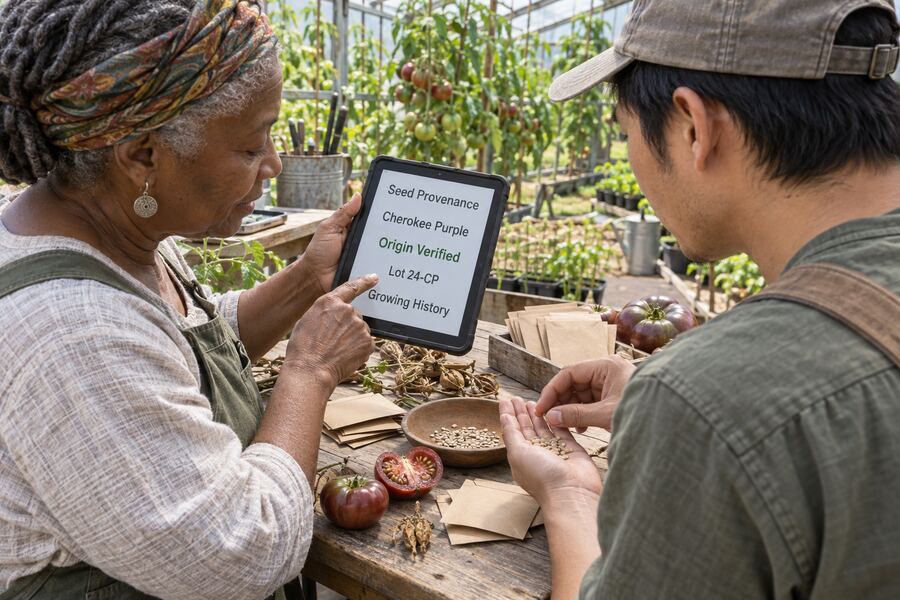
A packet of seeds looks like the simplest object in agriculture: a name on the front, a picture of the mature plant, a few lines about days to germination, and a scattering of dried embryos inside. But that packet carries a claim that is almost impossible for the person buying it to verify. It says this seed is a particular variety, grown a particular way, tracing back to a particular lineage, and none of that can be confirmed by looking at it, smelling it, or even planting it until months later when the plant has grown to maturity and either matches the description or does not. For most commercial vegetables this gap between claim and verification rarely matters, because large seed companies have reputations to protect and quality-control systems that catch most errors before a packet reaches a shelf. For heirloom growers, seed savers, and small farms working with rare or regionally significant varieties, the gap matters enormously, because the thing being sold is not just a plant that will produce a harvest but a genetic and cultural lineage that, once lost or corrupted, cannot be recovered from a database or a lawsuit.
This is the problem that a growing number of technologists, seed companies, and agricultural ministries are trying to solve with blockchain-based provenance systems. The pitch is straightforward: instead of a paper certificate that can be lost, altered, or simply not trusted by the next person down the chain, seed origin, variety, and growing history get written to a distributed ledger that no single party can quietly edit after the fact. A grower, seed librarian, or buyer can scan a code, pull up the record, and see where a seed came from, who grew its parent plants, what growing conditions it passed through, and what certifications or test results attached to it along the way. For an heirloom tomato variety passed down through a farming family for three generations, or a regionally adapted bean landrace that a seed library is trying to keep in circulation, that kind of durable, tamper-evident record is not a convenience. It is a form of protection against the very real and ongoing problem of mislabeling, genetic drift, and outright fraud in the seed trade.
It is worth being precise about what is actually new here, because “blockchain” has been attached to so many agricultural pitches over the past decade that skepticism is a reasonable starting position. Seed certification and traceability are not new ideas; national governments and seed associations have run certification programs and paper-based chain-of-custody systems for generations. What blockchain adds is not the concept of tracking a seed’s history, but a specific technical property: once a record is written and confirmed by the network, altering it without leaving a visible trace becomes extremely difficult, and everyone with access to the ledger sees the same version of history rather than whatever version a particular seller wants to show. That property is genuinely useful in a trade where the parties involved — a small-scale grower in one region, a seed exchange in another, a home gardener buying online from neither — often have no prior relationship and no easy way to check each other’s claims.
This article looks at what blockchain seed provenance actually involves, from how a record gets created and verified to what a grower actually sees when they scan a code on a seed packet. It examines the real benefits for heirloom growers, seed libraries, and small farms trying to protect rare varieties, and it walks through two documented, verifiable projects — one in India’s national seed certification system and one in a European rice-traceability pilot — that show what these systems look like when they move from concept to operation. It also takes seriously the limitations: the cost of participation, the persistent gap between a digital record and the physical seed it describes, and the open questions about who ultimately controls these ledgers. None of this is a promise that blockchain will fix seed fraud on its own. It is a look at a specific tool, what it can verify, what it cannot, and why the people most invested in protecting rare and heirloom varieties are paying attention to it now.
The Problem: Mislabeling and Lost Provenance in the Seed Trade
Before evaluating any technological fix, it helps to understand how seed identity actually gets lost, because the failure modes are more varied and more mundane than outright fraud. The most common source of error is simple mislabeling during the packing and distribution process: a grower harvests seed from several varieties in the same season, storage bins get mixed up, hand-written labels fade or fall off, and a packet ends up marked with the wrong variety name entirely. This happens at every scale of the seed trade, from large commercial operations to backyard seed savers trading through the mail, and it is rarely malicious. It is simply what happens when a manual, paper-based process handles thousands of small batches with no independent check at the point of sale.
A second and more insidious problem is genetic drift through unintentional cross-pollination. Many heirloom and open-pollinated varieties are outcrossing species that will readily cross with a neighboring variety if isolation distances are not maintained during seed production. A seed saver growing two varieties of squash too close together, without realizing that both are the same species and capable of cross-pollinating, can produce seed that looks identical to the parent variety but carries genetic material from the neighbor. The resulting plants may not show any obvious difference for a generation or two, meaning the contamination can persist and spread through further seed-saving before anyone notices the variety has changed. Once that has happened across enough growing seasons, there may be no clean reference population left to compare against, and the original variety, in any genetically meaningful sense, is gone even though its name lives on.
The severity of this problem also varies significantly depending on how a given crop reproduces. Self-pollinating crops such as tomatoes, beans, and peas are comparatively easy to maintain true-to-type because unwanted cross-pollination is rare without deliberate hybridization, which is one reason so many classic heirloom vegetable varieties come from these crop families. Crops that rely on wind or insect pollination, including corn, squash, and many members of the brassica family, are far more vulnerable, because a single insect visit from a nearby, incompatible variety can introduce genetic material that will not become visible until the following generation is grown out. A seed saver working with an heirloom squash variety may follow every recommended isolation practice and still lose genetic purity to a neighbor’s garden a quarter mile away, which is precisely the kind of quiet, undetectable corruption that a paper-based recordkeeping system has no mechanism to catch.
A third problem, and the one that draws the most attention in policy circles, is outright counterfeiting and fraud. In some regions, spurious or substandard seed is deliberately packaged and sold under the name of certified, high-quality varieties, exploiting the fact that a buyer cannot tell the difference until the crop fails to perform as expected. This is a well-documented problem in developing agricultural markets, where germination rates for counterfeit seed can fall far short of certification standards, sometimes dramatically so, while still being sold at prices that assume genuine quality. For a subsistence farmer, planting counterfeit seed can mean a failed season; for an heirloom seed exchange, a single batch of mislabeled or contaminated seed distributed to dozens of growers before the error is caught can undo years of careful variety maintenance.
What ties these problems together is the absence of a verifiable chain of custody. A grower who wants to know whether a seed truly is what it claims to be currently has very few options beyond trusting the seller’s reputation, growing the seed out and observing the mature plant, or in rare cases paying for genetic testing that most home gardeners and small farms cannot afford and would not know how to interpret. Reputation-based trust works reasonably well within tight-knit seed-saving communities where growers know each other personally, but it breaks down the moment a transaction crosses into a wider, more anonymous marketplace — precisely the kind of marketplace that online seed sales, mail-order exchanges, and cross-border trade in rare varieties increasingly represent. This is the gap that provenance systems, blockchain-based or otherwise, are trying to close: not by making a seed inherently more trustworthy, but by making its claimed history checkable by anyone who wants to look.
What Blockchain Seed Provenance Actually Means
At its core, a blockchain is a shared, append-only record maintained across a network of computers rather than sitting on a single company’s server. Once a piece of information is added and confirmed by the network, changing it retroactively would require rewriting that record on a large share of the participating machines simultaneously, which becomes computationally impractical as the network grows. For seed provenance, this means that when a breeder registers a new variety, a certifying body approves a seed lot, or a grower logs a harvest, that entry becomes part of a permanent, time-stamped history that no single actor — not even the company that built the system — can quietly edit later to cover up an error or misrepresent what happened. This is the property that separates a blockchain-based system from an ordinary database, where a database administrator can, in principle, alter historical records without anyone else knowing.
It is important to be precise about what this property does and does not guarantee, because the distinction matters for anyone deciding how much trust to place in these systems. A blockchain can guarantee that a record, once entered, has not been silently altered. It cannot guarantee that the record was accurate in the first place. If a seed producer enters false information about a seed lot’s origin or germination rate, the blockchain will faithfully and permanently preserve that false information exactly as it would preserve true information. This is sometimes called the “garbage in, garbage out” limitation, and it is the single most important caveat to understand about any blockchain provenance claim. The technology solves the problem of tampering after the fact; it does not solve the separate problem of verifying truth at the moment of entry. That verification still depends on the people and institutions — certifying agencies, accredited labs, reputable growers — who put information into the system in the first place.
Given that limitation, the real value of blockchain seed provenance comes from combining the tamper-evident ledger with credible verification at each point data enters it, and from making the resulting record visible and checkable by everyone downstream rather than locked inside one company’s private system. A well-designed system does not simply let anyone type in a claim about a seed’s origin; it structures the process so that specific actors — a certified seed producer, an accredited testing lab, a registered seed library — are the ones authorized to write particular kinds of entries, and it often pairs those entries with supporting evidence such as lab test results or inspection records. The blockchain then serves as the shared, trustworthy backbone that lets a grower three steps down the supply chain see the full history of entries without having to separately contact and trust each party who touched the seed along the way.
In practice, most agricultural provenance systems use what is known as a permissioned blockchain rather than a fully public one like the networks that underpin major cryptocurrencies. On a permissioned network, only vetted participants — a certifying agency, an accredited lab, a registered seed producer — are allowed to add entries or operate the computers that validate them, while the resulting record can still be made openly readable to anyone who wants to check it, including the general public. This distinction matters because it addresses a common misconception that blockchain-based seed systems require growers to understand cryptocurrency or hold a digital wallet; in most working systems, a grower’s only interaction is scanning a code and viewing a webpage, with the underlying validation process handled entirely by the institutions running the network. The tradeoff is that a permissioned system depends on the operator choosing trustworthy validators, which reintroduces an element of institutional trust that a fully public, decentralized blockchain is designed to avoid. For seed provenance specifically, this tradeoff is generally considered acceptable, since the alternative of a fully open network, where anyone could become a validator with no vetting at all, would make it harder to guarantee that only qualified, accountable bodies are entering agricultural data in the first place.
How a Seed’s Record Gets Created and Verified
The process typically begins well before a seed ever reaches a buyer, at the point where a breeder or seed producer registers a new lot or variety in the system. This initial entry usually includes the variety name, the parent lineage where relevant, the location and date of production, and any identifying genetic or morphological information the producer wants to attach. In systems built around formal seed certification, this step is tied to an existing regulatory process: a breeder seed is produced and verified, then used to grow foundation seed, which is in turn verified and used to grow certified seed sold to farmers or home growers. Each transition between these generations is an opportunity for an independent certifying body to inspect the crop, confirm it matches the registered variety, and only then authorize the next entry in the chain.
Verification at each stage is where the credibility of the entire system rests, and it looks different depending on what is being verified. For basic identity and chain-of-custody claims — this seed lot came from this farm, on this date, certified by this inspector — verification is largely a matter of institutional trust: the certifying body’s reputation and legal accountability back the claim, much as it always has in paper-based certification, except the resulting record is now shared on a tamper-evident ledger rather than filed in a cabinet. For more rigorous claims about genetic identity, some systems pair the blockchain entry with laboratory testing, such as DNA fingerprinting or marker-assisted verification, that can confirm a sample actually matches its claimed variety rather than relying solely on visual inspection of the growing plant. This layered approach — an authoritative party entering data, sometimes backed by lab verification, onto a ledger that preserves the entry unaltered — is what allows the system to make a meaningfully stronger claim than an unverified paper label, even though it cannot make the entry infallible.
Long-lived heirloom lineages present a particular challenge for this verification process, because a variety that has been grown and re-saved for several human generations accumulates dozens or even hundreds of individual seed-saving events, each of which is a point where an error could have entered the record. Some seed libraries and certification programs address this by requiring periodic re-verification: rather than trusting a decades-old paper trail indefinitely, a variety is grown out under controlled conditions every several years and compared against its earlier recorded characteristics, with the results logged as a new, current entry on the ledger rather than an amendment to the old one. This preserves the historical record intact, in keeping with the append-only nature of the ledger, while still giving current buyers a recent, meaningful confirmation that the variety they are purchasing still matches its claimed identity, rather than relying solely on an entry that might be many years old.
A practical consequence of this design is that not every actor in the seed trade can write to the ledger with equal authority, and a home gardener trading seeds informally with a neighbor is generally outside the system entirely unless a seed library or exchange specifically builds a pathway for informal seed-saving records to be logged. This is a real limitation for the grassroots seed-saving movement, which operates largely through exactly this kind of informal, person-to-person exchange, and it means that blockchain provenance today is most developed in contexts with an institutional backbone — a certifying government agency, a commercial seed company, a formal seed library — rather than in the fully decentralized, community-driven seed exchanges that many heirloom growers actually rely on.
QR Codes, Digital Passports, and What Growers See
For the person actually buying or growing the seed, the blockchain itself is invisible; what they interact with is almost always a QR code printed on the seed packet, tag, or accompanying certificate. Scanning the code with a phone opens a page, sometimes called a digital seed passport, that displays the information tied to that specific lot: variety name and any relevant lineage, the producer or growing region, the date of harvest and any relevant certification stamps, and in more developed systems, the chain of custody showing which entities handled the seed between the field and the point of sale. Because this page is generated by pulling directly from the underlying ledger rather than from a static webpage the seller controls, a grower has some assurance that the information reflects the same record that certifying bodies and other participants in the system are seeing, rather than marketing copy assembled specifically for that customer.
The sophistication of what a grower sees varies considerably by system. Some implementations offer little more than a digital version of what used to be printed on a paper tag — variety, origin, certification status — with the blockchain operating quietly in the background as a trust mechanism rather than a visible feature. Others offer a genuinely rich interface: a visual family tree of a variety’s lineage, photographs from inspection visits, test results for germination rate or disease screening, and a timeline of every recorded step the seed lot passed through. For an heirloom grower specifically trying to maintain a rare variety’s genetic integrity, this richer version is far more valuable, because it lets them see not just that a seed is labeled correctly but where in a lineage it sits and whether it has passed through any point where cross-contamination risk was elevated.
Accessibility is a practical detail that shapes how useful this interface actually is in the field. A digital passport that requires a strong data connection to load is of limited value to a grower in a rural area with poor mobile coverage, which is why some systems cache key information directly in the QR code itself or provide a lightweight, low-bandwidth version of the record alongside the full interactive page, ensuring that the most essential facts, at minimum, remain viewable even when a full connection is not available.
What this section of the system cannot do, and what growers should understand clearly, is authenticate the physical seed in their hand against the digital record with certainty. Scanning a code confirms that a record exists and shows what it claims; it does not prove that the seeds inside a particular packet are actually the seeds described by that record, since a dishonest seller could in principle print a valid, legitimate code on a packet of different seed entirely, especially in low-oversight markets. Serialized codes tied to individual batches, tamper-evident packaging, and spot-check testing by regulators or seed libraries all help close this remaining gap, but none of them close it completely, and this is one of the genuine limits of digital provenance that the rest of this article returns to. Taken together, these two layers — a verified record created through an institutional process, and a grower-facing interface that makes that record checkable at the point of sale — form the practical core of what blockchain seed provenance offers today, whatever the level of sophistication a particular system has reached.
Benefits for Heirloom Growers and Small Farms
For the individual home gardener working with heirloom varieties, the most immediate benefit of a well-built provenance system is simply confidence at the point of purchase. Someone buying a packet of a rare bean or tomato variety online, from a seller they have never dealt with before, currently has almost no way to verify the seller’s claims beyond reviews and reputation. A scannable, verifiable record that shows the seed’s lineage and the identity of whoever certified it gives that gardener something closer to the confidence they would have buying from a seed company with decades of trusted history, even when buying from a small, unfamiliar seed saver on the other side of the country. This matters disproportionately for rare and heirloom varieties precisely because the sellers are often small operations without the brand reputation that larger seed companies have built over time.
Seed libraries and community seed exchanges, which exist specifically to keep regionally adapted and heirloom varieties in circulation, benefit in a different way: a shared provenance record lets them track a variety’s genetic history across many growers and many seasons, which is exactly the kind of longitudinal recordkeeping that seed libraries have historically struggled to maintain with volunteer labor and paper logs. If a variety maintained by a seed library begins showing signs of genetic drift or unexpected trait changes, a searchable provenance record makes it possible to trace back through the chain of growers and identify where the divergence likely started, rather than simply noticing the problem after the fact with no way to investigate its origin. For a movement built on preserving specific genetic lineages against the homogenizing pressure of commercial hybrid seed, that kind of diagnostic capability is valuable in a way that goes beyond simple fraud prevention.
Small farms working with heirloom or landrace varieties for market sale gain a related but distinct advantage: the ability to substantiate premium claims to customers and buyers who are willing to pay more for verified heirloom or heritage produce but currently have to take the farm’s word for it. A farm that can point a restaurant buyer or a farmers-market customer to a verifiable record showing a tomato variety’s documented lineage back several generations has a stronger marketing claim than one relying purely on a name and a story, and in a market where “heirloom” labeling is not tightly regulated and is sometimes applied loosely to varieties with no real claim to the term, that verifiability becomes a genuine competitive advantage. Independent plant breeders working to develop or preserve specific genetic lines benefit as well, since a blockchain record can serve as a durable, time-stamped proof of a variety’s development history, which has practical value both for establishing a claim to have originated a particular cultivar and, in jurisdictions with plant variety protection laws, for supporting formal intellectual property claims. Certifying agencies and agricultural researchers gain a less obvious but still meaningful benefit from the same underlying data: the ability to look across many individual provenance records at once and spot patterns that would be invisible from any single transaction, such as a cluster of quality complaints tracing back to a particular producer or growing region, or a gradual shift in a variety’s recorded characteristics that might indicate widespread genetic drift before any individual grower would notice it in their own plot. This aggregate view depends on the underlying records being structured consistently and stored somewhere queryable across an entire region or program, which is exactly what a shared ledger, as opposed to thousands of separate paper files held by individual growers, makes possible. For heirloom and rare-variety preservation specifically, this kind of early-warning capability could let a seed library or extension program intervene — by isolating a compromised population or sourcing clean replacement stock — before a variety’s genetic identity is lost rather than after.
Across all of these groups, the underlying benefit is the same: a shared, checkable record substitutes for trust relationships that previously had to be built person by person, transaction by transaction, which is precisely what allows rare and heirloom seed to circulate more widely without losing the trustworthiness that a tight-knit community previously provided informally.
Documented Case Studies in Blockchain Seed Traceability
The gap between the theoretical promise of blockchain seed provenance and what is actually operating in the field is significant, and it is worth looking closely at real, documented systems rather than pilot announcements or white papers that never moved beyond a proof of concept. Two projects in particular illustrate both what has genuinely been built and how much distance remains between demonstrated capability and full-scale, everyday use: a national government seed-certification platform in India that has built and demonstrated a blockchain authentication layer, and a European Union-backed agricultural project that has run real blockchain-verified traceability pilots with rice growers and consumers across two full harvest cycles.
Finding examples that meet a high bar for verification is harder than the amount of marketing language around “blockchain agriculture” would suggest. A search of industry coverage and vendor announcements turns up a long list of pilot programs, white papers, and press releases describing blockchain seed-traceability concepts, many of which either never progressed past a conceptual design phase or stopped publishing results after an initial announcement, making it impossible to verify what, if anything, was actually built and used. Academic literature on the subject follows a similar pattern: numerous peer-reviewed papers propose blockchain architectures for seed certification and describe laboratory prototypes, but far fewer report on a system that has been deployed with real growers, real seed lots, and real transactions over a sustained period. This is a familiar pattern across many blockchain applications outside of finance, where the technology’s genuine usefulness is often real but the distance between a working demonstration and a piece of critical infrastructure that an entire industry actually relies on turns out to be much larger than initial announcements suggest.
The two cases examined here were selected specifically because they clear that higher bar: both have specific, named institutions behind them, both have published dates and measurable figures rather than vague claims of success, and both have documentation independent of the sponsoring organization’s own marketing, whether through peer-reviewed publication or a government agency’s own detailed public reporting on its rollout. Neither is a finished, mature system running at the scale that seed provenance advocates ultimately envision, and that gap between the current state of these projects and the fuller vision is itself an important, honest part of the story.
India’s SATHI Portal and Its Seed Blockchain Pilot
India’s Ministry of Agriculture and Farmers’ Welfare, working with the National Informatics Centre, launched the Seed Authentication, Traceability and Holistic Inventory portal, known as SATHI, in its first phase on April 19, 2023, with the system available at seedtrace.gov.in. SATHI was built to digitize India’s seed supply chain from the breeder-seed stage through certified seed sold to farmers, replacing what had been a largely paper-based certification and distribution process spread across the country’s many state-level seed certification agencies. The system organizes the seed chain into integrated functional areas covering breeder seed production and monitoring, seed certification, seed dealer licensing, and inventory tracking, and it issues QR-coded seed bags that allow a farmer to scan a code and see the seed’s certifying agency, producing organization, and stage in the supply chain.
By the time the platform’s rollout had reached its most recent nationally reported milestone, SATHI had integrated 16 states into the national seed grid, with more than 5,678 seed-producing agencies and more than 75,330 seed growers registered on the platform, according to the National Informatics Centre’s own published account of the project. A national-level workshop held in October 2023 brought together officials from state agriculture departments, the Indian Council of Agricultural Research, and central seed agencies to coordinate the rollout and gather feedback from the trial run of the supply-chain management module, which participating officials reported as positive.
The blockchain component of SATHI is the part of the project most relevant to this article, and it is important to describe accurately: as of the National Informatics Centre’s own published account of the project, full blockchain integration is described as the platform’s “way forward” rather than a feature already running at national scale. Specifically, the plan calls for seed certificates and the movement of seed bags through the supply chain to be pushed to a dedicated “Seed Blockchain,” with authentication and trace-and-track functions handled through application programming interfaces connected to that blockchain layer. A proof of concept for this blockchain authentication layer has already been demonstrated successfully, per the National Informatics Centre’s account, which represents a genuine technical milestone even though it stops short of the blockchain running as the live backbone of the entire national seed grid. SATHI is therefore best understood not as a finished blockchain system but as a large-scale, functioning digital seed-traceability platform, already covering millions of seed bags across sixteen states, that has proven its planned blockchain authentication layer works in principle and is positioned to extend it across the existing traceability infrastructure.
The scale of SATHI’s underlying engineering reflects a level of institutional investment well beyond a typical pilot project. The platform is built as a multitenant application on a microservices architecture, deployed through containers and orchestrated with Kubernetes so that a single national instance can serve every participating state while still allowing each state to configure its own workflows, terminology, and payment processes to match local administrative practice. This kind of infrastructure investment matters for the blockchain component specifically, because a proof-of-concept demonstration is meaningfully more credible when it sits on top of a platform already handling real transactional volume across sixteen states, rather than existing as an isolated technical experiment disconnected from any operating system. When India’s seed ministry describes the blockchain layer as the platform’s next phase rather than a finished feature, that framing should be read in the context of a program that has already solved the harder problem of getting a national digital seed-traceability system built, adopted by state certification bodies, and used by tens of thousands of registered growers — the blockchain authentication layer is being added to strengthen an existing, functioning system rather than serving as its sole justification for being built in the first place.
The TRACE-RICE Project: Blockchain Traceability from Field to Consumer
Where SATHI shows a blockchain authentication layer proven at the proof-of-concept stage inside a much larger traceability system, the European Union-supported TRACE-RICE project shows blockchain-verified traceability actually running end to end, from a farmer’s field to a consumer scanning a code on a package. TRACE-RICE brought together public and private stakeholders across three Mediterranean countries — Portugal, Spain, and Egypt — to build and test a full-chain traceability system for rice, covering both raw rice and ready-to-eat rice products, with the explicit goal of enhancing transparency and sustainability across the rice value chain.
The Portuguese pilot, conducted during the 2023 harvest, built a Rice Field Data Recording App using ArcGIS Survey123 to digitize agronomic and compliance records that had previously been kept on paper under the country’s Integrated Production farming standards. Those digitized field records were then linked to blockchain-verified QR codes printed on consumer-facing packaging, allowing a shopper to scan a package of rice and see verified information about the variety, the growing practices used, and the compliance record behind that specific batch. Documented results from the 2023 pilot included 174 recorded QR-code scan interactions from consumers, concentrated primarily around Lisbon, providing the project team with an initial, real-world dataset on how and where consumers actually engaged with the traceability information rather than relying on assumptions about consumer interest.
Building on that pilot, the project’s 2024 harvest phase expanded the system’s scope by incorporating data collection for Caravela, a Portuguese rice variety, and by adding monitoring across three additional plots in the Tejo, or Tagus, river region — one of Portugal’s principal rice-growing areas. This scaling phase was specifically designed to test whether the traceability system could adapt to a different variety and a broader set of production contexts beyond the original pilot plots, and the project’s own published findings describe the results as confirming that adaptability, positioning the blockchain-linked traceability approach as a replicable model rather than a one-off pilot tied to a single variety or region. The project’s methods and results were subsequently published in a peer-reviewed food science journal, giving the case an additional layer of independent scrutiny beyond the project’s own reporting. The peer-reviewed account of the project, published in a food science journal in 2025, went beyond simply reporting that the traceability system worked technically and examined the pattern of consumer engagement with the QR codes in some analytical depth, treating the concentration of scans around Lisbon and the modest but non-trivial total of 174 interactions as a genuine, if early, signal of how real shoppers behave when offered verified traceability information rather than assuming interest based on survey responses alone. That distinction is significant for anyone evaluating the broader promise of blockchain provenance in food and seed systems, because stated consumer interest in traceability, measured through surveys, has historically proven to be a poor predictor of how many people actually take the extra step of scanning a code in a store. A dataset built from real scanning behavior, even a modest one, is a more honest foundation for planning a wider rollout than a survey result suggesting broad hypothetical interest, and it is one of the more useful contributions the TRACE-RICE project has made to the field beyond the traceability system itself.
For seed and crop provenance more broadly, TRACE-RICE is a useful proof that a real population of ordinary consumers will engage with blockchain-verified variety and growing-history information when it is made available at the point of purchase, and that the underlying data-collection and verification workflow can be extended to new varieties and new growing regions without being rebuilt from scratch each time.
Limitations, Costs, and Open Questions
The most significant practical limitation facing blockchain seed provenance is cost, and it falls unevenly across the seed trade in a way that works against the very growers who might benefit most from it. Building and maintaining a blockchain-based traceability system, integrating it with certification workflows, printing and distributing serialized QR codes, and training the people who need to enter data all require sustained investment that large national governments and well-funded multi-country research projects can absorb but that an individual seed library, a small regional seed exchange, or a home-based heirloom seed business typically cannot. This creates a real risk that provenance verification becomes a feature available mainly to large, well-capitalized players in the seed trade, while the small, community-based seed-saving networks that do the most to preserve genetic diversity in rare and heirloom varieties are left without access to the same tools, unless nonprofit organizations, universities, or government extension programs step in to subsidize participation.
A second, more fundamental limitation is the gap, described earlier in this article, between a verified digital record and the physical seed it describes. No blockchain, however well designed, can inspect the actual contents of a sealed seed packet and confirm they match the record associated with its code. This gap can be narrowed through complementary measures — tamper-evident packaging that shows visible signs of interference, serialized codes unique to individual batches rather than reused across an entire variety, spot-check laboratory testing performed by regulators or seed libraries, and legal accountability for certifying bodies whose name appears on a fraudulent record — but none of these measures is native to the blockchain itself, and a system that markets its blockchain feature without also investing in these complementary safeguards is offering less protection than it may appear to.
A related, more technical obstacle is the absence of a shared data standard across the various provenance systems now being built independently by different governments, companies, and research consortia. A blockchain record created in one country’s certification system generally cannot be read or verified by a different country’s system without custom integration work, which limits the usefulness of provenance records for seed that crosses international borders, as heirloom and rare varieties frequently do when traded among collectors and seed libraries worldwide. Industry groups and standards bodies have begun discussing common data schemas for agricultural traceability, but as of now, no such standard has achieved the kind of broad adoption that would let a grower in one country trust a provenance record generated by an entirely different system in another.
There is also a meaningful question of who controls these ledgers and on what terms. Many of the operating systems described in this article, including SATHI, are run or coordinated by government bodies or large institutional consortia, which raises reasonable questions for independent seed savers and smaller seed companies about data ownership, the cost and process for gaining write access to the ledger, and whether a system built primarily to serve national food-security and certification goals will prioritize features that matter to heirloom and rare-variety preservation, which is a smaller and less commercially visible constituency than mainstream commodity seed production. A blockchain’s distributed, tamper-evident structure does not by itself guarantee an open or fair governance model; that depends entirely on the rules the operating institution sets for who can read the ledger, who can write to it, and under what conditions access can be granted, restricted, or revoked.
Finally, there is the ordinary challenge of adoption in a trade built on long-standing habits and relationships. Seed savers and small farms have operated for generations on paper labels, personal trust, and word-of-mouth reputation, and introducing a requirement to scan codes, check digital records, or enter data into an unfamiliar system asks people to change established practices for a benefit that is often more visible in the abstract than in any single transaction. The clearest path forward, based on the projects examined here, runs through institutions that already occupy a trusted, central role in a seed community — a national certification agency in the case of SATHI, a coordinated multi-country research consortium in the case of TRACE-RICE — building the infrastructure and absorbing the initial cost, with individual growers and consumers opting into a system that has already proven itself rather than being asked to build trust in the technology from nothing. For heirloom and rare-variety seed specifically, the equivalent trusted institutions would likely be established seed libraries, university extension programs, and nonprofit conservation organizations, and the pace of adoption in that corner of the seed trade will probably track how quickly those organizations decide the investment is worth making.
Final Thoughts
Blockchain seed provenance is, at its most honest, a tool for making an old and unglamorous problem slightly more tractable: the problem of knowing whether a seed is actually what someone claims it to be. That is not a small problem. Every heirloom tomato variety carrying a family’s history, every regionally adapted bean landrace a seed library is trying to keep from disappearing, and every small farm building a business on verified heritage produce depends on an unbroken, trustworthy chain of identity running back through however many growing seasons that variety has existed. For most of agricultural history, that chain has been maintained through personal relationships, community reputation, and paper records that could be lost, altered, or simply not trusted by someone outside the immediate circle. A tamper-evident, shared ledger does not replace the human relationships and institutional oversight that have always done the real work of keeping seed honest, but it gives them a durable, checkable backbone that can extend trust further than personal relationships alone ever could.
The broader significance of this shift reaches beyond convenience for individual buyers and sellers. Genetic diversity in food crops is not an abstract conservation talking point; it is a practical hedge against disease, changing climate conditions, and the narrowing of the food supply toward a small number of commercially dominant varieties bred for uniformity and shelf life rather than flavor, regional adaptation, or resilience. Heirloom and landrace varieties preserved by home gardeners, seed libraries, and small farms represent a meaningful share of the genetic diversity still in active cultivation, and anything that makes it easier to keep those varieties correctly identified, uncontaminated, and in circulation has value that extends well past any individual transaction. A provenance system that helps a seed library catch genetic drift before it spreads, or that lets a small farm substantiate a heritage claim to a buyer willing to pay for it, is doing work that supports food security and agricultural resilience even though neither the seed library nor the farm is thinking in those terms day to day.
None of this should be mistaken for a claim that the technology has solved the problem. The projects examined in this article are real and documented, but they are also, in most cases, still early: a national platform with a proven blockchain proof of concept rather than a fully deployed blockchain backbone, a multi-country pilot that has run for two harvest cycles rather than a decade of operating history, and in both cases, systems built around institutional and commercial seed chains rather than the informal, person-to-person seed exchanges where most heirloom preservation actually happens. The gap between a verified digital record and the physical seed inside a packet remains real and unresolved by the blockchain alone. What has genuinely changed is that the infrastructure for closing these gaps now exists and has been tested in the field, rather than existing only as a proposal. Whether it reaches the small seed libraries and backyard breeders who arguably need it most will depend less on the technology itself than on whether the institutions serving that community — extension programs, conservation nonprofits, agricultural universities — decide the investment is worth making, and on whether the cost of participation can be brought down enough that verification becomes a tool available to the smallest players in the seed trade rather than only the largest.
FAQs
- What does “blockchain seed provenance” actually mean in practice?
It means that information about a seed’s origin, variety, and growing history is recorded on a shared, tamper-evident digital ledger rather than on a paper label or a single company’s private database. A grower can typically scan a QR code on the seed packet to view that record, which may include the producing organization, certification status, growing region, and in more developed systems, a fuller lineage history. - Does a blockchain record guarantee that a seed is genuine?
No. A blockchain guarantees that a record, once entered, cannot be silently altered afterward, but it cannot guarantee that the information entered was accurate in the first place, and it cannot confirm that the physical seeds in a packet actually match the record associated with the code printed on it. The strength of any system depends on who is authorized to enter data and what verification, such as lab testing or inspection, backs those entries. - How is this different from the QR codes and certification stamps already used in the seed trade?
Traditional certification stamps and codes typically point back to a database controlled by a single company or agency, which can, in principle, be altered without anyone else knowing. A blockchain-based system distributes the record across a network so that no single party can quietly change history, and it often makes the same record visible to certifying bodies, sellers, and buyers alike rather than keeping it siloed. - Are there real, working examples of blockchain seed provenance, or is it still mostly theoretical?
Both. India’s SATHI portal is a large, operating national seed-traceability system that has demonstrated a working blockchain authentication proof of concept, though full blockchain integration across the platform is still described as a future phase. The European Union-backed TRACE-RICE project has run actual blockchain-verified traceability pilots linking field data to consumer-facing QR codes across two full harvest cycles in Portugal, which is a more complete real-world deployment, albeit for rice rather than garden seed specifically. - Can a home gardener or backyard seed saver participate in these systems today?
Generally not directly, at least not yet. Most operating systems are built around institutional actors — government certification agencies, commercial seed producers, formal research consortia — that are authorized to write verified entries to the ledger. Informal, person-to-person seed exchange, which is how most heirloom seed actually circulates, sits largely outside these systems unless a seed library or exchange specifically builds a pathway for it. - Why does provenance matter so much more for heirloom and rare varieties than for common commercial seed?
Common commercial varieties are usually backed by large seed companies with long-standing reputations and internal quality control, and if a variety is lost, it can often be replaced from company stock. Heirloom and rare varieties are frequently maintained by a small number of individual growers or seed libraries, so if genetic drift, cross-pollination, or mislabeling corrupts the seed and no clean reference population survives, that specific lineage can be permanently lost. - What are the biggest weaknesses of blockchain-based seed traceability right now?
The two most significant are cost, which makes these systems easiest to build for large institutions and hardest for the small seed libraries and independent growers who most need trustworthy provenance, and the persistent gap between a verified digital record and the physical seed it describes, which the blockchain itself cannot close without complementary measures like tamper-evident packaging and spot-check testing. - Who controls a blockchain seed provenance system, and does that matter?
It matters a great deal. A blockchain’s tamper-evident structure does not by itself guarantee fair or open governance; that depends on the rules set by whoever operates the system regarding who can read the ledger, who is authorized to write to it, and under what terms access can be granted or revoked. Systems run by national governments or large consortia may not prioritize features that matter most to independent heirloom growers and small seed libraries. - Will blockchain seed provenance eventually replace reputation and personal trust in the seed-saving community?
It is unlikely to replace it so much as extend it. Personal relationships and community reputation work well within tight-knit seed-saving circles where growers know each other, but they break down in wider, more anonymous markets like online seed sales. A shared, verifiable record gives buyers a way to extend a version of that trust to sellers they have never met, without eliminating the value of reputation within established communities. - What should a grower look for before trusting a seed seller’s provenance claims?
Look for whether the certification or provenance record is generated from an independent, verifiable source rather than text the seller has written themselves, whether codes are unique to individual batches rather than reused across an entire variety, and whether the certifying body or seed library behind the record has an established, checkable reputation. A scannable code is only as trustworthy as the verification process that stands behind it.