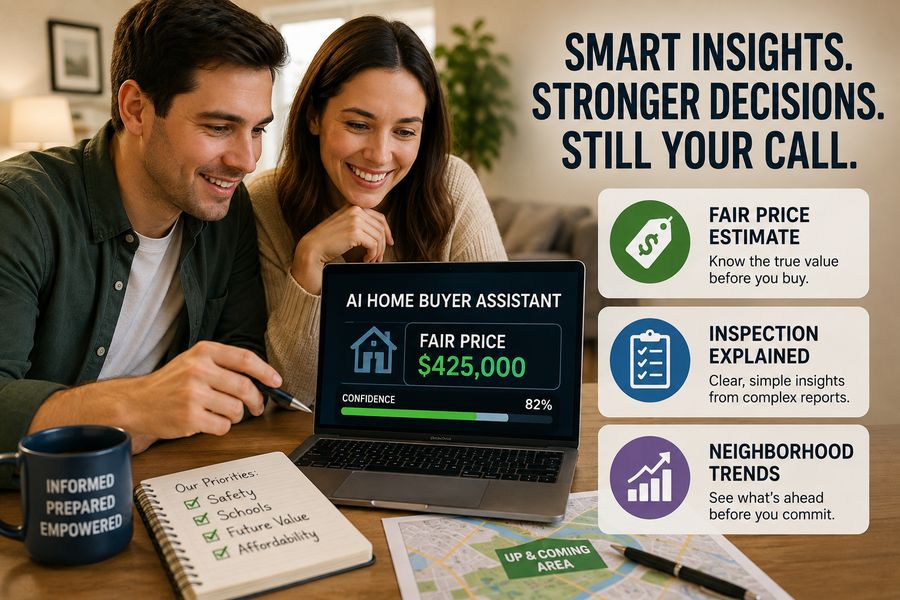
Buying a first home has always meant absorbing a flood of unfamiliar information in a short window of time. A buyer has to judge whether a listing price is realistic, whether a fourteen-page inspection report hides a costly problem, and whether a neighborhood that looks appealing today will still feel that way in five years. Real estate agents, appraisers, and inspectors have traditionally supplied that judgment, but their availability, cost, and regional focus mean a buyer often has to make partial decisions with incomplete context, especially in a fast-moving market where offers are due within days of a showing.
Artificial intelligence has moved into that gap over the past several years, not by replacing the people involved in a transaction but by making their information more digestible and more available earlier in the process. Automated valuation models now estimate a home’s fair price using millions of comparable sales, tax records, and property characteristics, updating those estimates far more frequently than a human appraiser could. Natural language tools can take a lengthy, jargon-filled inspection report and turn it into a plain-language summary that flags the issues most likely to matter for negotiation. Predictive analytics platforms model how a neighborhood’s prices, school ratings, and demand are likely to shift, giving buyers a forward-looking view that used to require a local expert’s intuition.
These tools are genuinely useful, and their accuracy has improved measurably in recent years as companies like Zillow and Redfin have rebuilt their pricing engines around neural networks and larger training datasets. At the same time, the same automation that makes these estimates fast and widely available has also drawn scrutiny from federal regulators, who have documented that valuation algorithms can embed and even amplify long-standing biases in housing data. That tension sits at the center of this article: AI has become a legitimately useful research assistant for first-time buyers, but it works best when treated as one input among several rather than as a final verdict.
The stakes of getting this process right are unusually high for a first-time buyer specifically. Unlike a repeat buyer who can draw on the equity from a previous home and a track record of having survived one closing already, a first-time buyer is typically stretching a limited down payment, navigating mortgage terminology for the first time, and making a decision that will shape their monthly budget for years or decades. A pricing mistake, a missed inspection issue, or a neighborhood that underperforms expectations does not just cost money; it can affect a buyer’s ability to relocate for a job, absorb an emergency expense, or build equity at the pace they had planned around. That combination of limited experience and high financial exposure is exactly why tools that widen access to reliable information matter more for this group than for almost any other participant in the housing market.
This article walks through how these tools function, where their numbers come from, and how a first-time buyer can use them intelligently. It looks at pricing tools like Zillow’s Zestimate and the Redfin Estimate, at AI-assisted inspection report summarizers, and at neighborhood forecasting platforms, before turning to the documented risks of over-relying on automated valuations and the regulatory response those risks have produced. Along the way, it draws on real, verifiable examples with published dates and metrics, because a first-time buyer deciding how much weight to give an algorithm deserves evidence rather than marketing claims. By the end, the goal is not to convince a reader that AI can make the decision for them, but to show how these tools can sharpen their own judgment instead of substituting for it.
How AI Is Changing the Way Buyers Approach the Market
A decade ago, a prospective buyer’s research process was largely manual: browsing listing photos, driving through neighborhoods, and relying on an agent’s read of recent comparable sales. Much of that still happens today, but it now happens alongside a layer of automated analysis that was not widely available to consumers before the mid-2010s. Real estate portals began publishing algorithmic price estimates to the public, mortgage lenders started using automated valuation models to speed up underwriting, and inspection software companies began experimenting with machine learning to process the photos and notes inspectors generate on-site. Each of these developments addressed a specific bottleneck: price estimates addressed the difficulty of judging fair value without professional training, inspection tools addressed the density and inconsistency of inspection reports, and forecasting tools addressed the fact that most buyers have no reliable way to estimate what a neighborhood will look like several years out.
This progression did not happen all at once, and it did not happen evenly across every part of the country. Dense metro areas with large volumes of public sales data saw these tools mature first, simply because the underlying models had more data to train on and more transactions to validate their predictions against. Smaller markets and rural areas, where home sales are less frequent and public records are sometimes incomplete or inconsistently formatted, have generally seen AI-driven tools arrive later and perform less reliably, a pattern that shows up directly in the regional error-rate differences discussed later in this article. Understanding that unevenness matters for a first-time buyer, because the usefulness of any given tool depends heavily on where they are actually shopping, not just on the tool’s national reputation.
What changed more recently is the underlying technology powering these tools. Earlier automated valuation models relied on comparatively simple statistical regressions built from a limited set of variables, such as square footage, bedroom count, and recent sales within a fixed radius. Newer systems use neural networks trained on far larger datasets that can weigh dozens or hundreds of variables simultaneously, picking up on patterns that a simpler model would miss, such as how a specific architectural style trades at a premium in one micro-market but not in the next town over. This shift mirrors what happened in other consumer-facing industries during the same period, where machine learning models replaced rule-based systems for tasks like fraud detection and product recommendations.
For a first-time buyer, the practical effect of this shift is that a meaningful amount of research that used to require a licensed professional, a paid subscription, or weeks of self-directed learning is now available instantly and often at no cost. A buyer can pull up a price estimate, a school-quality trend line, and a summary of comparable sales before ever contacting an agent. That does not eliminate the value of an agent, an appraiser, or an inspector; it changes the order in which a buyer engages with them, letting a buyer walk into those conversations with a baseline understanding rather than a blank slate.
This shift has also changed the pace at which buyers are expected to move. In competitive markets, offers are frequently due within days of a listing going live, which leaves little time for the kind of extended, independent research a buyer might once have conducted over several weeks. AI-driven tools compress that research timeline by surfacing a price estimate, a market trend, or a comparable-sales summary within seconds rather than requiring a buyer to track down and interpret public records manually. That speed is a double-edged benefit: it lets a prepared buyer act quickly and confidently, but it can also tempt a less experienced buyer into treating a fast answer as a complete one, which is precisely why understanding how these tools work, not just what they output, matters as much as the numbers themselves.
The sections that follow examine three specific categories of tools that illustrate this shift: pricing models, inspection-report summarizers, and neighborhood forecasting systems, each of which now plays a distinct role in how a first-time buyer prepares to make an offer.
Estimating Fair Prices: Automated Valuation Models Explained
An automated valuation model, commonly abbreviated as an AVM, is a statistical or machine learning system that estimates a property’s market value using available data rather than a physical walkthrough. Instead of a human appraiser visiting a home and comparing it to a handful of recently sold properties nearby, an AVM ingests tax assessor records, multiple listing service data, prior sale prices, square footage, lot size, and, in more advanced versions, satellite imagery and street-level photos, then runs that information through a model trained on millions of past transactions. The output is a single estimated value, often accompanied by a confidence range that reflects how much sales data exists for that specific area.
The term AVM predates the current wave of AI-driven real estate tools by decades; simple statistical valuation models have been used internally by lenders and appraisers since at least the 1990s. What has changed more recently is both the sophistication of the underlying models and their public availability. Where earlier AVMs were largely back-office tools used by mortgage professionals, consumer-facing versions like the Zestimate and the Redfin Estimate have made the same category of analysis directly accessible to anyone browsing a listing, without requiring an account, a fee, or a professional credential.
The accuracy of an AVM depends heavily on how much reliable data is available for a given market. In dense suburban areas with frequent home sales and consistent public records, AVMs tend to perform well because the model has many recent, comparable transactions to learn from. In rural areas, markets with unusual housing stock, or regions where sales data is sparse or inconsistently reported, the same model can produce estimates that are off by a wide margin. This is why every major AVM provider publishes a median error rate rather than claiming a fixed level of precision, and why that error rate is typically much lower for homes currently listed for sale, where the algorithm can incorporate live market signals, than for homes that are not on the market at all.
For a first-time buyer, understanding this distinction matters more than memorizing a single accuracy figure. An AVM estimate is a statistically informed starting point, not an appraisal, and it is most useful when a buyer treats it as a way to sanity-check a listing price rather than as the final word on what a home is worth. A listing priced dramatically above or below the AVM estimate is not necessarily wrong, but it is worth asking why the gap exists, whether the model is missing a recent renovation, an unusual lot, or a hyperlocal trend that a local agent would know about firsthand.
It is also worth understanding what an AVM cannot see. These models rely almost entirely on structured data such as square footage, bedroom and bathroom counts, lot size, and sale history, along with whatever photos and listing descriptions are available. They generally cannot account for the condition of a roof that looks fine in a photo but is nearing the end of its lifespan, the quality of a recent renovation versus a cosmetic one, or subjective factors like unusually good natural light or a poorly designed floor plan. This is one reason AVMs perform far better as a directional check than as a precise valuation for any single property, and why the gap between an AVM estimate and an eventual sale price tends to be largest for homes with unusual features or recent, significant renovations that have not yet been reflected in public records.
The two most widely used consumer-facing AVMs in the United States, Zillow’s Zestimate and the Redfin Estimate, both publish their methodology and their error rates openly, which makes them useful case studies for understanding what these tools can and cannot do.
Inside the Numbers: Zillow and Redfin’s Neural Network Models
Zillow rebuilt its Zestimate around a neural network architecture, a shift the company documented on its own research pages as part of what it describes as the most significant overhaul of the tool since its 2006 launch. According to Zillow’s published methodology, the new model draws on a much larger set of home facts and market signals than the earlier statistical version, and it produces estimates for roughly 125 million homes across the country. Zillow reports that the median error rate for off-market homes, meaning homes not currently listed for sale, has fallen to approximately 6.9 to 7 percent, while the median error rate for homes currently on the market is about 1.8 to 1.9 percent. Those numbers mean that for a typical on-market listing, the Zestimate lands within roughly two percent of the eventual sale price half of the time, a level of precision that would have been unusual for a purely automated tool a decade earlier.
Redfin publishes comparable figures for its own AVM, the Redfin Estimate, which the company says draws on more than 500 data points per market, combining MLS listings, tax records, and prior sales. Redfin reports a median error rate of about 1.86 percent for on-market homes and roughly 7.3 percent for off-market homes, figures that closely track Zillow’s published numbers and suggest the two companies have converged on similar levels of accuracy using similar categories of underlying data. Both companies are explicit that accuracy varies substantially by geography; Redfin has reported that its off-market error rate ranges from under 4 percent in data-rich markets like Colorado to well over 13 percent in markets with thinner sales data, such as Vermont. That regional spread is a useful reminder for a first-time buyer: an AVM’s headline accuracy figure is a national average, and the real precision in any specific neighborhood could be meaningfully better or worse.
What this comparison shows is that AVM accuracy has become a genuinely competitive, publicly tracked metric rather than a vague marketing claim, and that the leading tools have improved measurably as they adopted machine learning techniques over simpler statistical models. Zillow has noted that relative error rates for its model have declined by more than 15 percent nationally since the neural network overhaul, an improvement the company attributes directly to the larger feature set and pattern recognition the newer architecture allows compared with the linear regression techniques it replaced. That kind of measurable, company-reported progress is unusual in consumer software generally, and it reflects genuine competitive pressure between the two firms to publish credible, defensible numbers rather than inflated accuracy claims.
It also underscores why both companies still describe their tools as estimates rather than appraisals, and why lenders continue to require a licensed appraisal before finalizing a mortgage. A buyer using either tool gets a reasonable, data-backed starting point for a price conversation, not a substitute for the professional valuation that ultimately determines whether a lender will approve a loan at the agreed price.
Decoding Inspection Reports with AI
A professional home inspection typically produces a report running anywhere from twenty to more than a hundred pages, organized by system: roofing, plumbing, electrical, HVAC, foundation, and so on. Each section is usually written in a mix of technical language and inspector shorthand, accompanied by dozens of photographs, and the overall document rarely ranks its findings by urgency or cost. For an experienced buyer or investor, this format is workable because they know which categories of issues are minor and cosmetic and which ones are expensive or safety-critical. For a first-time buyer encountering an inspection report for the first time, the sheer length and technical density can make it difficult to separate a five-hundred-dollar repair from a problem that could cost tens of thousands of dollars to fix.
The format of these reports has historically varied a great deal from one inspector to the next, since no single national standard dictates exactly how findings must be organized, worded, or illustrated. One inspector might rank issues by severity using a simple color code, while another produces a purely narrative report with photos embedded throughout and no explicit prioritization at all. That inconsistency compounds the difficulty a first-time buyer faces, because the skill of reading an inspection report efficiently is not just about understanding construction terminology, it is also about learning to navigate whatever particular format a given inspector happens to use, often for the first and only time during the handful of home purchases a person makes in a lifetime.
AI-assisted tools have started to address this specific gap by parsing inspection reports and generating condensed, plain-language summaries. Some of these tools work on the inspector’s side, helping them produce clearer, more consistent reports in the first place, while others work directly for the buyer, ingesting a completed PDF report and extracting the findings that are most likely to affect negotiation or long-term cost. The value of these tools is not that they replace the inspector’s expertise; a report summarizer has no ability to physically examine a crawlspace or test an electrical panel. Their value is in translation: taking a document written for professional record-keeping and restating it in terms a first-time buyer can act on quickly, particularly during the short window most purchase contracts allow for requesting repairs or a price adjustment after inspection.
This translation layer matters because inspection contingencies typically run on tight deadlines, often seven to ten days from contract acceptance, during which a buyer has to decide what to ask a seller to fix, credit, or walk away over. A buyer who can quickly identify which findings are structural or safety-related versus which are routine maintenance items is in a stronger position to negotiate effectively within that window, rather than either overreacting to a long list of minor issues or missing a significant one buried in dense technical language.
The stakes of misreading an inspection report are not evenly distributed across issue types. A loose handrail or a missing smoke detector cover is inexpensive to remedy and rarely worth jeopardizing a purchase over, while a foundation crack, an aging roof nearing the end of its service life, or outdated aluminum wiring can represent tens of thousands of dollars in eventual cost and, in some cases, a safety hazard that affects whether a home is insurable at a reasonable rate. A first-time buyer without prior experience reading these reports has no intuitive baseline for which category a given finding falls into, which is exactly the gap AI-assisted summarization tools are designed to help close by grouping and flagging items according to their typical severity and cost implications.
How AI Reads and Summarizes a Lengthy Report
Several companies now offer AI-assisted tools built specifically around inspection documentation. Property Inspect, a home inspection software provider, built a feature called InspectAI directly into its platform, using AI to help generate clearer, more consistent report language from an inspector’s photos and field notes, and to auto-transcribe and complete portions of a report through what the company calls its Smart Fill service. This kind of tool sits primarily on the inspector’s side of the transaction, but it illustrates the broader trend: machine learning is being applied to make inspection documentation more structured and readable from the moment it is created, rather than only after the fact.
The mechanics behind tools like this generally involve two distinct AI capabilities working together. Computer vision models analyze the photographs an inspector takes on-site to help identify and categorize common issues, such as visible water staining, cracked masonry, or corrosion, while natural language models handle the writing side, converting an inspector’s shorthand notes or dictated observations into clear, complete sentences consistent with professional reporting standards. Because the inspector remains the one making the actual judgment calls about severity and cause, this kind of tool functions as an efficiency layer for professionals rather than as an independent evaluator of a home’s condition, which is an important distinction from the buyer-facing summarization tools discussed next.
On the buyer-facing side, a newer category of tools allows a buyer to upload a completed inspection report and receive an automated summary that groups findings by system and flags items that commonly warrant further attention or a licensed contractor’s estimate. These tools generally work by extracting text from the PDF, categorizing findings using a language model trained to recognize common inspection terminology, and presenting the results in a condensed format. Because this is a relatively young category of consumer software, buyers should treat the summaries these tools produce as a starting point for questions to ask an inspector or contractor directly, rather than as a substitute for reading the full report or having a professional walk through the findings verbally, which most inspectors already offer as part of their standard service.
Several apps in this category, including tools marketed under names like Inspection AI Analyzer and HomeInsight AI, allow a buyer to upload a report and receive a free or low-cost first analysis, often as a way to demonstrate the product before offering paid, more detailed versions. The specific companies and offerings in this space are likely to keep shifting as the category matures, but the underlying function they perform, translating a dense professional document into something a non-expert can act on quickly, is likely to remain valuable regardless of which particular app a buyer chooses to use for it.
Other tools take a more buyer-facing approach, allowing someone to upload a completed inspection PDF directly and receive an automated breakdown of findings, sometimes paired with rough repair-cost estimates pulled from regional pricing data. Because these tools are a relatively young category compared with established pricing AVMs, their accuracy in estimating repair costs varies more widely and should be treated as a rough planning figure rather than a contractor-grade quote, particularly for anything involving structural, electrical, or major mechanical systems where a licensed professional’s in-person assessment remains the only reliable basis for a firm number.
Taken together, AI-assisted inspection tools are most useful as a triage mechanism. They help a buyer move quickly from a dense document to a short list of items worth investigating further, which is particularly valuable given how little time most purchase contracts allow for the inspection contingency period. They do not replace the inspector’s on-site judgment, and a first-time buyer is still well served by asking the inspector direct questions about anything the summary flags as significant, since nuance about severity and repair urgency often does not survive automated summarization intact.
Forecasting Neighborhood Trends Before You Buy
Beyond estimating what a specific home is worth today, a growing set of AI-driven tools attempt to forecast where a neighborhood’s market is heading over the next several years. These platforms typically combine historical price trends, permitting and construction activity, school performance data, demographic shifts, and local economic indicators like employment growth, then apply machine learning models to project future appreciation or demand. Some of this functionality has been folded into the same portals that offer home price estimates, appearing as neighborhood-level trend charts or market health scores, while other tools are built specifically for this purpose and marketed toward both individual buyers and real estate investors evaluating multiple markets at once.
The appeal of this kind of forecasting for a first-time buyer is straightforward: a home purchase is typically the largest financial commitment a person makes, and most buyers plan to stay in the home for at least several years, which means the trajectory of the surrounding area matters as much as the home’s current condition. A neighborhood with strong projected appreciation, improving school ratings, and rising local employment offers a different risk profile than one with flat or declining indicators, even if the two homes are priced similarly today. Forecasting tools attempt to make that comparison visible earlier in the search process, before a buyer has narrowed down to a short list of specific listings.
These platforms typically work by training a model on years or decades of historical data for a given metro area or zip code, then identifying which combination of factors, such as building permit volume, median days on market, migration patterns, or wage growth, has historically preceded periods of above-average or below-average appreciation. Some tools present this as a simple trend line or a market health score, while others break the forecast down by category, separating a projection for price appreciation from one for rental demand or population growth, which allows a buyer to weigh the specific factors that matter most for their own situation, such as resale timeline versus long-term rental potential if their plans change.
That said, neighborhood forecasting is inherently less precise than pricing a specific, physically inspectable home, because it requires projecting forward rather than estimating a present value from existing data. Local markets can shift due to a single large employer relocating, a new transit line, a zoning change, or a shift in interest rates that changes what buyers nationally can afford, none of which a historical trend model can fully anticipate. A model trained primarily on historical patterns is, by construction, better at describing what has already happened than at predicting a genuinely novel shift, which is exactly the kind of event that most dramatically changes a neighborhood’s trajectory.
Buyers should treat neighborhood forecasts the way they would treat any economic projection: directionally informative, useful for comparing multiple areas against each other, but not a guarantee. The most responsible use of these tools is comparative rather than absolute, helping a buyer weigh one neighborhood against another rather than treating a specific projected appreciation percentage as a fact about the future. Combined with a conversation with a local agent who can explain what is actually driving those numbers on the ground, whether it is genuine underlying demand or a temporary shortage of listings, a forecasting tool becomes a genuinely useful part of due diligence rather than a source of false precision.
The Risk of Over-Trusting the Algorithm: Bias and Regulation
The same automation that makes AI-driven valuation tools fast and widely accessible has also drawn sustained scrutiny from housing researchers and federal regulators, because the data these models train on reflects decades of documented inequities in how homes have been valued and appraised in the United States. Research published in HUD’s Cityscape journal has found that even after data quality improvements and the adoption of machine learning, automated valuation models continue to yield larger valuation errors in majority-Black neighborhoods than in other areas, a pattern that mirrors long-documented disparities in traditional, human-conducted appraisals. Because an algorithm’s output can appear objective and precise even when it is built on biased historical inputs, researchers and consumer advocates have warned that automated tools can make bias harder to identify and correct, not easier, since a number on a screen carries an appearance of neutrality that a subjective human judgment does not.
This concern is not merely theoretical. Appraisal bias in the traditional, human-conducted process has been documented for decades through paired-testing studies and individual cases where identical homes received markedly different valuations depending on the racial composition of the neighborhood or, in some documented instances, on whether evidence of the homeowners’ race was removed from the home before a second appraisal. Because AVMs are trained on exactly the historical appraisal and sales data that these disparities are embedded in, a model can absorb those patterns mathematically even without any explicit reference to race in its inputs, simply by learning that certain neighborhoods have historically sold for less relative to comparable homes elsewhere and treating that pattern as predictive rather than as a symptom of historical discrimination.
Federal regulators responded to these concerns directly. In February 2022, the Consumer Financial Protection Bureau outlined a proposal, developed jointly with the Federal Reserve, the FDIC, the Federal Housing Finance Agency, the National Credit Union Administration, and the Office of the Comptroller of the Currency, to establish quality control standards for automated valuation models used in mortgage lending, specifically aimed at preventing discriminatory outcomes. The proposal was explicit about the underlying mechanism of concern: because AVMs are trained on historical sales and appraisal data, and because that historical data reflects decades of documented discriminatory practices in how homes in certain neighborhoods were valued, a model can reproduce those patterns at scale even when no individual decision-maker intends any discriminatory outcome.
That proposal moved through the federal rulemaking process over the following two years, and the agencies issued a final rule, titled Quality Control Standards for Automated Valuation Models, on June 24, 2024. The rule was published in the Federal Register on August 7, 2024, with an effective compliance date of October 1, 2025, and it requires mortgage originators and secondary market issuers that rely on AVMs to adopt policies ensuring high confidence in valuation estimates, protect against data manipulation, avoid conflicts of interest, and comply with applicable nondiscrimination laws, including through practices like random sample testing of model outputs. The rule applies specifically to the AVMs lenders use internally during mortgage underwriting rather than to consumer-facing tools like the Zestimate or the Redfin Estimate, but the underlying concern, that a model trained on biased historical data can reproduce that bias at scale, applies to any AVM regardless of who is using its output.
For a first-time buyer, this regulatory history is a useful corrective to the idea that an algorithmic price estimate is inherently more objective than a human one. It is not that AVMs are unreliable in general, since the accuracy figures published by Zillow and Redfin show real, measurable precision in most markets. The concern regulators have documented is narrower but important: valuation algorithms can inherit and sometimes compound biases present in the historical data they are trained on, particularly in neighborhoods with a history of discriminatory appraisal practices. A buyer, especially one purchasing in a historically underserved neighborhood, benefits from knowing that this is a recognized, regulated risk rather than a fringe concern, and that lenders are now under a specific federal mandate to test their valuation models for exactly this kind of disparity.
That knowledge does not mean discarding AVM estimates, but it does support the broader argument running through this article: an algorithm’s number is a data point to weigh against other sources, including a licensed appraiser and a knowledgeable local agent, not a figure to accept uncritically simply because it came from a model rather than a person. A buyer who understands this history is also better positioned to ask a lender or agent informed questions, such as how a given valuation was reached and whether it has been cross-checked against a human appraisal, rather than assuming a single automated figure closes the conversation.
How Buyers Can Use AI Without Surrendering Judgment
Given both the genuine usefulness and the documented limitations of these tools, the practical question for a first-time buyer is how to incorporate AI-generated insights into a decision without letting an algorithm make the decision for them. The starting point is recognizing what each type of tool is actually built to do. A price estimate is a statistical approximation drawn from comparable data, useful for sanity-checking a listing but not a substitute for an appraisal a lender will require anyway. An inspection summary is a triage aid that highlights what to ask about, not a replacement for the inspector’s own explanation of severity and urgency. A neighborhood forecast is a comparative signal for weighing one area against another, not a guarantee about a specific home’s future value. Holding these boundaries clearly in mind is what allows a buyer to use the outputs productively rather than treating any single number as authoritative.
This does not require a buyer to become a data scientist or to understand the internal mechanics of a neural network. It requires a habit of asking what a given tool was actually designed to measure, and whether the current situation falls within the range of conditions it handles well. A price estimate for a standard single-family home in a data-rich suburb is operating well within its design parameters; the same tool applied to a converted warehouse loft in a market with few comparable sales is being pushed well outside them, and a buyer who recognizes that distinction is far better equipped to weigh the number appropriately than one who treats every output with the same level of confidence.
From there, the most effective approach is to use AI tools to generate questions rather than answers. If a Zestimate or Redfin Estimate differs meaningfully from a listing price, the useful next step is asking an agent why, not assuming the algorithm or the seller is correct. If an inspection summary flags a roofing issue as significant, the useful next step is asking the inspector or a roofing contractor for a direct assessment and a repair estimate, not accepting the AI-generated severity label at face value. If a neighborhood forecasting tool shows strong projected appreciation, the useful next step is asking a local agent what is actually driving that projection, whether it is new transit access, a large employer moving in, or simply a temporary shortage of listings, since the underlying cause matters more than the projected number itself.
It also helps to remember that the people involved in a real estate transaction, agents, inspectors, appraisers, and loan officers, are still bound by professional standards, licensing requirements, and in the appraiser’s case, the same federal fair-lending framework that now explicitly covers automated tools as well. AI does not remove the value of those professionals; it changes when and how a buyer engages them, letting a buyer arrive at those conversations already informed rather than starting from zero. A first-time buyer who reviews a price estimate, an inspection summary, and a neighborhood trend chart before meeting with an agent is better positioned to ask sharp, specific questions than one who walks in without any independent research.
A useful habit is to write down, before each meeting with an agent, inspector, or lender, the two or three specific gaps between what an AI tool suggested and what common sense or local context might explain. If a price estimate seems low for a home that was clearly renovated recently, that gap is worth naming directly rather than silently discounting the estimate or the listing price. If a neighborhood forecast looks stronger than a buyer expected given what they know about the area, asking why can reveal either a genuine opportunity or a data quirk, such as a small number of recent sales skewing the trend line. This habit of naming specific discrepancies, rather than either blindly trusting or dismissing an AI output, is what turns these tools into a genuine aid to judgment rather than a source of either false confidence or unwarranted suspicion.
Used this way, AI functions as preparation for human judgment rather than a replacement for it, which is precisely the balance regulators, researchers, and the platforms themselves have converged on as these tools have matured.
Benefits and Limitations by Stakeholder
The value of AI-driven real estate tools looks different depending on which party in the transaction is using them, and understanding those differences helps a first-time buyer calibrate how much weight to give any single output. For buyers, the clearest benefit is speed and access: research that once required a paid subscription, a personal connection to an agent, or specialized training is now available instantly, often at no cost, which levels the playing field somewhat for buyers without existing real estate expertise or industry contacts. The corresponding limitation is that a buyer without domain expertise may struggle to judge when an AI-generated number should be trusted and when it should be questioned, particularly in markets with thin sales data where AVM error rates climb well above the national average.
This same tension shows up across every category of tool discussed in this article, not just pricing. A buyer benefits from a fast inspection summary but may not know when a flagged item genuinely warrants walking away from a deal versus simply negotiating a credit. A buyer benefits from a neighborhood forecast but may not have the local context to know whether a projected slowdown reflects a real economic shift or a temporary blip in a small dataset. In each case, the tool provides useful raw material, but interpreting that material correctly still depends on either the buyer’s own developing judgment or a professional’s input, which is why the stakeholder comparison below is as much about who fills that interpretive gap as it is about who benefits from the raw speed AI provides.
For real estate agents, AI tools have generally proven complementary rather than threatening, since they shift a portion of routine research online, freeing agents to focus on negotiation, local market nuance, and the interpersonal aspects of a transaction that automated tools cannot replicate, such as reading a seller’s motivation or navigating a multiple-offer situation. The limitation for agents is that clients now sometimes arrive with strong opinions formed by an algorithm, which occasionally requires an agent to spend time correcting a misplaced assumption rather than building understanding from scratch.
For lenders and appraisers, AVMs have sped up parts of the underwriting process, particularly for refinances and lower-risk transactions where a full appraisal may not be strictly necessary. The limitation, as the 2024 interagency rule makes explicit, is that this efficiency comes with a regulatory obligation to test these models for exactly the kind of bias that HUD-funded researchers have documented, meaning lenders cannot treat automation purely as a cost-saving measure without also building in the oversight the rule now requires.
For sellers, AI-driven pricing tools create a baseline expectation that can work for or against them: a home priced well above its AVM estimate may face more buyer skepticism than it once would have, since buyers now routinely check a listing against a public estimate before ever contacting an agent, while a well-maintained home in a data-sparse market may be undervalued by the same tools, making a knowledgeable agent’s counter-argument more important, not less, in justifying a price above what an algorithm suggests. Inspectors, for their part, generally benefit from AI-assisted documentation tools that reduce the time spent on report writing and formatting, though the core value they provide, the physical, hands-on assessment of a property’s condition, remains entirely outside what any current automated tool can replicate.
Across every stakeholder, the pattern is consistent: AI tools handle scale and speed well, while judgment, negotiation, and fairness still require human oversight.
Final Thoughts
AI has genuinely changed what a first-time buyer can know before they ever pick up the phone to call an agent, and that shift represents a meaningful expansion of access rather than a gimmick layered on top of an unchanged process. A buyer today can check a price estimate against a listing, get a plain-language read on an inspection report’s most pressing findings, and compare neighborhoods using data that used to require a paid analyst or years of local experience to assemble. That represents real democratization of information that historically favored buyers with existing industry connections or the resources to hire that expertise directly, and it matters most for exactly the population this article is written for: people navigating the largest purchase of their lives for the first time, often without a family member or friend who has recently been through the process to lean on.
That expansion of access carries real social weight because housing has long been a domain where information asymmetry compounded existing inequality, with buyers who lacked access to expert guidance frequently paying more, negotiating less effectively, or missing red flags that a more informed buyer would have caught. Tools that make fair-price estimates, inspection insights, and market forecasts broadly available in seconds, at no cost, work against that historical pattern, at least at the level of raw information access, and they do so for a population, first-time buyers without an established network of real estate contacts, that has historically borne the brunt of that asymmetry most directly.
But the same chapter of this article that covers documented bias in valuation algorithms is a reminder that technology does not automatically correct inequities baked into decades of housing data; left unchecked, it can just as easily launder them behind a veneer of mathematical objectivity. A number generated by a neural network can look more authoritative than a human appraiser’s judgment precisely because it appears precise and impartial, even when the data underneath it carries the same historical fingerprints that shaped decades of discriminatory appraisals. The 2024 interagency rule on automated valuation models exists precisely because regulators recognized that risk and decided it required an enforceable response rather than a voluntary best practice, and its arrival is itself evidence that the promise and the risk of this technology are now being taken equally seriously at the policy level.
The responsible path forward, both for the companies building these tools and the buyers using them, runs through exactly the kind of layered approach this article has described: automated estimates paired with professional verification, AI-generated summaries paired with direct conversations with inspectors and agents, and forecasting tools paired with local expertise that can explain the story behind the numbers. None of that requires distrust of the technology itself; Zillow and Redfin’s published accuracy improvements show these models genuinely work better than they did even a few years ago, and inspection summarizers and forecasting platforms provide real value in the narrow, well-defined tasks they are built for. What it requires is a first-time buyer who understands the difference between a tool that informs a decision and a tool that makes one, and who uses AI accordingly, as a research assistant that accelerates preparation rather than an authority whose output goes unquestioned. Held to that standard, AI is likely to keep making the home-buying process more transparent for exactly the buyers who have historically needed that transparency most.
FAQs
- What is an automated valuation model, and how is it different from a home appraisal?
An automated valuation model, or AVM, is a computer program that estimates a home’s market value using data like tax records, recent comparable sales, and property characteristics, without a person physically visiting the property. A traditional appraisal is conducted by a licensed appraiser who inspects the home in person and is generally required by mortgage lenders before finalizing a loan, since it carries legal and professional accountability that an automated estimate does not. - How accurate are tools like the Zestimate and the Redfin Estimate?
Both companies publish their error rates: Zillow reports a median error of roughly 1.8 to 1.9 percent for homes currently on the market and about 6.9 to 7 percent for off-market homes, while Redfin reports a median error of about 1.86 percent for on-market homes and roughly 7.3 percent for off-market homes. Accuracy varies significantly by region depending on how much sales data is available in a given area. - Can I rely on a price estimate instead of getting a professional appraisal?
No. Lenders require a licensed appraisal to finalize most mortgages, and an automated estimate is not a legal substitute for that process. A price estimate is best used as an early sanity check on a listing price, not as a final determination of a home’s value. - What can AI-assisted inspection tools actually do?
These tools typically read a completed inspection report and generate a condensed, plain-language summary that groups findings by system and flags items that commonly warrant further attention, helping a buyer prioritize questions during a short inspection contingency period. They cannot physically inspect a home themselves, and severity judgments should still be confirmed directly with the inspector or a relevant contractor. - Are neighborhood forecasting tools reliable for predicting future home values?
They are useful for comparing multiple neighborhoods against each other using historical trends, school data, and local economic indicators, but they cannot fully account for sudden changes like a new employer moving in or a shift in interest rates. They should be treated as directionally informative rather than as a guarantee of future appreciation. - Is there evidence that AI valuation tools can be biased?
Yes. Research published through HUD’s Cityscape journal has found that automated valuation models continue to produce larger errors in majority-Black neighborhoods even after data and modeling improvements, reflecting patterns long documented in traditional appraisals as well. This is a recognized, studied issue rather than a fringe concern. - What did the federal government do about bias in automated valuation models?
In June 2024, six federal agencies, including the Consumer Financial Protection Bureau and the Federal Reserve, issued a final rule called Quality Control Standards for Automated Valuation Models, published in the Federal Register in August 2024 with a compliance date of October 1, 2025. It requires lenders using AVMs to test for bias, protect against data manipulation, and comply with nondiscrimination laws. - Should a first-time buyer trust an AI-generated price estimate over their agent’s opinion?
Neither should be trusted exclusively. A price estimate offers a fast, data-driven starting point, while an agent brings local market nuance, negotiation experience, and knowledge of factors an algorithm may not capture, such as a recent renovation or a hyperlocal trend. The two are most useful when compared against each other rather than treated as competing authorities. - Do these AI tools cost money to use?
Many of the most widely used consumer tools, including the Zestimate and the Redfin Estimate, are available for free on their respective platforms. Some specialized inspection-report summarizers and neighborhood-forecasting platforms charge for advanced features, though basic versions or limited free trials are often available. - What is the single most important thing a first-time buyer should remember when using AI tools?
Treat every AI-generated output as a starting point for a question, not as a final answer. Whether it is a price estimate, an inspection summary, or a neighborhood forecast, the most reliable approach pairs the algorithm’s output with a conversation with a qualified professional, such as an agent, inspector, or appraiser, before making a financial decision based on it.