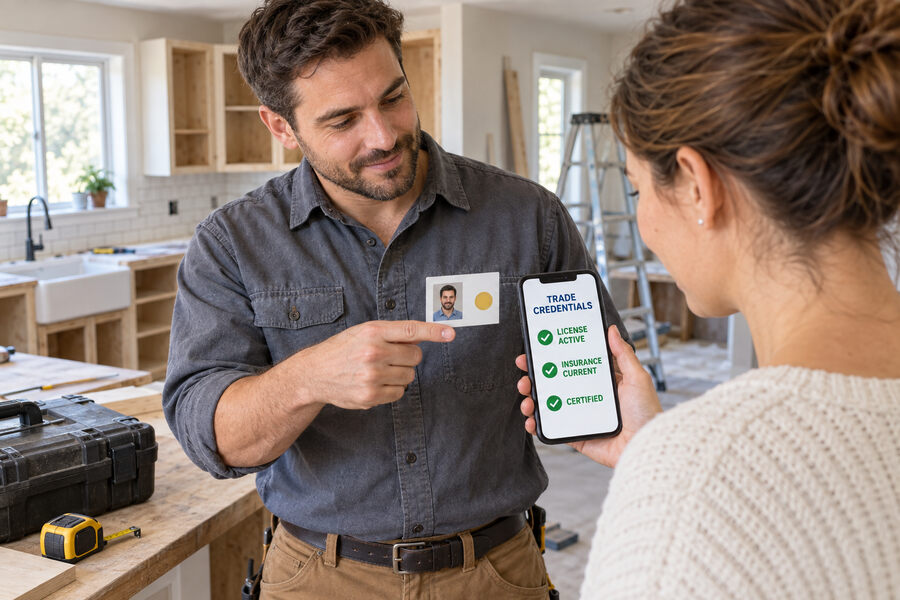
Hiring someone to work on a home is an act of trust that most people perform with surprisingly little verification. A homeowner searching for someone to rewire a panel, replace a roof, or build an accessory dwelling unit typically relies on a business card, a truck with a company logo, a handful of online reviews, and a verbal or written assurance that the person standing on the porch is properly licensed, bonded, and insured. Confirming that assurance independently has historically required real effort: looking up a license number on a state licensing board’s website, calling an insurance carrier to confirm a policy is still active, or simply taking the contractor’s word for it and hoping for the best. That gap between what a homeowner is told and what a homeowner can actually, easily confirm is where a great deal of consumer harm in the trades has traditionally lived, and it is the specific gap that a new generation of blockchain-based and cryptographically verifiable credentialing systems has begun trying to close.
The scale of the underlying problem is not a matter of speculation. Licensing boards across the country field tens of thousands of consumer complaints against contractors every year, insurance fraud tied to fabricated or lapsed coverage remains a well-documented drain on the construction industry specifically, and the most damaging cases, examined in detail later in this article, often involve a contractor whose license or bond status changed after a homeowner had already signed a contract and handed over a deposit, precisely the kind of real-time status change that a manual, one-time lookup at the start of a project cannot catch. Blockchain technology, which underlies a small but growing number of real, currently operating verification platforms, offers a structurally different approach: rather than a static record that a homeowner checks once and then has no way of monitoring, a blockchain-anchored credential can, in principle, be checked instantly at any time, by anyone with the right link or scan, and is designed to be resistant to the kind of quiet, after-the-fact tampering or fabrication that has undermined trust in paper certificates and PDF documents for decades.
It is worth being direct about the state of this technology before going further, because the phrase “verification on blockchain” has been used loosely enough in marketing materials across many industries that some skepticism is warranted before accepting any specific claim at face value. This article focuses on documented, currently operating systems with real users, real dates, and real figures behind them, rather than speculative pilots or blockchain branding applied to what is, on closer inspection, an ordinary centralized database. Some of the systems examined here genuinely use blockchain infrastructure as their technical foundation; others use conventional cryptographic verification and digital credentialing techniques that achieve some of the same practical goals without a public or permissioned blockchain specifically, and this article draws that distinction clearly rather than blurring it, because an honest account of where this technology actually stands is more useful to a homeowner or a tradesperson than an inflated one.
It is also worth situating this specific application within the broader arc of how blockchain technology has been discussed publicly over the past decade. Early, highly speculative claims about blockchain transforming nearly every industry overnight gave way, by the mid-2020s, to a more grounded, incremental reality in which the technology has found genuine, durable traction in a smaller number of specific, well-suited applications, credential and supply-chain verification prominent among them, precisely because these applications benefit specifically from tamper-evidence and cross-organizational trust rather than requiring the more exotic financial or computational properties blockchain is sometimes associated with in other contexts. Contractor and trade credential verification fits this narrower, more grounded category unusually well, since the core problem, multiple independent parties, a homeowner, a licensing board, an insurance carrier, needing to trust the same piece of status information without relying on any single one of them as the sole authority, is close to the specific problem blockchain architecture was originally designed to solve.
This article begins with the real-world cost of the verification gap this technology aims to close, using a well-documented 2024 contractor collapse in California alongside national complaint data to establish why this problem matters. It then walks through how homeowners and regulators verify credentials today, before explaining plainly what a blockchain-based verification system actually does differently. From there, it examines three real, currently operating systems: a blockchain-based network addressing the specific, chronic problem of fabricated insurance certificates in construction, a broader blockchain credentialing network relevant to trade certifications, and a digital, though not blockchain-specific, credential wallet built for the construction workforce. It closes with an honest assessment of what a homeowner scanning a single code can and cannot confirm today, and the structural barriers still standing in the way of a more complete system. No background in blockchain technology, insurance, or construction licensing is assumed.
The Real Cost of Unlicensed and Unverified Contractors
The consequences of inadequate contractor verification are not abstract, and one of the clearest illustrations comes from the collapse of Anchored Tiny Homes, a California-based accessory dwelling unit builder that shut its doors without notice in July 2024, leaving customers across the state without the homes, refunds, or answers they were owed. The company had built a substantial customer base marketing itself as a specialist in accessory dwelling units, a category of home construction that surged in demand across California following state legislative changes intended to ease housing shortages, and it collected deposits from homeowners that, according to subsequent reporting and regulatory findings, frequently ranged from 30 to 50 percent of a project’s total contract value, far exceeding the state’s legal limit on contractor deposits of $1,000 or 10 percent of the contract price, whichever amount is less.
As financial pressure on the company mounted, reporting on the collapse described a pattern in which Anchored Tiny Homes allegedly used deposits collected from new customers to cover obligations to earlier customers, a structure some coverage of the case compared to a Ponzi scheme, before the company filed for Chapter 7 bankruptcy revealing $12.8 million in liabilities against just $1.2 million in assets. More than 450 customers were reportedly affected, with individual reported losses ranging from roughly $32,000 to $40,000 in typical cases, one reported loss of $80,000, and at least one homeowner in Rohnert Park who reported losing $315,700 with nothing to show for it. California’s Contractors State License Board formally revoked the company’s license in December 2024, its investigation documenting systematic deposit violations, an absence of evidence that permits had been filed for most contracts, and funds that had been transferred out of dedicated project accounts, findings that came after the board had already suspended the company’s license once it discovered Anchored Tiny Homes had canceled its legally required contractor’s bond.
That last detail is the one most directly relevant to the argument for real-time, continuously verifiable credentials rather than a single point-in-time check: the company’s bond, a form of financial protection specifically meant to provide recourse to consumers if a licensed contractor fails to fulfill contractual obligations, had been canceled at some point during the company’s operation, a change in status that a homeowner who had checked the company’s licensing record months earlier, or even at the start of their own specific project, would have had no way of detecting without repeating that same manual lookup at exactly the right moment. The pattern visible in the Anchored Tiny Homes case, a business that appeared legitimate, held real licensing, and only later revealed the extent of its financial distress, recurs often enough in California regulatory enforcement records that consumer advocates have specifically warned homeowners against treating an active license check performed at the very start of a relationship as a permanent guarantee of a contractor’s ongoing financial health or continued compliance, advice that is sound but that also implicitly concedes the underlying tooling problem this article is centrally concerned with, since following that advice properly would require homeowners to repeatedly and manually re-check a contractor’s status throughout a project, a burden most people are not equipped or inclined to carry on their own without better supporting technology. This case is far from an isolated anomaly. California’s Contractors State License Board received more than 20,500 complaints against contractors in a recent year alone, a nearly 19 percent increase over the prior year, and unlicensed contracting is estimated to form a meaningful share of a broader underground construction economy in the state that researchers have placed somewhere between $60 billion and $140 billion annually. Nationally, the Federal Trade Commission recorded approximately 83,000 reports of home repair and improvement scams in 2023 alone, a figure that, combined with the roughly 2.7 in every 10,000 California homeowners the state estimates fall victim to a home improvement scam in a given year, establishes clearly that the gap between what a contractor claims and what a homeowner can verify is not a marginal, rarely encountered problem but a persistent, well-documented source of financial harm operating at meaningful scale across the country.
The Anchored Tiny Homes case is also instructive precisely because it does not fit the simplest, most intuitive version of this problem, an entirely unlicensed operator working with no oversight at all. The company held an active license for a substantial period of its operation, marketed itself prominently, and built a large, seemingly legitimate customer base before its bond cancellation and subsequent license revocation, meaning homeowners who did exactly what consumer advocates recommend, checking that a license existed and was active before signing a contract, would still have been exposed to the harm that followed, since that initial check could not have detected a status change that occurred later in the relationship. This is precisely why the distinction this article draws between one-time verification and continuous, real-time verification matters so much in practice: the existing system is not failing because homeowners are not checking anything at all, but because the checking tools available to them are structurally limited to a single moment in time, a limitation that affects even conscientious, well-informed consumers who follow every piece of standard advice currently available to them.
How Homeowners and Regulators Verify Credentials Today
Understanding what a blockchain-based verification system would actually improve requires an honest look at the tools already available to a homeowner today, because the existing system is not entirely without safeguards, even if those safeguards fall short in specific, well-documented ways. Every U.S. state that requires contractor licensing operates some form of public license lookup tool, typically a searchable database on the relevant licensing board’s website where a homeowner can enter a license number or business name and see whether a license is currently active, when it was issued, whether it carries any disciplinary history, and, in states like California, whether the associated bond is currently in force. These tools represent genuine, meaningful public infrastructure, and consumer advocates consistently recommend using them as a baseline first step before hiring any contractor for a significant project.
The practical limitations of this system are structural rather than a matter of any individual licensing board doing a poor job. A license lookup reflects the licensing database’s status at the exact moment a homeowner performs the search, meaning it can only be as current as the last time that record was updated, and, as the Anchored Tiny Homes case illustrates clearly, a status change, a canceled bond, a lapsed insurance policy, a newly filed complaint, can occur at any point after a homeowner’s initial check without that homeowner having any automatic way of learning about it unless they think to repeat the same manual lookup again later in the project, a step most homeowners understandably never think to take once work has already begun. Insurance verification specifically has proven even more difficult to manage reliably than license status, because a certificate of insurance, the standard document a contractor provides as proof of active coverage, is typically a static PDF or paper document generated at a single point in time by an insurance agent, and nothing about that document format prevents it from becoming outdated the moment a policy is later canceled, non-renewed, or modified, a gap that industry researchers have found is exploited often enough that fabricated or manipulated certificates of insurance represent a persistent and costly source of fraud specifically within the construction and logistics sectors, discussed in more detail in the case study below.
The result is a verification system that works reasonably well for confirming a snapshot in time but does not naturally extend into the kind of continuous, real-time assurance that would actually protect a homeowner across the full duration of a project, which can run for weeks or months after the initial hiring decision was made. This is precisely the structural gap that blockchain-based and other cryptographically verifiable credentialing systems are designed to address, not by replacing the underlying licensing boards and insurance carriers that create these records in the first place, but by changing how those records are stored, updated, and checked, a distinction explained in detail in the next section.
Trade-specific certifications add a further layer of complexity to this already imperfect picture, since a general contractor’s business license says nothing about whether the specific electrician or plumber physically performing specialized work on a given day holds the individual trade certification that work may legally require. Verifying an individual worker’s certification has traditionally depended on that worker, or their employer, voluntarily providing documentation, a wallet card, a certificate, a training provider’s printed transcript, that a homeowner has essentially no independent way to confirm is genuine, current, or even correctly matched to the person presenting it, short of contacting the issuing training organization directly, a step that all but the most determined homeowners are realistically ever going to take before work begins on a home renovation.
What “Verification on Blockchain” Actually Means
A blockchain is, at its core, a shared digital ledger maintained across a network of independent computers rather than stored on a single company’s private server, with new entries cryptographically linked to previous ones in a way specifically designed to make quietly altering a past record, without that alteration being detectable, extremely difficult. Applied to professional credentials, this structure offers two properties that are directly relevant to the verification gap described above: tamper-evidence, meaning any attempt to alter a previously recorded credential status leaves a detectable trace rather than silently overwriting the old record, and, in many implementations, the ability to reflect a status update, a canceled bond, a lapsed insurance policy, a suspended license, in a way that anyone checking the credential afterward will see, rather than only the specific database the update happened to be entered into.
The construction and insurance industries were, in this respect, comparatively well suited to early blockchain adoption compared with many other sectors that experimented with the technology during the same general period, precisely because both industries already depended heavily on multi-party documents, insurance certificates, lien releases, permits, and inspection records, whose value comes specifically from being trusted simultaneously by several independent organizations rather than serving any single company’s internal record-keeping needs alone, a use case blockchain architecture is particularly well matched to relative to purely internal business processes that never needed cross-organizational trust in the first place. It is important to be precise about what this technology does and does not automatically guarantee, since the term has been applied inconsistently across the broader technology industry. A blockchain does not, by itself, verify that the information entered into it was accurate in the first place; if a licensing board or insurance carrier enters incorrect information onto a blockchain-based system, that error is just as tamper-evident and just as difficult to quietly alter as accurate information would be, meaning the trustworthiness of the overall system still depends heavily on the integrity of whichever party is authorized to write new records onto it. What blockchain infrastructure specifically improves upon is the resistance of the record to unauthorized after-the-fact modification, and, in the better-designed implementations examined in this article, the ability to keep a credential’s status current in something close to real time by connecting the blockchain-based record directly to its original source, an insurance carrier’s own policy management system or a licensing board’s own database, rather than relying on a static, manually distributed document that a homeowner has no way of confirming has kept pace with the underlying reality.
This distinction, between a blockchain-based record that stays synchronized with its authoritative source and a document that is generated once and then frozen in time, is the single most important technical concept for understanding why the systems examined in the rest of this article represent a genuine improvement over the status quo rather than simply a more fashionable way of storing the same static information. A homeowner scanning a QR code or checking a link tied to a blockchain-anchored insurance certificate or trade credential is not looking at a snapshot from whenever that document happened to be generated; in a properly implemented system, they are looking at a record that reflects the credential’s actual, current status at the moment of the check, updated automatically whenever the underlying policy or license changes, which is precisely the continuous verification capability that a traditional paper certificate or a one-time database lookup cannot provide on its own.
A second useful technical distinction concerns who can write to the underlying ledger in the first place, since not every blockchain system is designed the same way in this respect. Some of the systems relevant to credential verification use what is generally called a permissioned blockchain, where only specifically authorized organizations, an accredited insurance carrier, a recognized training provider, a government licensing board, are allowed to add or update records, rather than the fully open, anyone-can-participate model associated with public cryptocurrency networks. This design choice matters directly for credential verification, since it means the system retains the tamper-evidence and cross-organizational trust benefits of blockchain architecture while still ensuring that only legitimate, accountable institutions can actually issue or modify a credential in the first place, addressing a reasonable concern that an entirely open system might otherwise struggle to prevent fraudulent entities from issuing convincing-looking but entirely fabricated credentials of their own.
Certificial and the Smart COI Network: Fixing the Insurance Blind Spot
The most extensively documented real-world application of this technology to the trades specifically addresses certificates of insurance, the standard proof-of-coverage document that contractors, subcontractors, and vendors routinely provide to homeowners, general contractors, and other parties requiring confirmation of active insurance coverage before work begins. Certificial, a company founded in 2019, launched what it describes as a blockchain-based real-time insurance verification platform built specifically to replace the static, easily outdated certificate of insurance with a continuously updated digital record, connecting directly to the data held by insurance agencies and carriers rather than relying on a document generated once and then distributed as a fixed PDF.
The scale of the problem this platform targets is itself a matter of public record: industry data cited in Certificial’s own published materials describes fraud rates as high as 25 to 30 percent for certificates of insurance that arrive directly from vendors rather than through a verified, carrier-connected channel, particularly within the construction and logistics industries specifically, a strikingly high figure that reflects how easily a static document can be altered, forged, or simply allowed to go stale without the requesting party’s knowledge. Certificial’s platform, branded the Smart COI Network, addresses this by connecting directly to insurance agency management systems, meaning a certificate issued through the network updates automatically whenever the underlying policy is renewed, modified, or canceled, rather than requiring a party to manually request an updated certificate and hope the contractor or subcontractor remembers to provide one.
The platform’s real-world scale and continued momentum are documented through a series of dated public announcements rather than vague marketing claims. On June 11, 2025, Certificial announced the official launch of its Vendor Management Partner Program, bringing together more than a dozen inaugural partners spanning transportation, real estate, construction, third-party risk management, procurement, and aviation, including named companies such as Truckstop, Achilles Global Risk Management, and Apex Analytix, each integrating with the Smart COI Network to give their own users real-time insurance visibility rather than relying on manually collected paperwork. Several months later, on October 14, 2025, Certificial announced a partnership with ACORD, the insurance industry’s global standards-setting body, whose standardized certificate-of-insurance format has served as the industry baseline since 1976, to develop what the companies jointly termed “Smart COIs,” digital certificates that update automatically whenever a policy is canceled, changed, or renewed, rather than requiring a new static document to be issued and redistributed by hand each time a change occurs. As of that October 2025 announcement, Certificial’s own published figures describe its Smart COI platform as supporting hundreds of thousands of agencies, enterprises, and vendors, with named client relationships including Zurich North America and PowerFlex documented in the company’s own published case studies.
For homeowners specifically, the direct, immediate relevance of a system like Certificial’s is less about consumer-facing use, since the platform is built primarily for business-to-business insurance verification between agencies, general contractors, and vendor management platforms, and more about what it demonstrates as a proof of concept: that real-time, continuously synchronized credential verification for the construction trades is not merely a theoretical proposal but an operating system already handling verification at meaningful scale for a substantial share of the U.S. commercial insurance market, addressing exactly the kind of after-the-fact status change, illustrated starkly by the canceled bond in the Anchored Tiny Homes case, that a one-time manual check cannot catch.
The network’s growth pattern is also worth noting for what it suggests about how this kind of infrastructure tends to actually spread through an industry once it reaches a certain threshold of adoption. Rather than launching with a single, comprehensive product aimed directly at consumers, Certificial built its network first around the specific businesses, insurance agencies and the large commercial entities that most frequently request certificates of insurance from their vendors and subcontractors, whose direct financial exposure to fraudulent or outdated certificates gave them the clearest, most immediate incentive to adopt a better verification method. Only after reaching meaningful scale within that business-to-business layer did the network begin forming the kind of standards-body partnership, with ACORD specifically, that could plausibly extend its reach toward the broader, more fragmented base of smaller agencies, individual contractors, and eventually, in principle, homeowner-facing verification tools, a sequencing pattern that offers a realistic template for how the trade-credential and licensing side of this technology might similarly need to mature in stages rather than arriving all at once as a single, fully realized consumer product.
Blockchain Professional Credentials Beyond Insurance: The Velocity Network
Insurance status is only one category of credential relevant to hiring a trustworthy contractor; underlying trade certifications, apprenticeship completions, and professional qualifications matter just as much, and a separate blockchain-based initiative has been built specifically to address the broader category of verifiable professional and educational credentials, of which trade certifications form one part. The Velocity Network Foundation was established in January 2020 when fourteen organizations from across the human capital management and education technology industries came together to build what the foundation describes as an “Internet of Careers,” a blockchain-based public permissioned network designed to let individuals claim, control, and share verified records of their education, work history, skills assessments, and professional credentials without depending on any single centralized company to hold and gatekeep that data.
The network reached a significant operational milestone on March 1, 2022, when the Velocity Network Foundation announced the successful launch of its mainnet, the live, fully operating version of its blockchain network, moving the project from a development and testing phase into a functioning system that member organizations could begin building real credential-issuance and verification services on top of. According to the foundation’s own published figures, its founding member organizations collectively hold career-related data, encompassing professional and student credentials, skills assessments, and employment records, for more than 700 million individuals across their existing systems, giving a sense of the scale of the underlying data ecosystem the network was designed to eventually connect and make independently verifiable, even though the number of credentials actually issued and verified through the live blockchain network itself at any given point represents a smaller, actively growing subset of that broader founding-member data pool.
The relevance of a network like this to trade credentials specifically lies in its designed architecture rather than in a claim that it was built exclusively, or even primarily, for the construction trades. The Velocity Network’s model, individuals holding a portable, cryptographically verifiable digital credential wallet that can include any type of verified qualification, an apprenticeship completion, a safety certification, a trade license, and sharing specific credentials selectively with whichever employer, general contractor, or homeowner needs to confirm them, represents the same underlying architectural pattern that a more complete, contractor-specific verification system would need: a credential that lives with the individual tradesperson rather than being scattered across dozens of separate licensing boards, training providers, and certifying bodies, each maintaining its own disconnected record with no shared, homeowner-friendly way to check all of them at once. Whether the trades sector specifically adopts the Velocity Network itself, a different blockchain credentialing system, or some other emerging standard remains an open question this article does not attempt to resolve, but the underlying architectural approach the network has already proven operational at scale represents exactly the kind of infrastructure the fragmented trade credentialing landscape, examined later in this article, currently lacks.
The Velocity Network’s governance structure is itself part of what makes it a relevant reference point for trade credentialing specifically, since the foundation operates as a member-governed, nonprofit body rather than a single, privately owned company controlling the network for its own commercial benefit, a structural choice its founding members have described as essential to gaining the trust of the wide range of competing organizations, education providers, background-check companies, and human-capital-management platforms among them, whose participation the network depends on. A construction-specific credentialing network would face a similar governance challenge: state licensing boards, private certifying bodies like NCCER, insurance carriers, and individual contractors would each need some baseline confidence that the underlying verification infrastructure was not effectively controlled by, or biased toward, any single commercial competitor in the space, a trust problem that a broadly representative, foundation-style governance model of the kind Velocity Network has already tested at scale is specifically designed to address.
Digital Trade Credentials in Construction: The NCCER Example
Closer to the construction trades specifically, the National Center for Construction Education and Research, an independent nonprofit that has served since 1996 as one of the construction industry’s leading providers of standardized training curricula and industry-recognized credentials across more than forty distinct craft areas, has moved its own credentialing system toward a fully digital model in recent years, offering a useful, concrete case study of what instant credential sharing looks like in practice within this specific industry, alongside an important caveat about the difference between a digital credential and a specifically blockchain-based one.
Beginning with a 2023 collaboration with the digital credentialing company Credly to help develop verifiable digital credentials for its craft professionals, and continuing through a February 2026 partnership naming BuilderFax, a digital credential management platform, as NCCER’s official credential wallet, the organization has built a system in which a craft professional’s earned certifications are automatically added to a personal digital wallet the moment they are completed, and can be shared instantly with a prospective employer or general contractor through a QR code, an emailed link, or a text message, rather than requiring a physical card or a manually requested paper transcript. According to the companies involved, a credential shared this way through BuilderFax’s verification page displays the underlying certification data directly to whoever scans the code, and the platform’s own materials describe using blockchain or comparable cryptographic verification methods specifically to ensure the underlying credential data cannot be falsified in transit, giving employers and, in principle, homeowners working directly with an independent tradesperson, a fast, difficult-to-forge way to confirm a specific certification is genuine.
It is worth being precise here in the interest of the accuracy this article has committed to throughout: publicly available information describing NCCER’s digital wallet system does not confirm that the underlying infrastructure runs on a public or permissioned blockchain in the same explicit, verifiable sense as Certificial’s Smart COI Network or the Velocity Network’s mainnet, and this article draws that distinction deliberately rather than assuming every digital, QR-code-based credential system necessarily qualifies as blockchain technology simply because it achieves some of the same practical goals through cryptographic verification more broadly. What the NCCER example demonstrates clearly, regardless of the precise underlying technical architecture, is that the construction trades workforce specifically has already moved a meaningful share of its own credentialing infrastructure toward instant, scan-based digital verification, driven in significant part by a documented, projected shortage of nearly 499,000 construction workers in 2026 alone that has made fast, frictionless credential verification a genuine business priority for an industry racing to deploy qualified tradespeople as quickly as possible onto data center, clean energy, and broader infrastructure projects.
This labor-shortage-driven urgency also helps explain why the construction industry specifically, rather than some other trade or professional sector, has produced multiple independent, well-resourced digital credentialing efforts within a relatively short window of time. When qualified workers are scarce enough that a projected shortage approaching half a million people is treated as an urgent industry-wide planning concern, the administrative friction of manually verifying a worker’s qualifications before deploying them onto a job site becomes a genuine bottleneck worth solving quickly, rather than a minor inconvenience that can be tolerated indefinitely, which is a large part of why NCCER, an organization with decades of institutional history built around paper card credentials, moved as quickly as it did toward a fully digital, instantly shareable model once a workforce shortage of this scale became an unavoidable industry-wide concern.
What a Single Scan Could (and Couldn’t) Verify
Bringing these three case studies together, it is worth constructing an honest, realistic picture of what a homeowner in 2026 could plausibly verify today by scanning a single code presented by a contractor, as distinct from the more complete, unified system this article’s title implicitly gestures toward as an aspiration rather than a fully realized reality. If a contractor’s liability insurance is issued through an agency participating in Certificial’s Smart COI Network, a homeowner or general contractor with appropriate access could, in principle, confirm that the policy is currently active and see whether it has been recently modified or canceled, addressing directly the specific blind spot that allowed the Anchored Tiny Homes bond cancellation to go undetected for as long as it did. If the specific tradesperson on site holds an NCCER-issued craft credential managed through a digital wallet like BuilderFax, a homeowner could scan a QR code and see the underlying certification details directly, without needing to take the worker’s word for a qualification that would otherwise require a phone call to NCCER or a training provider to confirm.
What a single scan generally cannot yet do, as of this writing, is unify all of these separate credential types, business license status, contractor bond status, liability insurance, individual worker trade certifications, safety training records, and any relevant disciplinary history, into one single, comprehensive lookup that draws from every one of these currently separate systems simultaneously. A homeowner today might reasonably need to check a state licensing board’s own lookup tool for business-level license and bond status, separately confirm insurance coverage through whatever verification system, if any, the contractor’s insurance agency happens to participate in, and separately verify any individual worker-level trade certifications through yet another system entirely, an improvement over the fully manual status quo in each individual category but still considerably short of the single, unified scan the framing of this technology sometimes implies is already fully available.
This gap between the current, fragmented reality and a more complete future system is not primarily a technical limitation; each of the individual verification systems examined in this article works as designed within its own specific domain. It is instead a reflection of how genuinely fragmented contractor licensing and credentialing authority remains across the United States, a structural challenge examined in the next section, and it represents the clearest area where continued progress, likely through expanded partnerships between the kind of platforms profiled in this article and the thousands of separate state and local licensing authorities that currently operate independently of one another, would need to occur before the single-scan promise in this article’s framing becomes something close to a complete, homeowner-facing reality rather than a capability that currently exists in separate, non-integrated pieces.
There is also a meaningful difference worth naming between what a homeowner working directly with an independent tradesperson can verify today and what a general contractor managing a larger crew of subcontractors can verify, since the business-to-business verification networks profiled in this article, Certificial’s Smart COI Network in particular, were built primarily to serve exactly this second use case, a general contractor or property manager needing to confirm insurance coverage across dozens or hundreds of subcontractor relationships simultaneously, rather than a single homeowner confirming one contractor’s status for one renovation project. This means some of the real-time verification infrastructure already operating at meaningful scale today is, in practice, more directly accessible to a large construction firm’s compliance department than to an individual homeowner working with a solo tradesperson, an uneven distribution of the technology’s current benefits that mirrors, in a smaller and more specific way, similar accessibility gaps that have emerged around other verification technologies examined in other contexts, where a system’s most sophisticated capabilities tend to reach large institutional users well before they reach individual consumers directly.
Barriers to Adoption: Fragmented Licensing, Incentives, and Trust
Understanding why a more unified system has not yet emerged requires grappling honestly with the structural barriers involved, the first and most significant of which is the sheer fragmentation of contractor licensing authority in the United States. Unlike a single national licensing system, contractor licensing in the U.S. is governed separately by each state, and within many states, further divided by specific trade, meaning a single unified verification system would need to establish a working technical and administrative relationship with dozens of separate government licensing boards, each with its own legacy database, its own update procedures, and its own institutional priorities that may or may not include integrating with an outside, privately operated verification network. Achieving the kind of comprehensive coverage this article describes as still aspirational would require a coordination effort spanning a genuinely large number of independent public agencies, a far more complex undertaking than the insurance industry example, where a comparatively smaller number of large agency management system providers and standards bodies like ACORD could serve as effective, high-leverage integration points.
A further practical wrinkle worth naming is the sheer diversity of legacy technology already embedded within state licensing boards themselves, many of which operate database systems that were built years or decades ago and were never designed with an external, real-time integration in mind, meaning even a licensing board fully persuaded of the public-interest case for blockchain-based verification would likely face a genuinely significant technical modernization project, not merely a policy decision, before it could participate in a network like the ones examined in this article. This is a meaningfully different starting position than the insurance industry occupied, where large agency management system providers had already invested heavily in modern, API-accessible infrastructure for reasons entirely unrelated to blockchain adoption, giving companies like Certificial existing technical on-ramps to connect to rather than needing to first prompt a wave of underlying government-system modernization before any integration could even begin.
Incentive alignment represents a second, related barrier. Certificial’s Smart COI Network succeeded in reaching meaningful scale in significant part because it solved a problem, fraudulent or outdated certificates of insurance, that already cost the businesses requesting those certificates real, quantifiable money through fraud losses and administrative overhead, giving those businesses a direct financial reason to adopt a better system voluntarily. A comparable incentive is less obviously present for many individual state licensing boards, which are government agencies funded through licensing fees and appropriations rather than businesses competing on the basis of superior fraud prevention, meaning the case for a given licensing board to invest in blockchain-based integration depends more on public-interest and consumer-protection arguments than on the kind of direct commercial incentive that drove insurance-industry adoption, a genuine but generally slower-moving basis for institutional change.
Trust and governance questions round out the barriers worth naming directly. A blockchain-based verification system still requires someone to operate the underlying network, determine which organizations are authorized to write new credential records onto it, and maintain the infrastructure over time, meaning the core promise of a tamper-evident, decentralized record does not eliminate the need for homeowners, regulators, and industry participants to place trust in whichever organization or consortium governs the network itself, a governance question the Velocity Network Foundation has approached through its stated commitment to a member-governed, non-proprietary model in which, according to the foundation, no single company owns the network. Whether that governance model, or an alternative one, ultimately proves durable and trustworthy enough to anchor a truly comprehensive, homeowner-facing contractor verification system remains, honestly, an open question that will be answered only through continued real-world operation and continued public scrutiny, rather than one this article, or the technology’s current proponents, can fully resolve in advance.
A final, practical barrier concerns the sheer diversity of local building and licensing rules layered on top of state-level licensing itself, since many cities and counties impose their own permit requirements, contractor registration rules, or additional local certifications on top of whatever a state license already covers, meaning even a hypothetically perfect state-level blockchain verification system would still leave a homeowner needing to separately confirm compliance with whatever additional local rules apply to their specific project and jurisdiction. Reconciling this local layer with any broader verification standard would likely require either individual local governments adopting compatible digital systems of their own, a slow, jurisdiction-by-jurisdiction process given the thousands of local building departments operating across the country, or state-level systems absorbing and republishing local requirements in a standardized way that local governments would need to actively cooperate in maintaining, neither of which represents a quick or purely technical fix to what is, at bottom, a longstanding feature of how construction regulation in the United States has always been structured.
Final Thoughts
The verification gap this article has documented, between what a contractor claims and what a homeowner can actually confirm in real time, sits at the center of a genuinely consequential category of consumer harm, one measured not in abstract statistics but in specific, documented losses like the more than $12 million in liabilities left behind by a single collapsed California contractor and the tens of thousands of complaints state licensing boards process every year. What the case studies examined throughout this article demonstrate is that blockchain-based and cryptographically verifiable credentialing has moved past the stage of theoretical promise into genuine, dated, operating infrastructure, a real network verifying insurance coverage for hundreds of thousands of agencies and vendors, a real blockchain mainnet holding career and credential data relevant to hundreds of millions of people, and a real digital wallet already in the hands of construction craft professionals sharing verified certifications by QR code today rather than at some unspecified future date.
That progress carries real significance for financial inclusion and economic security that extends beyond the specific homeowners this article has focused on. A tradesperson whose legitimate, hard-earned certifications can be instantly and reliably verified gains a meaningful competitive advantage in a labor market racing to fill a documented shortage approaching half a million workers, while a homeowner able to confirm a contractor’s insurance and licensing status in real time, rather than relying on a document that may already be outdated by the time it is presented, gains genuine protection against exactly the kind of after-the-fact status change that turned a canceled bond into a multimillion-dollar loss for hundreds of families. Both sides of that transaction benefit when trust can be established quickly, cheaply, and reliably, and reducing the friction and uncertainty involved in that trust-building process is not merely a matter of convenience but a meaningful contributor to a more efficient, more equitable market for skilled labor. This dynamic mirrors similar trust-and-verification challenges playing out across other corners of the economy, from professional services to online marketplaces, in which the parties best served by a technology capable of confirming a genuine, unique, and currently valid credential are often the honest participants on both sides of a transaction, the licensed, properly insured contractor and the good-faith homeowner alike, since both stand to lose when fraud, whether from a bad-faith actor or a simple lapse in coverage nobody caught in time, is allowed to persist unchecked within a system that lacked the tools to catch it earlier.
The honest limitation this article has tried to be clear about throughout is that this progress remains genuinely partial rather than complete. No homeowner today can scan one single code and see a comprehensive, unified picture spanning business licensing, bonding, insurance, and every relevant individual worker credential all at once, and closing that remaining gap will require the kind of sustained, unglamorous coordination between technology providers and thousands of independent government licensing authorities that rarely generates headlines but ultimately determines whether a genuinely useful capability reaches the ordinary homeowners who need it most. The trajectory documented in this article, real operating networks reaching real scale, dated milestone by dated milestone, suggests that trajectory is continuing to move in a promising direction, even if the fully realized, single-scan future implied by this technology’s boosters remains, honestly, still under construction.
FAQs
- What does it mean to verify a contractor’s credentials “on blockchain”?
It generally means a license, insurance policy, or trade certification is recorded on a tamper-evident, shared digital ledger connected to its original source, so its status can be checked in real time rather than relying on a static document that may already be outdated. - Is blockchain-based contractor verification widely available to homeowners today?
Not yet as a single unified system. Real, operating platforms exist for specific categories, such as insurance verification and individual trade credentials, but no comprehensive system currently unifies business licensing, bonding, insurance, and worker certifications into one homeowner-facing lookup. - What happened with Anchored Tiny Homes, and why does it matter here?
The California accessory dwelling unit builder collapsed in July 2024 after allegedly using new customer deposits to cover old obligations; its contractor’s bond had been canceled prior to the California Contractors State License Board revoking its license in December 2024, a status change that manual, one-time verification could not have caught. - What is the Smart COI Network, and what problem does it solve?
Certificial’s Smart COI Network is a blockchain-based platform that keeps certificates of insurance synchronized with the underlying policy in real time, targeting fraud rates estimated as high as 25 to 30 percent for vendor-submitted insurance certificates in construction and logistics. - What did Certificial announce in 2025?
On June 11, 2025, Certificial launched its Vendor Management Partner Program with construction-industry partners including Truckstop; on October 14, 2025, it announced a partnership with ACORD, the insurance industry’s global standards body, to develop automatically updating “Smart COIs.” - What is the Velocity Network, and how does it relate to trade credentials?
The Velocity Network Foundation operates a blockchain-based “Internet of Careers,” launched to mainnet on March 1, 2022, letting individuals hold portable, verifiable digital credentials, an architecture that could in principle include trade certifications alongside education and employment records. - Does NCCER use blockchain for its construction credentials?
NCCER’s digital credential wallet, developed with Credly starting in 2023 and formalized through a 2026 partnership with BuilderFax, uses cryptographic verification to prevent falsified credentials, though public information does not confirm it runs on a blockchain in the same explicit sense as Certificial’s or Velocity’s systems. - Can a homeowner verify a contractor’s license without any special technology?
Yes. Every U.S. state that licenses contractors operates a public license lookup tool where a homeowner can check a license number’s status, though this reflects only a single point in time rather than ongoing, real-time monitoring. - Why hasn’t a single, unified verification system emerged yet?
Contractor licensing is fragmented across dozens of separate state and local authorities with independent databases and priorities, and government licensing boards generally lack the direct financial incentive that drove faster, more consolidated adoption in the insurance industry. - What should a homeowner do today, given these limitations?
Check a contractor’s license status directly through the relevant state licensing board’s lookup tool, ask whether insurance can be confirmed through a real-time verification service rather than a static certificate, and recheck status periodically for any project lasting more than a few weeks.