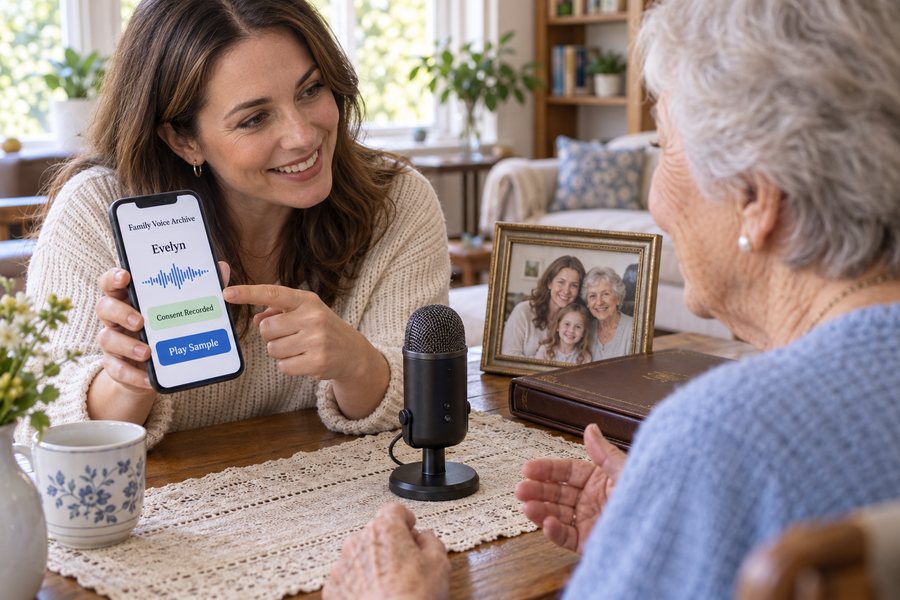
For as long as recording technology has existed, families have collected small, fixed fragments of the people they love: a voicemail saved long after it should have been deleted, a home video with a few seconds of unscripted laughter, a handful of photographs where someone’s expression captures something essential about who they were. These keepsakes share one quality that has always limited their comfort: they are frozen. A saved voicemail says the same thing every time it is played, a video loops the same handful of seconds, and neither can answer a question a grieving person did not think to ask while the person was still alive to answer it. Artificial intelligence has recently made a different kind of keepsake possible, one built from hours of recorded conversation and shaped into something that can respond, in a recognizable voice, to questions it was never specifically asked to record an answer for. A small but growing number of companies now offer exactly this: a way to interview someone while they are living, or to work from whatever recordings already exist, and produce an interactive voice that family members can continue to talk with after that person has died.
This article treats that technology honestly, which means being precise from the outset about what it actually is and is not. It is not a resurrection, a genuine continuation of a person’s consciousness, or anything that scientists or the companies building these products themselves claim represents actual sentience; every service examined in this article is explicit that it produces a simulation built from recorded patterns of speech, drawing on those recordings and, in most cases, general-purpose language models to generate plausible responses to new questions. Understanding it as a sophisticated, interactive keepsake, rather than a literal continuation of the person, is the accurate frame this entire article works from, and readers should treat any marketing language suggesting otherwise with appropriate skepticism.
It is also worth being upfront that this is genuinely new territory, not a mature, long-settled category of consumer technology. The companies building these products have generally existed only since the early 2020s, the ethical and psychological research examining their effects on grieving families is still limited and preliminary, and even the companies themselves have experienced real business instability, including at least one well-documented bankruptcy filing examined later in this article. None of this means the technology has no value; many families who have used it describe real comfort, and this article takes those experiences seriously rather than dismissing them. It means a family considering this technology deserves a clear-eyed account of both the comfort it can provide and the real uncertainties, financial, ethical, and psychological, that come with a genuinely new kind of product built around some of the most vulnerable moments in a person’s life.
This article walks through why families are turning to this technology in the first place, how the underlying recording and modeling process actually works, and who is affected and in what ways, the person being preserved, the family members who will eventually use the finished product, and the companies that build and maintain it. It then examines two documented, verifiable examples of this technology in practice: an entrepreneur who built an interactive version of himself in the final weeks of a terminal illness, and a well-known platform whose real adoption by families exists alongside a real, dated corporate bankruptcy that illustrates exactly the kind of practical fragility this article takes seriously rather than glosses over. Finally, it addresses the consent and ethical questions that researchers studying this technology have raised, including the specific and important point that no one who died before this technology existed, and relatively few who have used it since, ever had a meaningful opportunity to consider in advance how their voice and manner might be used by their survivors, or by a company, after they were gone.
Readers approaching this subject should know that thoughtful people, including families who have used these services and the researchers who study them, hold genuinely different views about whether this technology helps or complicates grief, and this article does not try to settle that question on anyone’s behalf. What it aims to do is lay out, as clearly and honestly as possible, what the technology actually does, what real families have actually experienced, and what open questions remain, so that anyone considering it for themselves or a loved one can make that decision with accurate information rather than either uncritical enthusiasm or reflexive alarm.
This article is written for a reader who has never encountered this category of technology before and wants a plain, careful account of what it involves before deciding whether it is right for their own family. It assumes no prior familiarity with artificial intelligence, voice modeling, or the small industry of companies that have built these products, and it tries throughout to distinguish clearly between what has actually been documented, through named individuals, dated events, and independently reported facts, and what remains genuinely uncertain or contested, since a subject this personal deserves precision rather than either promotional enthusiasm or unfounded alarm.
Why Families Are Turning to AI to Preserve a Voice
The circumstance that has produced some of the most well-documented uses of this technology is a terminal diagnosis, a period in which someone knows, often with real precision, that their remaining time is limited, and in which they and their family have an unusual and difficult opportunity: the chance to deliberately create something for after they are gone, rather than relying only on whatever recordings happened to already exist. Families in this situation have described wanting something more responsive than an old voicemail or video, a way to preserve not just the sound of a voice but something closer to the experience of asking that person a question and hearing them answer it in their own words and cadence, particularly for family members, grandchildren especially, who may grow up with only fragmentary memories of the person otherwise.
A second and quite different circumstance involves sudden or unexpected loss, where no advance planning was possible and a family is left working from whatever recordings already exist, old voicemails, videos, voice memos, rather than a deliberately recorded interview process. Services built around this scenario generally rely on a smaller and less controlled set of source material, which meaningfully affects both the technical quality of the result and the ethical questions involved, since the deceased person had no opportunity to choose what would be preserved or how it might later be used, a distinction this article’s later discussion of consent treats as genuinely important rather than a minor technical detail.
A third driver, less dramatic than a diagnosis or a sudden loss but increasingly common, is simply generational distance: grandchildren and great-grandchildren who will grow up long after an older family member has died, and whose only connection to that person will be whatever a family chooses to preserve now. Older family members interested in leaving something for descendants they may never meet, or may meet only briefly, have adopted these services specifically to bridge that gap, treating the process less as a response to imminent loss and more as an extension of the impulse behind a family history project or an oral history recording, just built with more interactive technology than a simple audio archive would offer.
This generational motivation connects to a longer-standing family practice that predates any of this technology by generations: the ethical will, a written document, common in several religious and cultural traditions, in which a person sets down their values, hopes, and life lessons for descendants rather than only their financial estate. Families and individuals drawn to AI voice preservation for this reason often describe it in language borrowed directly from that older tradition, framing the process less as a novel technological experiment and more as a modern, interactive extension of something people have done for a very long time through letters, journals, and recorded oral histories, a framing worth taking seriously as evidence that at least part of the appeal here is continuous with much older human practices rather than something wholly new to this specific technology.
What unites all three circumstances is dissatisfaction with the fundamental limitation of a static keepsake. A photograph or an old recording can prompt a memory, but it cannot respond to a new question, cannot tell a story it was not already telling, and cannot adapt to who is asking or what they specifically want to know. Families describe this gap in similar terms across very different personal circumstances: they are not looking to replace grief or to pretend someone is still alive, but they want something more responsive than a fixed artifact to hold onto, a distinction worth taking seriously rather than assuming every family using this technology is confused about what it actually provides.
It is also worth naming plainly that this technology exists within a broader, commercially competitive landscape of AI products marketed toward emotional needs, companion chatbots, AI-generated commemorative content, and grief-support applications among them, and that the same broad advances in conversational AI and voice synthesis that made general-purpose chatbots widely available after the early 2020s are what made voice preservation specifically viable at consumer prices and timelines. Understanding this technology as one specific application within that larger wave, rather than an entirely separate phenomenon, helps explain both why several companies emerged in roughly the same few years and why the underlying technical capability, generating plausible, contextually appropriate speech from a trained model, is shared with far more mundane AI products a reader may already be familiar with.
Some services occupying adjacent corners of this broader landscape are worth distinguishing clearly from the voice-preservation category this article focuses on, since coverage of the space often blurs them together in ways that can mislead a family evaluating their options. Text-based chatbot services that simulate a deceased person’s writing style from a questionnaire, and free or low-cost novelty applications built around a fictionalized conversation with the dead, generally involve a much lighter technical process, less individualized source material, and correspondingly less capacity to actually resemble the specific person they are meant to represent, compared with the more extensive, higher-cost interview and modeling process the two case studies in this article describe. A family evaluating this technology should understand that the category spans a considerable range of technical sophistication and cost, and that a ten-dollar novelty chatbot and a fifteen-thousand-dollar custom voice model, while sometimes discussed together in media coverage, are meaningfully different products with correspondingly different capabilities and limitations.
How AI Voice Preservation Actually Works
Despite meaningful differences between specific companies’ products, the general process shares a common structure: a person is recorded, often extensively, answering a wide range of questions and providing sample speech, that recorded material is processed and used to build a model capable of generating new responses in that person’s voice and general manner, and the finished product is then made available to family members who can pose new questions and receive generated answers, rather than only replaying fixed, pre-recorded content.
The most important technical distinction within this category is between systems built around a large library of pre-recorded video or audio clips, matched to new questions using algorithms that select the most relevant existing recording, and systems that generate genuinely new speech using a voice model trained on someone’s recordings, capable of producing sentences that person never actually spoke during the recording sessions. The first approach has the advantage of using only material the person actually said in their own words, since every possible output was genuinely recorded by them, but it is inherently limited to answering questions reasonably well matched to something already in its library, and can produce an awkward or clearly mismatched response when asked something the recorded material never anticipated. The second approach can respond much more flexibly to unexpected questions, since it generates new speech rather than retrieving existing clips, but this flexibility comes with a real tradeoff: the words being spoken were never actually said by the real person, only generated by a model trained to sound like them, a distinction families should understand clearly rather than assume away when evaluating how literally to treat what the finished product says.
Cost and time investment vary considerably depending on which approach a specific company uses and how extensive the recording process is. Some services can produce a usable result from a relatively modest interview session lasting a few hours, while others involve a multi-day process specifically designed to capture a wide range of speech patterns, emotional tones, and personal details, at correspondingly higher cost. This variation matters practically for families deciding whether and how to pursue this technology, since a more extensive, more expensive process generally produces a result capable of handling a wider range of future questions and sounding more consistently like the actual person, while a lighter-touch process trades some of that fidelity and flexibility for a lower cost and time commitment, an especially relevant consideration for a family working within the compressed timeline of a terminal diagnosis.
Underlying both approaches is a genuinely important technical dependency worth understanding: the more flexible, generative systems described above generally rely at least partly on large, general-purpose language models originally trained on enormous datasets of ordinary internet text and conversation, rather than being built entirely from scratch using only a single individual’s recordings. This means the underlying model answering a new question is, in a meaningful sense, drawing on general patterns of human speech and reasoning learned elsewhere, and then adapting that general capability to sound like, and where possible reflect the documented views of, the specific person being preserved, rather than functioning as a system that has learned to think purely and exclusively the way that one individual person did. This distinction matters for calibrating expectations honestly: a generated response can sound remarkably true to a person’s documented views and manner of speaking, but it is always, at some level, a blend of that specific person’s recorded material and the broader patterns the underlying general-purpose model already contained before that person’s recordings were ever added to it.
Recording and Training: What It Takes to Capture Someone’s Voice and Manner
The recording phase typically involves a structured interview process in which the subject answers a wide range of questions about their life, their views, and their personal history, in some cases supplemented by a specific list of phrases designed to capture particular sounds, emotional tones, or speech patterns that a voice model needs in order to generalize convincingly to new sentences later on. This process can take anywhere from a few hours to several days depending on the specific service and the ambition of the final product, and it typically requires a reasonably quiet recording environment and a functioning voice, which is itself a meaningful constraint for people pursuing this option very late in a terminal illness, when speaking for extended periods may already be physically difficult.
Once recorded, the raw material goes through a computational process that extracts the distinctive characteristics of a person’s voice, their pitch, cadence, characteristic phrases, and speaking style, and uses that information to build a model capable of generating new speech in a recognizable approximation of that voice. This process can take anywhere from hours to a couple of days depending on the amount of source material and the specific technical approach involved, and it is generally not something the person being recorded needs to be present for, since it happens after the interview sessions are complete. Many services also incorporate broader knowledge or personality information provided separately from the raw voice recordings, such as written answers to questions about someone’s values, opinions, or life stories, which the underlying conversational system draws on when generating substantive answers to new questions, layered on top of the voice model that determines how those answers actually sound when spoken.
A genuinely important limitation of this entire process, worth stating plainly rather than glossing over, is that no amount of recording can fully anticipate every question a family member might eventually want to ask. The resulting system, however sophisticated, is still working from a finite, if sometimes large, set of source material and a model trained to extrapolate from it, meaning it will inevitably handle some unexpected or highly specific questions less convincingly than others, sometimes producing a response that sounds plausible but does not actually reflect anything the real person specifically believed or would have said, a distinction addressed further in the ethics section of this article.
Physical and medical circumstances also shape how much of this process is realistically achievable in any given case, a consideration that matters enormously for families pursuing this option during a terminal illness rather than as a proactive, unhurried family history project. Recording a comprehensive interview session, or the specific phrase library some systems require, generally demands sustained vocal effort and mental clarity, both of which can become genuinely difficult in the later stages of many terminal illnesses, meaning families who wait until very late in an illness to begin this process may find themselves working with a meaningfully smaller and more limited set of source material than they would have captured earlier, a practical reason some services and hospice-adjacent resources now encourage families to consider this option, if they want it at all, earlier in an illness rather than waiting until time has become extremely short.
Interacting With a Preserved Voice After Death
For the family member on the other end of this technology, the actual experience generally involves some combination of typing or speaking a question and receiving a spoken response in the preserved voice, sometimes accompanied by video, depending on which specific product a family used. Family members who have described this experience publicly report a range of reactions, from genuine comfort at hearing a familiar voice answer a question in a recognizably similar way to how the real person would have, to a more unsettling or emotionally complicated reaction, particularly the first time they use it, or when a response comes across as slightly off in a way that is hard to precisely articulate but noticeably different from how the real person actually spoke.
This variability in emotional response is not a flaw specific to any one company’s product; it reflects something inherent in the underlying technology and in the enormous variation in how individual people process grief. A response that one family member finds comforting, a familiar turn of phrase, a characteristic bit of humor, an answer consistent with what they know the person actually believed, another family member may find distressing precisely because it sounds almost right but not quite, drawing attention to the gap between the simulation and the actual person in an uncomfortable way. Companies offering these products generally do not, and reasonably cannot, guarantee a uniformly positive emotional experience for every single family member who chooses to use them, and families considering this technology should go in expecting a genuinely personal and unpredictable reaction rather than simply assuming everyone in the family will experience it in exactly the same way.
A practical limitation worth noting is that most of these systems are explicitly designed to handle a conversational range roughly bounded by what the person actually discussed or was likely to discuss during their lifetime, rather than functioning as a general-purpose oracle capable of commenting on events or questions that arose only after their death. A family member asking a preserved voice about a current event that happened only after the person died, for instance, will generally receive either an honest acknowledgment that the system simply has no information about it, or, in less carefully designed implementations, a generated response that sounds confident but has no actual basis in anything the real person ever said or genuinely believed, a distinction that matters enormously for how much weight a family should reasonably place on any given specific answer.
How often a family actually chooses to use a finished product also varies considerably, and companies operating in this space have generally been candid that usage patterns differ widely rather than settling into any single predictable rhythm. Some families report turning to a preserved voice occasionally, around a birthday, an anniversary, or a moment when a specific memory feels especially present, treating it similarly to a periodic visit to a grave or a deliberate rereading of old letters, while others use it more rarely, creating the profile primarily as an act of preservation for the future rather than something they expect to interact with often themselves. Neither pattern appears to be more common or more clearly correct than the other in the documented accounts available so far, and companies building these products have generally avoided prescribing how frequently a family should use the finished result, leaving that entirely to individual preference.
Benefits and Concerns by Stakeholder
For the person creating a preserved voice while still living, the process itself, separate from whatever value the finished product eventually provides to survivors, is something a meaningful number of participants describe as valuable in its own right. Sitting down to articulate one’s values, life stories, and personal history in a structured way can function similarly to writing a memoir or an ethical will, a longstanding practice of leaving behind reflections and guidance for descendants, and several people who have gone through this process while facing a terminal diagnosis have described it as a meaningful way to spend some of their remaining time, independent of how their family ultimately chooses to use the finished result.
For surviving family members and mourners, the primary benefit is the specific quality this article’s introduction described: an interactive rather than static keepsake, one capable of responding to a question rather than only replaying a fixed memory. Grief researchers and grief counselors have generally not concluded that this is uniformly helpful or uniformly harmful; rather, the available evidence and clinical observation suggest wide variation depending on the individual mourner, the nature of the relationship, and how the technology is actually used, whether as an occasional, deliberate way to revisit a connection, similar to visiting a grave or rereading old letters, or as something reached for constantly in a way that could plausibly interfere with the gradual adjustment most grief processes eventually require.
Children and grandchildren who never met, or barely knew, the person being preserved represent a distinct beneficiary group with a different relationship to the technology than someone processing an immediate, personal loss. For this group, the value is less about processing active grief and more about gaining some access to a family member they otherwise would only know through photographs and secondhand stories, a use case that raises fewer of the acute grief-related concerns discussed later in this article but still carries the consent question of whether the preserved person would have wanted their voice and manner used this way for descendants they may never have met themselves.
The companies operating these platforms occupy a genuinely difficult stakeholder position, since they are simultaneously providing a product to grieving or anticipatorily grieving customers and running a commercial business that needs to remain financially viable to keep serving those same customers over time. This tension is not hypothetical; the StoryFile case study examined later in this article shows a real, documented instance of a company built around exactly this kind of emotionally significant product filing for bankruptcy protection, which raises legitimate questions about what obligations a company in this space owes its existing customers when its underlying business model comes under financial strain, a question with no settled industry-wide answer at this point.
Extended family members and friends outside the immediate household represent a stakeholder group whose interests are easy to overlook but genuinely relevant to how families should think about using this technology, particularly around shared or public occasions like a memorial service. The documented Ed Asner case examined later in this article, in which his StoryFile was played at his memorial and moved some attendees while unsettling others, illustrates directly that a choice made by one part of a family, typically whoever is closest to the deceased and most involved in planning a memorial, can have a meaningfully different emotional effect on a wider circle of mourners who were not necessarily consulted about that decision. Families considering a public or group use of this technology, rather than a private, individual one, have real reason to think through in advance how a wider circle of mourners might react, rather than assuming a reaction similar to their own closest relationship with the deceased.
Documented Case Studies in AI Voice Preservation
AI voice preservation is recent enough, and the number of companies operating in the space small enough, that most of what can be said with real confidence comes from a handful of well-documented, independently reported examples rather than large-scale industry statistics. Two cases stand out for the specificity and verifiability of what has been publicly reported about them: an individual entrepreneur’s documented experience building a preserved voice while facing a terminal diagnosis, and a well-known platform whose real user adoption exists alongside a formally filed, dated corporate bankruptcy, together illustrating both the human experience of using this technology and the real business fragility that comes with a genuinely new and unproven commercial category.
Eternos and Michael Bommer: Building a Voice Before the End
Michael Bommer, a 61-year-old startup entrepreneur living in a suburb of Berlin, was diagnosed with terminal colon cancer and, according to reporting by the Associated Press published in June 2024, began discussing with his wife Anett what she would miss most after his death, a conversation in which she told him she would especially miss being able to ask him questions and hear his perspective whenever she wanted. That specific conversation is what led Bommer to reach out to his friend Robert LoCascio, a former colleague from the software company LivePerson and the founder and chief executive of Eternos, an AI-powered legacy platform whose name derives from the Italian and Latin word for “eternal.” Working together, Bommer and LoCascio’s team built what the company described as a comprehensive, interactive AI version of Bommer within approximately two months, and Bommer became Eternos’s first documented client.
The technical process involved Bommer recording 300 specific phrases designed to capture the distinctive characteristics of his voice, a recording set that then went through a compression and modeling process taking approximately two days to complete, producing a voice model the AP described as bearing real resemblance to Bommer’s actual speech, though notably missing some of the natural hesitations, “hmms” and pauses, present in his unscripted speaking cadence. Beyond the voice itself, Bommer answered extensive questions about his life story, his political views, and his personality, information the underlying conversational system draws on when generating substantive responses, with the system built using a combination of an in-house model and external large language models supplied by major AI developers including Meta, OpenAI, and the French company Mistral AI. The complete package, according to the AP’s reporting, cost approximately $15,000, and under Eternos’s stated policy the legal rights to the resulting AI belong to the person it was modeled on and can be passed down to family members as an asset, a structure LoCascio described as specifically intended to keep the underlying technology companies from retaining rights over the result.
What makes this case study valuable for understanding both the promise and the limits of this technology is the direct, documented testimony of the people actually involved rather than secondhand marketing claims. Bommer himself, in the AP’s reporting, explicitly rejected the idea that building this technology reflected a wish for immortality, comparing it instead to writing a memoir, and described his own attitude toward his remaining time with evident calm. His wife Anett, by contrast, described real ambivalence about whether she would actually use the finished product after his death, saying she more readily imagined herself sitting with one of his old sweaters and a glass of wine in the early period of mourning rather than turning to the AI version, while acknowledging she could not be certain how she would feel later. This documented difference in perspective between the person creating the preserved voice and the family member who would eventually use it is itself an important, honestly reported data point about how differently people within the very same family can relate emotionally to this technology, and it argues clearly against simply assuming that building this kind of legacy is automatically experienced as comforting by everyone it is ultimately built for.
StoryFile: Real Families, Real Adoption, and a Real Bankruptcy
StoryFile, a California-based company and one of the most prominent names in this category, built its product around pre-recorded interactive video, in which a subject is extensively interviewed on camera and the platform’s algorithms later select the most relevant recorded answer to whatever question a user poses, producing an experience in which the subject appears to make eye contact, breathe, and blink while responding. According to the company’s own figures reported in mainstream coverage, approximately 5,000 people had created StoryFile profiles as of the technology’s broader media coverage in 2023 and 2024, representing real, meaningful adoption for a company operating in a genuinely new product category.
Individual family experiences with the platform have been documented directly. Matt Asner, son of actor Ed Asner, has spoken publicly about his father’s StoryFile, which was played at Ed Asner’s memorial service, an experience Matt Asner described as moving for some attendees while unsettling for others, a candid, documented example of exactly the kind of mixed emotional reception this article’s earlier discussion of family stakeholders described in the abstract. Separately, Lynne Nieto described watching her late husband’s StoryFile for the first time roughly six months after his death, saying the experience was, in her own words, a little hard to watch, a firsthand account that neither straightforwardly endorses nor rejects the technology but instead reflects the genuinely complicated emotional territory it occupies.
The company’s business trajectory adds a distinct and important dimension to this case study. On May 5, 2024, StoryFile, Inc. filed a voluntary petition for Chapter 11 bankruptcy protection in the U.S. Bankruptcy Court in White Plains, New York, declaring approximately 1.5 million dollars in assets against roughly 10.5 million dollars in liabilities. In an affidavit filed with the court, interim chief executive James Fong described StoryFile candidly as a start-up with an unproven, if promising, technology and business model that had continued to burn through cash despite additional fundraising and new revenue streams. As part of its reorganization, the company stated it was setting up a fail-safe system intended to ensure families would retain access to their stored materials even if the company itself did not survive, a direct, practical response to precisely the kind of company-continuity risk this article’s ethics section discusses. StoryFile ultimately emerged from Chapter 11 after its assets were acquired by Key 7 Investment Company, continuing to operate under new ownership rather than shutting down entirely.
This case study matters because it demonstrates, with real names, dates, and dollar figures rather than hypothetical concern, that a company built around emotionally significant, once-in-a-lifetime recordings of deceased or dying family members is still an ordinary business subject to ordinary business risk, including the possibility of running out of money. Families who had already created StoryFile profiles of loved ones faced a real, documented period of uncertainty about whether those recordings would remain accessible, and while the company’s eventual reorganization and continued operation under new ownership represents a reasonably favorable outcome, it was not a guaranteed one, and it is a genuine, documented illustration of a risk this article’s ethics section addresses directly rather than treating as a merely theoretical possibility.
It is also worth noting, in fairness to the company, that James Fong’s own affidavit to the bankruptcy court was notably candid rather than evasive about the company’s situation, explicitly describing StoryFile as an unproven business model rather than overstating its stability to creditors or the court, and that the reorganization plan specifically prioritized preserving family access to stored recordings rather than treating that continuity as secondary to other creditor or shareholder interests. This does not erase the real uncertainty families experienced during the bankruptcy proceedings themselves, but it does suggest that at least this particular company’s leadership treated the preservation of irreplaceable family recordings as a genuine priority during a period of serious financial distress, rather than as an afterthought, which is a meaningfully different outcome than families might reasonably have feared going into the filing.
Consent, Ethics, and Open Questions
The most fundamental and least resolvable ethical question in this space involves consent, specifically the fact that a person can only consent to how their preserved voice will be used based on their imagination of future circumstances, not the actual circumstances that eventually arise. Someone who agrees to have their voice preserved for their grandchildren cannot fully anticipate every context in which that voice might later be used, whether by a company changing its terms of service, a family member using it in a way the original person might not have wanted, such as at a public memorial rather than private family use, or a future technology that repurposes the underlying recordings in ways not contemplated when the original recording was made. This is a genuinely different and considerably more limited form of consent than the ongoing, revisable consent a living person can actively give and later withdraw, and researchers studying this technology have specifically flagged it as a real, unresolved problem rather than one current industry practices have adequately solved.
Researchers at the University of Cambridge’s Centre for the Future of Intelligence, including Katarzyna Nowaczyk-Basinska and Tomasz Hollanek, have studied this category of technology directly, describing services built around interacting with simulations of the dead using terms including “deadbots” and “griefbots,” and have specifically raised questions about the rights and dignity of people who are no longer alive to weigh in on new uses of their likeness, as well as the ethical propriety of a platform serving bereaved users also potentially advertising other products alongside that experience. Nowaczyk-Basinska has described the current moment candidly as a largely unstudied, large-scale social experiment, noting that very little is actually known yet about the short-term or long-term psychological consequences of interacting with these simulations, and characterizing the current period as one in which humanity’s long history of practices around death and mourning has, for the first time, become fully integrated into a commercial marketplace, a framing worth taking seriously rather than dismissing as academic hand-wringing.
A related and practically significant concern involves the risk that continued or frequent interaction with a preserved voice could complicate rather than support healthy grieving, since grief processes generally involve a gradual adjustment to a loved one’s absence, and a technology explicitly designed to simulate ongoing presence could, for some individuals, make that adjustment harder rather than easier. This is not a uniform risk, since the same technology that some mourners describe as harmful to their healing process, others describe as a helpful, occasional supplement to more traditional forms of remembrance, similar to visiting a grave or rereading old letters, and the honest, evidence-based position at this point is that individual variation matters enormously and no blanket claim about the technology’s psychological effect, in either direction, is currently well supported by rigorous research.
Grief professionals who work directly with bereaved families generally counsel against any single family member making a unilateral decision to create or use this kind of technology on behalf of a whole family without some discussion beforehand, precisely because the documented reactions described throughout this article, from Matt Asner’s account of his father’s memorial StoryFile moving some attendees while unsettling others, to Anett Bommer’s own described ambivalence about her husband’s Eternos voice, show that a choice one person experiences as comforting can be experienced quite differently by another person mourning the same loss. This does not mean family consensus is strictly required before anyone can use this technology, since a person creating their own preserved voice while still living retains a real claim to make that decision for themselves, but it does suggest that families are generally better served by talking openly about the choice in advance, rather than one member introducing a finished product to grieving relatives without warning during an already difficult period.
The company-continuity risk demonstrated concretely by StoryFile’s 2024 bankruptcy filing raises a further practical question that families should weigh seriously before investing significant money and emotional energy into any specific platform: what actually happens to a preserved voice, and to the underlying recordings it was built from, if the company operating it goes out of business, is acquired by a different company with different values, or simply discontinues the specific product a family relied on. Some companies, StoryFile among them following its bankruptcy, have implemented specific fail-safe measures intended to guarantee continued family access to underlying materials regardless of the company’s own fate, but this is not a universal industry standard, and a family considering this technology should specifically ask any provider what happens to their recordings and their finished product if the company itself does not survive.
A closely related, forward-looking question involves what happens as the underlying general-purpose language models these systems rely on continue to be updated, retired, or replaced by their developers over time, a dependency largely outside any individual family’s or even any individual company’s direct control. A voice model built today using a specific version of a widely available language model could, in principle, need to be rebuilt or adapted if that underlying model is eventually discontinued by the larger technology company that created it, introducing a second, less visible layer of continuity risk beyond the voice-preservation company’s own business stability, one that families are unlikely to think about upfront but that is worth understanding as part of the genuinely new and still-settling technical landscape this entire category of product depends on.
Final Thoughts
AI voice preservation occupies genuinely new ground, sitting somewhere between the deeply personal, ancient human practice of remembering the dead and the distinctly modern, commercially mediated world of subscription software and venture-funded startups, and the honest way to evaluate it is neither with uncritical enthusiasm nor reflexive dismissal but with the same care a family would bring to any other decision made during a period of illness, loss, or anticipatory grief. The documented cases examined in this article, Michael Bommer’s deliberate, months-long collaboration with Eternos, and the real families who have used and continue to use StoryFile despite the company’s own well-documented financial fragility, show real people finding real value in this technology, alongside real, unresolved uncertainty about consent, psychological effect, and corporate continuity that no family should enter into blindly.
What distinguishes this technology from previous eras of grief and memory work is not that it introduces new emotions people have never felt before, longing, comfort, unease, ambivalence, all of these appear throughout the history of how people relate to keepsakes, letters, and old recordings, but that it introduces a genuinely new interactive quality to an old set of feelings, and does so through a commercial industry still young enough that neither its long-term psychological effects nor its business stability are well established. Families weighing this technology deserve accurate information about both dimensions, not a sales pitch focused only on comfort and not a reflexive dismissal focused only on the discomfort some people understandably feel, since the actual, documented experience of families who have used these services runs the full range between those two poles.
The broader social question this technology raises, about what obligations exist toward both the living and the dead as commercial companies increasingly mediate how people process loss, deserves ongoing, serious attention from researchers, from the companies building these products, and from families making individual decisions about whether to use them, rather than a single settled answer this article could responsibly claim to provide. What can be said with confidence is that the specific, documented examples available so far, an entrepreneur choosing to spend part of his final months building something for his family, a company whose real financial instability directly affected families who had trusted it with irreplaceable recordings, a range of mourners experiencing everything from comfort to discomfort when actually using these products, offer a genuinely useful, unglamorized starting point for anyone trying to understand what this technology actually is, rather than what marketing materials or either enthusiastic or alarmist coverage might suggest.
Anyone considering this technology, whether preserving their own voice for family members or deciding whether to interact with a preserved voice of someone they have lost, deserves to make that choice deliberately, informed by the real tradeoffs this article has tried to describe honestly rather than by assuming either that the technology offers straightforward comfort or that it represents an unambiguous ethical hazard. The right answer, based on the documented experiences examined carefully throughout this article, appears to genuinely differ from person to person and family to family, which is itself the most honest and useful conclusion this particular subject currently supports.
FAQs
- Is an AI-preserved voice actually the person, or just a simulation?
It is a simulation built from recorded speech and, in most cases, general-purpose language models trained to generate plausible new responses. No company examined in this article claims the result is a genuine continuation of the person’s consciousness, and readers should treat any marketing suggesting otherwise with skepticism. - How much does it cost to create one of these services?
Costs vary significantly by provider and by how extensive the recording process is. The documented Eternos case involving Michael Bommer cost approximately fifteen thousand dollars for a comprehensive, custom-built voice model, while other platforms offer less extensive options at lower price points. - What happens if the company that built my loved one’s preserved voice goes out of business?
This is a real, documented risk rather than a hypothetical one. StoryFile, one of the best-known companies in this space, filed for Chapter 11 bankruptcy protection in May 2024 before being acquired and continuing operations under new ownership; families should specifically ask any provider what safeguards exist for their recordings if the company does not survive. - Can a preserved voice answer any question, including about things that happened after the person died?
Generally no. Most systems are built to respond within the range of what the person actually discussed or was likely to discuss during their life, and a well-designed system should indicate when it has no real basis for an answer rather than generating a confident-sounding response with no connection to anything the actual person said or believed. - Did the real people involved in creating these services actually find it valuable?
Documented accounts vary. Michael Bommer described the process of building his Eternos voice as similar to writing a memoir and valuable in itself, while his wife expressed real ambivalence about whether she would actually use the finished product, illustrating that even within the same family, reactions to this technology can differ substantially. - What do grief researchers actually think about this technology?
Researchers, including a team at the University of Cambridge’s Centre for the Future of Intelligence, have described the field as a largely unstudied social experiment, raising open questions about consent, dignity, and psychological effects rather than offering a settled verdict that the technology is either broadly helpful or broadly harmful. - Can someone who has already died have their voice preserved using old recordings?
Some services work from existing material like voicemails or home videos rather than a dedicated interview process, though this generally limits both the technical quality of the result and raises a distinct ethical question, since the deceased person had no opportunity to choose what would be preserved or consent to this specific use. - Is it possible to preserve a voice as a family history project rather than in response to a specific illness or loss?
Yes. Some people pursue this technology specifically to leave something for descendants they may never meet, treating it as an extension of oral history recording rather than a direct response to an immediate diagnosis or loss. - Could frequent use of a preserved voice make grief harder to process?
This is a genuine, documented concern among researchers, though the evidence suggests significant individual variation rather than a uniform effect; some mourners describe occasional use as comforting and supplementary to traditional remembrance, while others worry frequent use could interfere with the gradual adjustment grief typically requires. - Who legally owns the AI version created through one of these services?
This varies by provider and their specific terms of service. Under Eternos’s stated policy, for example, legal rights to the resulting AI belong to the person it was modeled on and can be passed down to family members as an asset, a structure intended to keep the underlying technology providers from retaining separate rights over the result.