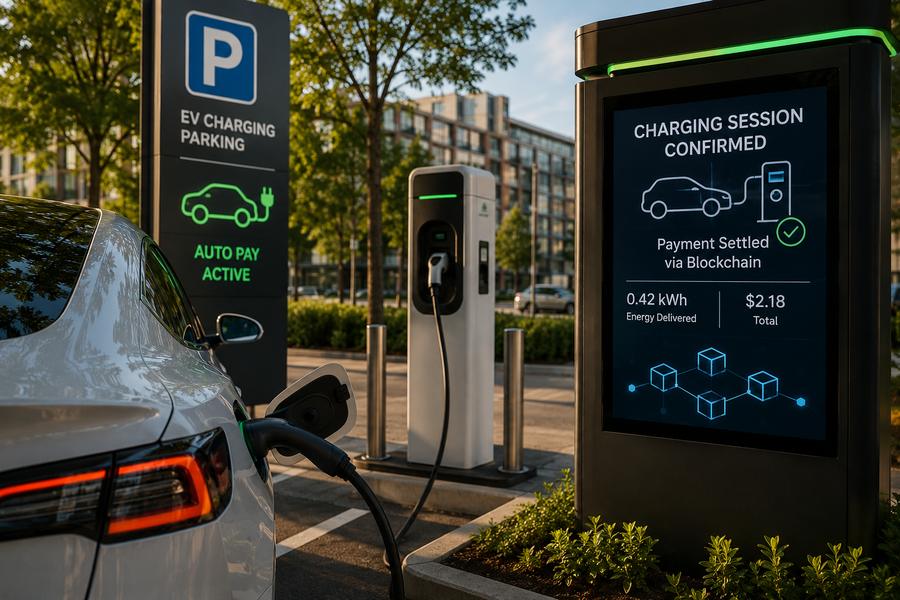
For all the progress that electric vehicles have made in displacing the gasoline engine, the simple act of paying to charge one of them remains a surprisingly clumsy experience, a tangle of plastic cards, smartphone applications, and account logins that stands in awkward contrast to the sleek technology of the cars themselves. A driver who pulls into an unfamiliar charging station may find that the network requires a particular app, that the app demands a fresh registration, that the registration needs a payment method entered on a cracked touchscreen in the cold, and that none of this effort carries over to the next station down the road, which belongs to a different company with its own walled garden. Parking presents a parallel frustration, with its meters that take only exact change, its competing apps for different garages and city blocks, and its perpetual uncertainty about whether the payment actually registered before the enforcement officer arrives. These are small indignities taken one at a time, but together they represent a real drag on the convenience that electric mobility was supposed to deliver.
A different model is now emerging, one in which the vehicle itself becomes the payer, settling its bills for energy and for space automatically and invisibly, without the driver reaching for a wallet or a phone at all. The idea rests on giving the car a verifiable digital identity and a means of holding and transferring value, so that when it plugs into a charger or rolls into a parking bay, the machine on each side of the transaction can recognize the other, agree on a price, and settle the account in the background. Much of the technical foundation for this vision draws on blockchain systems and the standards built around them, which provide a way for independent machines that have never met before to trust one another and exchange value without a human intermediary vouching for either party. The result is a quietly radical reimagining of how everyday commerce might work when the participants are not people but the things they own.
This article examines blockchain payments for electric vehicle charging and smart parking for readers who may have encountered the phrase machine-to-machine payments without grasping what it means in practice or how close it is to reality. It begins with the payment problem that lurks behind every charge and every parking session today, explaining why the current experience is so fragmented and where the friction comes from. It then explains how machine-to-machine payments actually work, describing the digital identity, wallets, and standards that turn a vehicle into an economic actor capable of transacting on its own. From there it surveys real-world deployments, drawing on documented projects from major automakers and technology companies rather than speculative promises, before weighing the benefits for drivers, operators, and cities against the obstacles that still stand in the way. It closes by describing what adoption realistically looks like for an ordinary driver, so that readers come away with both an understanding of the technology and a grounded sense of when and how it will touch their own lives.
The Payment Problem Behind Every Charge and Park
The difficulty of paying for a charge is not an accident of poor design but a consequence of how the electric vehicle charging industry grew up, with dozens of separate networks each building its own customer relationship, its own app, and its own payment system in a race to claim territory. A driver who wants to charge across a region may need accounts with several different operators, each holding a separate balance, each with its own pricing rules and membership tiers, and each requiring its own authentication ritual at the charger. This fragmentation imposes a cognitive and practical burden that has no equivalent in the gasoline world, where any card works at any pump, and it has become one of the most frequently cited sources of dissatisfaction among electric vehicle owners who otherwise enjoy their cars. The problem is most acute precisely when it matters most, on long trips through unfamiliar territory where the driver has no prior relationship with the local network and must improvise a payment arrangement at the moment of need.
The mechanics of authentication compound the inconvenience in ways that reveal how much hidden complexity sits behind a simple charge. At many stations the driver must initiate the session through an app, which requires a working data connection, a charged phone, and an account in good standing, any one of which can fail at the wrong moment. Tap-to-pay card readers, which networks have added under regulatory pressure in some regions, ease the burden but introduce their own failure points, from unreliable connectivity to readers that reject perfectly valid cards. Behind each of these interactions sits a chain of intermediaries, including the charging network, a payment processor, a card network, and a bank, each taking a small fee and adding a small delay, an arrangement that works tolerably for a large purchase but sits poorly atop a transaction that might be worth only a few dollars of electricity. The economics of conventional payment rails were designed for human-scale purchases made occasionally, not for frequent small settlements between machines.
Parking suffers from a strikingly similar set of problems, fragmented across municipal meters, private garages, and a proliferation of apps that rarely talk to one another. A driver moving through a city may encounter a coin-operated meter on one block, a pay-by-plate kiosk on the next, and a garage that insists on its own application with its own registration, none of which remembers the driver from one visit to the next. The friction is severe enough that cities and operators lose revenue to drivers who simply give up and risk a ticket, while drivers lose money to overpayment when they buy more time than they use because the systems make it difficult to pay only for what they consume. As with charging, the underlying issue is the absence of a common, low-cost way for a vehicle and a piece of infrastructure to recognize one another and settle a small bill, a gap that forces every interaction through a human-mediated interface.
It is worth dwelling on the scale of the inconvenience, because it is easy to underestimate from the comfort of a familiar home charger. The driver who charges almost entirely at home or at a single regular workplace station rarely confronts the full extent of the problem, having set up one account once and rarely touching it again, and may wonder what all the complaint is about. The picture changes completely for the driver on a long journey, for the renter without a private charger, for the apartment dweller who depends on public infrastructure, and for the visitor in an unfamiliar city, all of whom must repeatedly negotiate fresh relationships with networks they have never used before. These are precisely the situations in which electric mobility most needs to feel effortless if it is to win over skeptics, and they are precisely the situations in which today’s payment friction is most punishing, which is why the problem matters far more than the experience of the contented home charger would suggest.
What unites these frustrations is a structural mismatch between the nature of the transactions and the systems built to handle them. Charging and parking generate frequent, low-value, machine-mediated exchanges that ideally would happen automatically, yet they are routed through payment and identity systems designed for occasional, higher-value, human-mediated purchases. Every app login, every card swipe, and every account registration is a workaround for the fact that the car and the charger, or the car and the parking bay, cannot simply identify themselves to each other and agree to exchange value directly. Closing that gap is the problem that machine-to-machine payment systems set out to solve, and understanding the shape of the problem makes it easier to see why the proposed solution takes the form it does.
How Machine-to-Machine Payments Work
Machine-to-machine payments rest on a deceptively simple premise, which is that a device can be given the means to identify itself, hold value, and complete a transaction without a person operating it at the moment of purchase. In the context of a vehicle, this means equipping the car with a secure digital identity that other machines can verify, a wallet that can hold or access funds, and the ability to negotiate and settle a payment automatically when it connects to a service such as a charger or a parking system. The vision is that the car becomes a participant in commerce in its own right, an economic actor that pays for the things it consumes as it consumes them, rather than a passive object whose owner must reach into a separate payment system every time a bill comes due. This reframing of the vehicle from a thing that is paid for into a thing that pays is the conceptual heart of the entire approach.
The reason blockchain technology features so prominently in this field is that it solves the specific problem of how two machines that have never interacted before can trust one another enough to exchange value. In a conventional payment, trust is supplied by intermediaries, a bank vouching for the buyer and a payment network guaranteeing the merchant, but inserting those intermediaries into every small machine transaction is slow and expensive. A blockchain offers an alternative in which identity and transaction records live on a shared, tamper-resistant ledger that all participants can verify independently, so that a charger can confirm a car’s identity and its ability to pay without phoning a bank, and the resulting payment can be recorded in a way that neither party can later dispute. The technology effectively replaces the trusted intermediary with shared mathematics, which is precisely what is needed when the parties are autonomous machines transacting frequently and in small amounts.
It helps to distinguish between two related ideas that are often conflated in discussions of this technology, namely the automation of payment and the decentralization of trust. Automating payment simply means removing the human step, so that the car pays without the driver acting, and this can be achieved with conventional systems, as the widely deployed certificate-based versions of Plug and Charge demonstrate. Decentralizing trust means removing the central authority that everyone must rely upon, so that no single company or institution controls the identities, the records, or the settlement, and it is here that blockchain technology makes its distinctive contribution. The most ambitious vision of the self-paying vehicle combines both, delivering not only the convenience of automatic payment but also an open system in which any vehicle can transact with any infrastructure without permission from a gatekeeper, and understanding this distinction clarifies why some deployments described later look quite advanced while still falling short of the fully open ideal. The remainder of this section examines the building blocks that make this possible in concrete terms.
Digital Identity, Wallets, and the Vehicle as an Economic Actor
The foundation of a self-paying vehicle is a digital identity that is both unique to the car and verifiable by others without reference to a central authority that everyone must trust. In the systems being developed for this purpose, such an identity often takes the form of a self-sovereign identity, a credential controlled by the vehicle itself and recorded on a blockchain so that any other machine can confirm its authenticity. The peaq network, a blockchain built specifically for connecting machines and physical infrastructure, uses identifiers it calls peaq IDs for exactly this purpose, assigning each device a verifiable identity that lets it participate in transactions and prove who it is. With such an identity in place, a charger encountering a car for the first time can establish that the vehicle is what it claims to be and is authorized to pay, the digital equivalent of checking a passport, but performed in milliseconds and without a human in the loop.
Paired with identity is the wallet, the component that allows the vehicle to hold or draw upon value and to transfer it when a payment is due. A vehicle wallet need not contain a hoard of cryptocurrency; it may instead be a secured link to the owner’s funds, authorized to spend within limits the owner sets, much as a subscription service is authorized to charge a card. What the wallet provides is the ability to settle a transaction automatically the moment the terms are agreed, transferring value from the car to the charger or parking operator without the owner approving each individual payment. Because these settlements are frequent and small, the systems are designed to handle micropayments efficiently, recording many tiny transactions without the per-transaction fees that would make such payments uneconomical on traditional rails, an efficiency that is essential when a single charging session might involve continuous metering of energy delivered.
Connecting these capabilities to the physical act of charging is a body of technical standards, the most important of which is the international standard known as ISO 15118, which defines how a vehicle and a charging station communicate. This standard underpins the feature commonly marketed as Plug and Charge, in which the car and the charger exchange identity and authorization information automatically as soon as the cable is connected, so that charging begins and payment is arranged without the driver touching an app or a card. The standard handles the secure exchange of credentials that lets the charger trust the car and bill the correct account, and it has become the technical backbone on which seamless authenticated charging is built across the industry. While ISO 15118 in its widely deployed form relies on a centralized system of certificates rather than a blockchain, it establishes the crucial principle that the vehicle authenticates and authorizes payment by itself, and blockchain-based identity systems aim to extend that principle to a broader, more open machine economy. The peer-to-peer dimension of this architecture deserves particular attention, because it is what separates the open machine economy from a merely automated one. Projects building community-powered charging networks envision a world in which the charger need not belong to a large corporate network at all, but might be a unit installed by a homeowner, a small business, or a cooperative, made available to passing vehicles and compensated automatically through the same identity and wallet systems. The blockchain layer is what makes this feasible at scale, because it allows a vehicle and a stranger’s charger to establish trust and settle payment without either party needing a pre-existing account with the other or a shared intermediary to vouch for them. The firm charge.xyz, for instance, has built its peer-to-peer charging platform on the peaq network, using peaq IDs as its identity standard and smart contracts as its payment and data layer, an arrangement that illustrates how the building blocks fit together into a working whole. In such a system the distinction between charging provider and charging customer softens, since any participant with a charger and an identity can play either role, which is the kind of structural openness that distinguishes a genuine machine economy from a polished proprietary convenience.
Together, identity, wallets, and communication standards transform the car from an object that is charged into one that charges itself, settling the bill as a natural byproduct of plugging in.
From Pilots to Pavement: Real-World Deployments
The notion of a self-paying vehicle can sound like distant speculation, yet a substantial body of documented deployments shows that core elements of the idea are already operating in the world, with major automakers, suppliers, and technology firms moving from laboratory demonstrations to public infrastructure. These projects fall along a spectrum, from polished commercial features that millions of drivers can use today to ambitious research demonstrations that point toward a more fully autonomous future, and examining them in turn gives a realistic picture of how far the technology has actually come. What they share is the goal of removing the human payment step from charging and parking, replacing the app and the card with a direct, authenticated exchange between machines, and they demonstrate that this goal is achievable rather than merely conceivable.
At the commercial end of the spectrum, the seamless authenticated charging built on ISO 15118 has moved firmly into production across the largest charging networks and a growing list of vehicles. Electrify America, the largest public fast-charging network in North America, announced full support for the ISO 15118 standard across its direct-current fast chargers in 2024, bringing genuine Plug and Charge to a vast footprint of stations. The list of compatible vehicles has expanded rapidly, with models such as the Porsche Taycan, Mercedes-Benz EQS, Lucid Air, and Ford Mustang Mach-E supporting the standard from earlier model years, and 2024 models including the BMW i4, i5, i7, and iX alongside the Hyundai Ioniq 5 and Ioniq 6 joining them. Regulators have reinforced the momentum, with Germany mandating ISO 15118 compliance for new chargers beginning in 2024 and New York requiring publicly funded charging projects to support the communication standard in both hardware and software as of December 2023. Even where networks have not fully implemented the standard, they have built interim versions of the same convenience, as EVgo has done with its Autocharge+ system, which the company has reported accounts for around thirty percent of its charging sessions, a figure that shows how readily drivers adopt automatic authentication once it is offered.
The convenience that these systems deliver, in which a driver simply plugs in and walks away while the car handles identification and payment, is the most tangible proof that machine-mediated settlement works at scale, even if the underlying plumbing in these particular cases relies on certificate systems rather than public blockchains. The significance for the broader machine economy is that drivers have demonstrably embraced the experience of a vehicle that authenticates and pays on its own, validating the central premise on which more advanced blockchain-based systems are built. The remaining frontier is to extend that same seamlessness beyond a single network’s walled garden into an open system where any car can transact with any piece of infrastructure, and to broaden it from charging into adjacent services such as parking, which is where the more experimental projects come into play.
At the research and demonstration end of the spectrum, several projects have shown vehicles transacting more autonomously and across a wider range of services, pointing toward the open machine economy that the commercial deployments only partly realize. Bosch, working alongside partners including the peaq network within a broader European effort to build decentralized identity for connected devices, demonstrated a peer-to-peer parking and charging arrangement at the IAA Mobility event in which a smart car, a charging station, and a parking system transacted autonomously among themselves. The demonstration relied on self-sovereign identities recorded on a blockchain, which the project termed MoveIDs, permitting a sufficiently capable car to park in a smart bay and be billed automatically rather than requiring the driver to get out and arrange payment separately. Separately, at the CES technology show in early 2024, Bosch and Volkswagen’s software subsidiary Cariad showcased automated valet charging, in which an electric vehicle is guided driverlessly to an open parking space equipped with a charge point and a robot recharges it automatically, integrating autonomous movement with the kind of automatic payment this article describes. These projects remain demonstrations rather than products available to ordinary drivers, but they are concrete, documented, and recent, and they show that the vision of a vehicle that finds, uses, and pays for services with minimal human involvement is being actively engineered by serious companies rather than merely imagined.
Mercedes-Benz, the EVgo Network, and Plug-and-Charge
Mercedes-Benz offers one of the clearest examples of an automaker building automatic payment into a charging experience of its own design, having launched a global high-power charging network with seamless settlement at its core. The company opened its first high-power charging stations in the fourth quarter of 2023, with initial locations in Atlanta in the United States, Chengdu in China, and Mannheim in Germany, and it set out to expand the network to more than two thousand high-power charging points by the end of 2024. A defining feature of these stations is Plug and Charge, which the company describes as automating the charging and payment process the moment the cable is plugged in, so that a Mercedes-Benz driver need only connect the car for billing to be handled automatically through their account. The same capability extends beyond the company’s own stations, with Plug and Charge available to its drivers at networks including Electrify America, provided the feature is activated in the Mercedes-Benz application.
The arrangement illustrates both the promise and the present limits of the technology in a commercial setting. On one hand, it delivers exactly the experience that machine-to-machine payment promises, in which the act of plugging in is the only thing the driver does and everything else, including identity verification and payment, happens invisibly between the car and the charger. On the other hand, it remains tied to a particular automaker’s ecosystem and account structure, with compatibility that varies by model, since certain vehicles are explicitly excluded from Plug and Charge support, a reminder that even leading deployments are still bounded systems rather than the open machine economy that blockchain proponents envision. The Mercedes-Benz network nonetheless demonstrates that a major manufacturer considers automatic authenticated payment a competitive necessity rather than a novelty, and it shows ordinary drivers what the experience feels like in daily use, which matters enormously for adoption.
The EVgo example fills out the picture by showing how a charging network rather than an automaker approaches the same goal, and how quickly drivers gravitate to the convenience when it is available. EVgo’s Autocharge+ allows a vehicle to be recognized automatically at the charger so that a session starts without an app interaction, and the company has indicated that it intends to roll out the full Plug and Charge standard once the complexities of certification and implementation are resolved, while continuing to support its existing system in the meantime. The reported figure that roughly thirty percent of EVgo’s charging sessions are initiated through this automatic method is among the more telling data points in the field, because it reflects real behavior at scale rather than a pilot’s optimistic projection. Taken together, the automaker-led and network-led approaches show that automatic vehicle payment for charging is not a future aspiration but a present reality experienced by large numbers of drivers, with the open, blockchain-based versions of the idea building upon a foundation that the market has already accepted.
Benefits for Drivers, Operators, and Cities
The advantages of machine-to-machine payment systems become clearest when examined through the eyes of the different parties who stand to gain, beginning with the drivers whose daily experience the technology most directly transforms. For a driver, the central benefit is the disappearance of friction, the replacement of a fumbling ritual of apps and cards with the simple act of plugging in or parking and walking away. This convenience is not merely a pleasant luxury but a meaningful reduction in the cognitive load of operating an electric vehicle, removing one of the most frequently cited annoyances and one of the genuine barriers that deter some prospective buyers from making the switch. Beyond convenience, automatic settlement can bring fairer billing, since a vehicle that meters its consumption precisely and pays for exactly what it uses avoids the overpayment that occurs when drivers buy a fixed block of parking time or charging that they do not fully consume, and it can give drivers a clear, consolidated record of their transactions across networks rather than balances scattered among incompatible accounts.
For the operators of charging networks and parking facilities, the benefits center on cost, reliability, and the customer relationship, even though the transition requires significant investment. A payment system that settles directly between machines can reduce the layers of intermediaries that each take a fee, lowering the cost of processing the small transactions that dominate charging and parking, an efficiency that matters greatly when margins on a few dollars of electricity are thin. Automatic authentication also reduces the support burden created by failed app logins and rejected cards, which are a significant source of customer complaints and abandoned sessions, and it can improve utilization by making the infrastructure easier to use, since friction at the point of payment is a direct cause of lost revenue. Operators additionally gain access to verifiable, tamper-resistant transaction records when blockchain systems are used, which simplifies reconciliation and auditing, and they can participate in open networks that attract any compatible vehicle rather than only their own subscribers, potentially expanding their addressable market beyond the confines of a proprietary app.
Cities and the broader public realm stand to gain in ways that are less obvious but potentially significant, particularly as parking and charging become instruments of urban management rather than mere conveniences. When vehicles can pay automatically and precisely for the space and energy they use, cities gain the ability to implement sophisticated, responsive pricing that reflects real demand, encouraging turnover in congested areas and steering drivers toward underused facilities, all without the enforcement costs and disputes that plague today’s meter-based systems. The reduction in time spent searching for parking and arranging payment can ease congestion and lower emissions, since circling for a space and idling at a charger both waste energy and clog streets. Open machine-payment systems could also lower the barrier for small operators and even individuals to offer charging or parking, since a verifiable identity and automatic settlement make it feasible for a homeowner or small business to rent out a charger or a space without building a payment apparatus of their own, a possibility that projects building community-powered peer-to-peer charging networks are actively pursuing. There is also a broader economic benefit that cuts across all three groups, which is the way automatic, precise settlement enables business models that are impractical under today’s clumsy payment systems. Energy itself becomes easier to price dynamically, so that a charger might offer cheaper electricity when the grid is lightly loaded and the vehicle, knowing its owner’s preferences, might choose to charge then, an interaction that requires the kind of fine-grained automatic payment that machine-to-machine systems provide. The same precision opens the door to arrangements in which a parked electric vehicle sells energy back to the grid or to a building at moments of high demand, being compensated automatically for the service, turning the car from a pure consumer of energy into a participant in the energy market. These possibilities remain mostly ahead of us, but they illustrate that the payment layer is not a mere convenience but an enabling foundation, since markets in energy and space can only become as responsive and granular as the systems that settle their transactions allow, and a frictionless settlement layer is the precondition for the more intelligent mobility and energy systems that many cities and utilities hope to build.
The cumulative effect, across all three groups of stakeholders, is a mobility system in which the payment layer recedes into the background and the infrastructure works more efficiently for everyone, though realizing these gains depends on overcoming a set of real obstacles.
The Obstacles Standing in the Way
For all its promise, the vision of vehicles that pay for themselves confronts a formidable set of obstacles, the first of which is the sheer technical and organizational difficulty of achieving interoperability across a fragmented industry. The whole point of an open machine-payment system is that any vehicle should be able to transact with any piece of infrastructure, yet achieving this requires agreement on standards, identity systems, and settlement mechanisms among automakers, charging networks, parking operators, payment providers, and technology firms that have their own commercial interests and existing investments. The history of the charging industry, with its proliferation of incompatible apps and accounts, shows how strong the pull toward proprietary, walled systems can be, and even widely adopted standards like ISO 15118 have taken years to move from specification to broad deployment because of the certification, testing, and coordination they require. Building a truly open system on top of blockchain identity is a more ambitious undertaking still, and it must overcome both technical hurdles and the reluctance of incumbents to cede control of the customer relationship.
Regulatory and legal uncertainty forms a second major obstacle, particularly where the systems touch cryptocurrency, data protection, and consumer financial protection. A vehicle that holds and spends value automatically raises questions about who is liable when a payment goes wrong, how the funds are safeguarded, and whether the arrangement triggers financial regulations designed for banks and payment institutions, questions that differ from one jurisdiction to the next and that have not been comprehensively resolved. Where blockchain systems use a cryptocurrency token to settle transactions, the volatility of that token becomes a practical problem, since neither a driver nor an operator wants the price of a charge to swing with a speculative market, which is part of why much real-world deployment leans on stable units of value or on settlement in conventional currency behind the scenes. Data protection law adds further complexity, because a system that tracks where and when vehicles charge and park accumulates a detailed record of people’s movements, and reconciling the verifiability that machine payments require with the privacy that drivers deserve and that the law increasingly demands is a genuine tension rather than a solved problem.
A third cluster of obstacles concerns adoption, trust, and the practical readiness of the physical infrastructure, which together determine whether an elegant system on paper becomes a usable system in the world. Drivers must be willing to entrust a vehicle with the authority to spend their money automatically, a step that requires confidence in the security of the identity and wallet systems and in the protections available if something goes wrong, and that confidence will be earned only gradually as the systems prove themselves. The infrastructure itself must be upgraded, since automatic authentication and payment require chargers and parking systems with the necessary hardware and software, and the existing stock of equipment is uneven, with many older installations incapable of supporting the standards without replacement. Security looms over all of this, because a system in which machines hold value and authenticate one another automatically presents an attractive target, and a serious breach affecting vehicle identities or wallets could damage trust across the whole field. A further and often overlooked obstacle is the question of who bears the cost and reaps the reward of building the open infrastructure, since the parties best positioned to enable an open system are frequently those with the least commercial incentive to do so. A large charging network that has invested heavily in its own app and its loyal subscriber base may see little advantage in joining an open system that would let its customers wander freely to competitors, and an automaker that has built a polished proprietary experience may prefer to keep its drivers within its own ecosystem. This tension between the collective benefit of openness and the private incentive to maintain a walled garden has slowed many promising technologies before, and it can be resolved only through some combination of regulation, competitive pressure, and the emergence of neutral platforms that no single incumbent controls. The progress of standards like ISO 15118 shows that such alignment is possible, but it also shows that it tends to require sustained external pressure rather than arising spontaneously from the market.
These obstacles are not insurmountable, as the steady progress of deployments demonstrates, but they are substantial enough that the transition will unfold over years rather than months, and unevenly across regions and market segments.
What Adoption Looks Like for Everyday Drivers
For an ordinary driver trying to make sense of all this, the most useful question is not whether a fully autonomous machine economy will someday arrive but what the technology means for them in the near term, and the honest answer is that its most polished form is already available to many and spreading steadily to more. A driver buying a new electric vehicle today has a reasonable chance of owning a car that supports Plug and Charge, and a driver using a major network such as Electrify America or a manufacturer’s own stations may already be able to charge by simply plugging in, with payment handled automatically through an account set up once in advance. The practical first step for such a driver is to check whether their vehicle supports the standard, which is increasingly common on recent models, and to activate the feature in the relevant app, after which the experience of charging changes from a series of interactions into the single act of connecting the cable. This is the version of the future that has already arrived, and it requires nothing exotic from the driver beyond a one-time setup.
A practical note worth making is that the experience still varies considerably depending on the vehicle, the network, and the region, so a driver’s mileage will literally differ from one trip to the next. A car that charges seamlessly at one network’s stations may still require an app at another’s, and a feature that works flawlessly at home may behave differently abroad, where different standards and regulations apply. The sensible expectation is not that every charge and every park has suddenly become effortless, but that an increasing share of them have, and that the share is growing steadily as compatible vehicles and upgraded infrastructure spread. A driver who treats automatic payment as a welcome convenience where it exists, rather than as a guarantee they can rely upon everywhere, will navigate this transitional period with the least frustration and the most benefit.
The experience will broaden in the coming years as more networks implement open standards and as the convenience extends from charging into parking and other services. Drivers should expect the patchwork of proprietary apps to give way gradually to systems that work across networks, reducing the need to maintain multiple accounts, and to see automatic payment appear in parking garages and eventually at curbside spaces as operators upgrade their equipment. The more advanced, blockchain-based systems that allow a car to transact with any piece of infrastructure, including chargers and parking spaces offered by small operators or individuals, will likely appear first in specific pilots and forward-leaning markets before becoming commonplace, so a driver’s encounter with them will probably be gradual rather than sudden. Throughout this transition, the sensible posture for a driver is to take advantage of the automatic payment features their vehicle and preferred networks already offer, to pay attention to the permissions and spending limits these systems allow them to set, and to keep their accounts and payment methods current, since the convenience depends on the underlying authorization remaining valid.
It is worth being clear-eyed about what will not change overnight, so that drivers neither dismiss the technology as hype nor expect more than it can yet deliver. The fully autonomous vision, in which a car independently finds, books, and pays for charging and parking with no human involvement at all, remains largely in the realm of demonstrations and pilots, impressive but not yet a daily reality, and the open, universal machine economy that some envision will take years to assemble from the standards, regulations, and infrastructure it requires. What is real and present is the steady disappearance of payment friction from charging, the early extension of the same idea into parking, and a clear direction of travel toward vehicles that handle more of their own transactions over time. A driver who understands this can make practical use of what exists today while recognizing the more ambitious developments for what they are, namely the leading edge of a transition that is well underway but far from complete.
Final Thoughts
The movement toward vehicles that pay for their own charging and parking represents something larger than a convenience upgrade, for it marks an early and concrete instance of machines becoming participants in economic life rather than mere instruments of it. When a car can hold an identity, verify the identity of a charger, agree on a price, and settle the bill without a person mediating any step, the boundary between the things people own and the economic actors who transact begins to blur, and the implications reach well beyond the parking lot and the charging station into a future in which all manner of devices might buy and sell the services they need. The electric vehicle, sitting at the intersection of transportation, energy, and digital infrastructure, has become a natural proving ground for this idea, and the progress documented across the industry shows that the foundations are being laid not in theory but in deployed systems that real drivers use.
The transformative potential lies in the way these systems could dissolve the friction that has accumulated around small, frequent transactions, friction that the conventional payment system was never designed to handle gracefully. By replacing intermediated, human-mediated payments with direct settlement between authenticated machines, the technology promises to make the infrastructure of daily mobility work more smoothly for drivers, more efficiently for operators, and more intelligently for cities that can finally price and manage their scarce space and energy with precision. There is a genuine social dimension to this as well, for open machine-payment systems that lower the barrier to offering charging or parking could broaden participation in the mobility economy, allowing individuals and small operators to provide services that once required the scale of a large network, and in doing so distributing the benefits of electrification more widely than a landscape of corporate walled gardens would allow.
Yet the responsible view holds these possibilities alongside their attendant challenges, recognizing that a system in which machines spend money automatically and track where vehicles go carries real risks to privacy, security, and consumer protection that must be addressed rather than wished away. The same verifiability that makes machine payments trustworthy can become a detailed record of people’s movements, and the same automation that removes friction can remove the moment of human judgment that catches an error or a fraud, so the design of these systems must build in the protections, the limits, and the transparency that keep them serving the people who depend on them. The intersection of this technology with social responsibility will be defined by whether the industry treats privacy and security as foundational requirements or as afterthoughts, and by whether the open, inclusive version of the machine economy prevails over a fragmented one that merely relocates today’s walled gardens onto new rails.
What seems clear is that the direction of travel is set, even if the timeline and final shape remain uncertain, because the convenience of a vehicle that pays for itself is too compelling and too well demonstrated to reverse. The task ahead is less about proving that the technology works, which deployments have already done, than about building the standards, rules, and trust that will let it work openly, fairly, and safely at scale. If that work is done well, the day will come when paying to charge or park feels as effortless and invisible as it should always have been, and the small daily frictions that once accompanied electric mobility will be remembered as artifacts of an earlier and clumsier age.
FAQs
- What are machine-to-machine payments for electric vehicles?
Machine-to-machine payments allow a vehicle to pay for services such as charging or parking automatically, without the driver using an app, card, or cash at the moment of purchase. The car is given a verifiable digital identity and a means of holding or accessing funds, so that when it connects to a charger or enters a parking system, the two machines can recognize each other, agree on a price, and settle the bill in the background. The driver simply plugs in or parks and walks away while the transaction happens invisibly. - Why is blockchain used for these payments?
Blockchain technology solves the problem of how two machines that have never interacted before can trust one another enough to exchange value. Instead of relying on banks and payment networks to vouch for each party, a blockchain records identity and transactions on a shared, tamper-resistant ledger that everyone can verify independently. This lets a charger confirm a car’s identity and its ability to pay without contacting a bank, and it makes the frequent, very small payments that charging and parking involve more practical than they would be on conventional payment rails. - What is Plug and Charge and how does it relate to this?
Plug and Charge is a feature, defined by the international standard ISO 15118, in which an electric vehicle and a charging station automatically exchange identity and authorization information the moment the cable is connected, so charging begins and payment is arranged without any app or card. It is the most widely deployed form of automatic vehicle payment today. While its common implementation uses a certificate system rather than a public blockchain, it establishes the same principle that the vehicle authenticates and pays for itself, which blockchain-based systems aim to extend further. - Can I use automatic charging payment today, or is it still experimental?
Many drivers can use it today. Major networks such as Electrify America have rolled out full support for the ISO 15118 standard, and a growing list of vehicles, including recent Porsche, Mercedes-Benz, Lucid, Ford, BMW, and Hyundai electric models, support Plug and Charge. If your vehicle is compatible, you typically activate the feature once in the relevant app, after which charging becomes as simple as plugging in. The more advanced, fully autonomous blockchain systems remain in pilots, but the core convenience is already real. - Do I need to own cryptocurrency to use these systems?
Generally no. Even when a system uses blockchain technology underneath, the driver usually does not need to buy or hold cryptocurrency. The vehicle’s wallet is often a secured authorization to spend from the owner’s ordinary funds within limits the owner sets, and settlement frequently happens in conventional currency behind the scenes. Designers deliberately shield drivers from cryptocurrency volatility, because no one wants the price of a charge to swing with a speculative market, so the experience is meant to feel like an ordinary automatic payment. - What real companies are deploying this technology?
Several. Mercedes-Benz opened a global high-power charging network in late 2023 with Plug and Charge built in, aiming for more than two thousand charging points. Electrify America announced full ISO 15118 support across its fast chargers in 2024, and EVgo has reported that around thirty percent of its sessions use its automatic Autocharge+ system. On the more experimental side, Bosch has demonstrated automated valet charging with Volkswagen’s Cariad unit, and blockchain networks such as peaq are building identity and payment systems for peer-to-peer charging. - Is it safe to let my car spend money on its own?
The systems are designed with security and owner control in mind, typically letting you set spending limits and authorize only specific kinds of transactions, much as you would with a subscription or a digital wallet. That said, any system in which machines hold value and authenticate automatically is an attractive target, so security is a serious and ongoing concern. The sensible approach is to use the spending limits and permissions the system offers, keep your accounts current, and rely on established networks and manufacturers whose systems have been tested at scale. - How does this help with parking, not just charging?
Parking suffers from the same fragmentation as charging, with incompatible meters, kiosks, and apps that rarely remember a driver from one visit to the next. Machine-to-machine payment lets a vehicle identify itself to a parking system and pay automatically for exactly the time it uses, avoiding both the hassle of finding the right app and the overpayment that comes from buying fixed blocks of time. Demonstrations have shown cars paying for parking bays autonomously, and operators are beginning to upgrade equipment to support this, though it is less widespread than automatic charging so far. - What are the main obstacles to wider adoption?
Three stand out. The first is interoperability, since a truly open system requires automakers, networks, and operators with competing interests to agree on common standards and cede some control. The second is regulatory and legal uncertainty around cryptocurrency, data protection, and who is liable when an automatic payment goes wrong. The third is practical readiness and trust, because much existing infrastructure must be upgraded, and drivers must gain confidence that letting a car spend money automatically is secure. These obstacles are being overcome steadily, but they make the transition a matter of years. - Will this technology track everywhere I drive and charge?
It has that potential, which is one of the most important concerns surrounding it. A system that automatically records where and when a vehicle charges and parks accumulates a detailed picture of its owner’s movements, and the verifiability that makes machine payments trustworthy can conflict with the privacy that drivers deserve and that data protection laws increasingly require. Reconciling these is an unsolved design challenge, and the value of these systems for the public will depend heavily on whether privacy protections are built in as a foundational requirement rather than added as an afterthought.