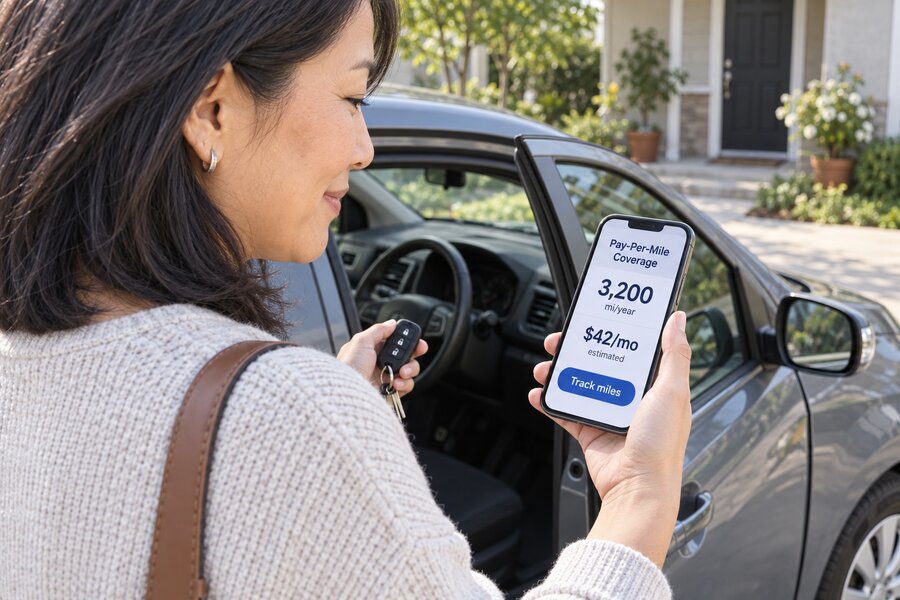
Most drivers who renew a car insurance policy every six or twelve months never stop to ask a simple question: how much of that premium is actually paying for the miles they personally drove, and how much is paying for miles an average driver in their zip code, age bracket, and vehicle class is assumed to drive. For decades, the honest answer has been that the two numbers are only loosely connected. A retiree who drives to the grocery store twice a week and a commuter who logs forty highway miles a day have historically been quoted premiums built from the same broad actuarial buckets, adjusted for a handful of demographic and vehicle factors but not for the one variable that intuitively matters most to how much risk a driver actually poses: the number of miles they put on the road. Anyone who has driven noticeably less than their household’s other cars, worked from home for years, or owns a second vehicle that mostly sits in a garage has likely suspected they were quietly subsidizing someone else’s commute, without any real way to prove it or price their policy accordingly.
Pay-per-mile insurance is the industry’s direct answer to that suspicion. Instead of pricing a policy around an assumed annual mileage band drawn from statistical averages, insurers offering this model charge a small fixed base rate to cover the vehicle while it is parked, plus a per-mile rate applied only to the miles actually driven, verified through a plug-in telematics device, a smartphone app, or periodic odometer readings. The pitch is straightforward: a driver who genuinely puts fewer miles on their car should pay less for coverage than one who does not, and the model finally gives insurers a cheap, reliable way to confirm that a driver’s actual mileage matches what they are being charged for, rather than relying on a self-reported estimate at the time of signup that both insurer and driver know is often just a guess.
It is worth being precise about what pay-per-mile insurance is and is not, because the broader category it sits inside, usage-based insurance, covers a wider range of pricing approaches that get conflated in casual conversation. Some usage-based programs price a policy primarily on driving behavior, hard braking, rapid acceleration, late-night driving, phone use behind the wheel, rather than on mileage itself, and a driver could rack up relatively few miles under one of these behavior-scored programs and still see little discount if their driving style is judged risky. Pay-per-mile programs, by contrast, are built around the single variable of distance traveled, with the daily or monthly base fee held constant and the per-mile charge doing essentially all of the work of adjusting the bill up or down. Some insurers blend both approaches, layering a behavioral score on top of a per-mile base, but the pure pay-per-mile model this article focuses on is the one where mileage is the dominant, and often only, usage variable being priced.
This article walks through why conventional, average-based pricing has historically shortchanged low-mileage drivers, how a pay-per-mile policy actually calculates a bill from telematics data, and which kinds of drivers stand to benefit the most, and which should think twice before switching. It then examines two documented, verifiable developments in this specific corner of the insurance industry: a pioneering American insurer’s growth and eventual absorption into a larger insurtech company, and a British pay-by-mile insurer whose rise and subsequent wind-down illustrate that this model, while genuinely useful for the right driver, has not yet proven itself as a permanently stable standalone business in every market where it has launched.
Readers evaluating this subject for the first time sometimes assume the interesting part is the tracking device or the app itself, but the more useful framing is that pay-per-mile insurance is fundamentally a pricing precision problem. Insurers have always wanted to charge each driver a premium that reflects their actual risk as closely as possible, since a company that consistently overcharges low-risk drivers will lose them to a competitor who prices more accurately, while a company that undercharges high-risk drivers loses money on every claim. Mileage has always been understood as one of the strongest predictors of accident risk, more miles driven generally means more exposure to a crash, but insurers lacked an affordable, reliable way to verify actual mileage at scale until telematics hardware and smartphone GPS became cheap and ubiquitous. Keeping that framing in mind makes it easier to evaluate this model on its actual merits: not as a novelty gadget bolted onto a policy, but as insurers finally gaining the tool they needed to price the one variable that mattered most all along.
This article is written for someone who has never used a pay-per-mile policy and wants to understand, in plain terms, whether the model would actually save them money and what they would be trading away to get that savings. It assumes no prior familiarity with telematics hardware, insurance rating factors, or the corporate history of the companies that have built this product, and it tries to be equally direct about the model’s genuine advantages and its real limitations, rather than presenting it as an unambiguous upgrade over conventional coverage for every driver in every situation. Insurance pricing is ultimately a numbers exercise specific to each household’s own driving pattern, and the goal here is to give readers the actual framework and documented examples needed to run that exercise for themselves rather than a generic recommendation to switch.
How Traditional Auto Insurance Pricing Falls Short for Low-Mileage Drivers
Conventional auto insurance underwriting has long relied on a mileage band, a broad estimate of annual miles driven, typically self-reported by the policyholder at signup and rarely verified afterward unless a claim investigation happens to surface odometer records. Insurers use this self-reported figure alongside dozens of other rating factors, vehicle make and model, garaging zip code, driver age and history, credit-based insurance scores in states that permit them, to arrive at a premium, but the mileage estimate itself is generally treated as a rough input rather than a precisely tracked variable, and insurers have historically had limited practical ability to confirm whether a driver who reported ten thousand annual miles at signup is still driving anywhere close to that figure three years into the policy.
This creates a systematic mismatch for anyone whose actual driving falls well below the assumed average for their rating category. A retiree who no longer commutes, a remote worker who gave up a daily drive to an office, or a household that owns a third vehicle used only for occasional errands all tend to drive dramatically fewer miles than the mileage band their premium was built around, yet they generally pay close to the same rate as a household member or similarly rated driver who commutes daily, because the insurer has no efficient mechanism to distinguish between them beyond a self-reported estimate that carries little weight in the actual pricing formula. Industry mileage surveys have repeatedly found wide dispersion in how much individual drivers within the same rating category actually drive in a given year, which means the assumption embedded in a flat, mileage-band-based premium is, for a meaningful share of policyholders, simply wrong in a way that costs them money every renewal cycle.
The shift toward remote and hybrid work arrangements that accelerated in the early 2020s made this mismatch considerably more visible and more costly for a large segment of the driving population. Millions of workers who previously commuted five days a week reduced their driving dramatically, sometimes overnight, while their auto insurance premiums, priced against pre-pandemic commuting assumptions baked into their rating category, did not automatically adjust to reflect the new reality unless the driver proactively contacted their insurer, updated their stated mileage, and, in many cases, still saw only a modest discount rather than a price that scaled cleanly with the actual reduction in miles driven. This gap between a structural change in driving behavior and a pricing system slow to reflect it is precisely the opening that pay-per-mile insurers have targeted, marketing directly to exactly this population of drivers who know, often to the mile, how much less they are actually driving than their premium assumes.
A second and less discussed source of mismatch is multi-car households, where a family may own two or three vehicles but effectively drive only one or two of them regularly, leaving an older or backup vehicle largely idle in a driveway or garage for most of the year. Conventional insurers typically still charge close to a full premium for that idle vehicle’s liability and comprehensive coverage, since state law generally requires any registered, driveable vehicle to carry at least minimum coverage, and insurers have limited ability under conventional rating structures to meaningfully discount a policy just because a specific car happens to sit unused most weeks. This is a second, distinct population, alongside remote workers and retirees, for whom mileage-based pricing has an obvious and often substantial financial upside, since a vehicle driven a few hundred miles a year under a per-mile model can cost a small fraction of what the same vehicle would cost under a conventional flat-rate policy.
A further wrinkle in conventional pricing involves how insurers have historically treated mileage estimate updates after a policy is already in force. Most conventional insurers allow a policyholder to update their estimated annual mileage at renewal, and a driver who proactively reports a significant reduction can sometimes see a modest rate adjustment, but this system still depends entirely on the driver noticing the discrepancy, understanding that it might affect their premium, and taking the initiative to contact their insurer and request a change, a process many policyholders simply never go through even when their actual driving has shifted substantially. Insurers, for their part, have historically had limited incentive to proactively flag to a customer that reduced driving might qualify them for a lower rate, since doing so reduces the insurer’s own premium revenue from that policyholder, meaning the burden of catching and correcting this kind of overpayment has fallen almost entirely on the driver.
Taken together, these dynamics, a rating system built around broad mileage assumptions rather than verified actual usage, a slow institutional response to structural shifts in commuting behavior, limited pricing flexibility for underused household vehicles, and a self-reporting update process that places the entire burden of correction on the policyholder, describe why a meaningful share of drivers have been effectively overpaying relative to their actual risk exposure for as long as flat, mileage-band-based pricing has dominated the market. It is this specific and quantifiable overpayment, not a vague sense that insurance is expensive in general, that pay-per-mile insurance is designed to correct.
How Pay-Per-Mile Insurance Actually Works
At a mechanical level, a pay-per-mile policy combines a small fixed charge, typically billed daily or monthly, that covers the vehicle for liability and often comprehensive protection while parked, with a variable charge calculated from the actual miles driven during that billing period. This structure means a driver who takes an extended trip and drives far more than usual in a given month will see a correspondingly higher bill that month, while a driver who barely uses the car during a slow month sees a correspondingly lower one, a genuinely different experience from a conventional annual or six-month premium that stays fixed regardless of how driving patterns fluctuate within the policy term.
It is worth distinguishing this cleanly from the broader category of usage-based insurance that also monitors driving behavior rather than mileage alone. Behavior-scored programs typically track metrics like hard braking events, rapid acceleration, cornering forces, and the time of day a vehicle is driven, using these signals to build a risk score that can raise or lower a premium independent of total distance traveled, which means a driver in one of these programs who drives cautiously but frequently might still see a discount, while a driver who drives rarely but aggressively during those rare trips might not. Pure pay-per-mile programs, by design, generally do not incorporate this kind of behavioral scoring at all, focusing exclusively on distance as the pricing variable, which makes the model considerably simpler to understand and predict from a driver’s perspective, even though it means a per-mile policy will not reward genuinely careful driving with a further discount beyond whatever savings come from driving fewer total miles.
The commercial viability of this model has depended heavily on the cost and reliability of the underlying tracking technology, which has changed considerably over the past decade. Early per-mile pilots and niche insurers relied on dedicated hardware devices plugged into a vehicle’s onboard diagnostics port, an approach that works reliably but requires the insurer to manufacture, ship, and eventually retrieve physical hardware from every policyholder, a meaningful operational cost at scale. As smartphone GPS and low-power background location tracking matured, several insurers shifted toward app-based mileage tracking that requires no separate hardware at all, lowering the cost of offering the product and making it easier for a driver to sign up and start seeing accurate per-mile billing within days rather than waiting for a device to arrive in the mail.
Regulatory approval has also shaped how quickly this model could expand from a single pilot market into a nationally available product. Auto insurance rate structures generally require approval from each state’s insurance regulator before an insurer can legally charge customers under a new formula, which means a per-mile pricing structure approved and functioning well in one state cannot simply be rolled out nationwide overnight; it has to work through a separate regulatory filing and approval process in every additional state where the insurer wants to offer it. This state-by-state approval requirement is a significant part of why pay-per-mile products have historically been available in a majority but not the entirety of U.S. states at any given time, and why an insurer’s list of available states tends to grow gradually year over year rather than becoming complete on the product’s initial launch.
Telematics, Tracking Devices, and What Data Gets Collected
The plug-in device approach, often called an OBD-II dongle after the onboard diagnostics port most vehicles built after the mid-1990s are equipped with, connects directly to the vehicle’s internal computer system and can read odometer mileage directly from the car itself, which generally produces highly accurate mileage figures without depending on a driver remembering to open an app or carry a phone during every trip. These devices typically also collect some combination of GPS location during trips, hard-braking and acceleration events, and time-of-day driving patterns, even on policies marketed as pure mileage-based products, because insurers often want the option to layer behavioral scoring into future pricing models even if the current policy structure does not use it, and because location data helps insurers detect and prevent mileage-reporting fraud.
App-based tracking instead relies on a smartphone’s own GPS and motion sensors to detect when a trip begins and ends and to calculate distance traveled, an approach that avoids the cost and installation friction of physical hardware but introduces its own accuracy challenges, since a phone left at home during a trip, a dead battery, or a background app permission accidentally disabled can all cause missed or undercounted mileage. Most insurers using this approach build in fallback verification methods, periodic odometer photo uploads, or reconciliation against DMV registration renewal odometer readings, to catch and correct significant discrepancies between app-tracked mileage and a vehicle’s actual odometer, since a systematic undercount would eventually become visible and costly to the insurer.
A third, lower-tech verification method some insurers use, particularly for policies aimed at genuinely low-mileage or seasonal drivers, is periodic odometer photograph submission through a mobile app, where the policyholder takes and uploads a picture of the odometer at set intervals, and the insurer calculates mileage and bills retroactively based on the difference between readings. This method requires no continuous tracking or location data collection at all, which appeals specifically to privacy-conscious drivers who are comfortable with mileage-based pricing but uncomfortable with a device or app that could also reveal exactly where and when they drove, a distinction covered in more detail later in this article’s discussion of privacy trade-offs.
Each of these three methods also differs in how quickly a discrepancy gets caught and corrected. A plug-in device reading mileage directly from a vehicle’s computer generally produces close to real-time accuracy with little room for a policyholder to inadvertently undercount, while an app relying on a phone left behind or a permission accidentally toggled off can drift from actual mileage for weeks before either the driver or the insurer notices a mismatch against an odometer photo or a DMV registration reading. Odometer-photo submission sits at the opposite end of this spectrum from real-time accuracy, since it only reconciles mileage at whatever interval, often every few months, the insurer requires photo submission, meaning a driver on this method effectively pays retroactively for a period rather than seeing charges reflect their driving in near real time.
Base Rates, Per-Mile Rates, and How Premiums Are Calculated
The base rate in a typical pay-per-mile policy functions similarly to a fixed subscription fee, covering the vehicle for comprehensive and often liability protection while parked, regardless of whether it is driven at all that day or month, and this base rate is generally set using the same underlying rating factors, vehicle type, driver history, garaging location, that a conventional insurer would use to price a full policy. On top of this fixed charge, the insurer applies a per-mile rate, often expressed in cents per mile, that is multiplied by the verified mileage driven during the billing period to produce the variable portion of the bill, with many programs capping the number of miles that count toward billing in a single day to prevent an unusually long single trip from producing an outsized one-day charge.
Estimating likely monthly cost under this model requires a driver to have a reasonably accurate sense of their own typical mileage, which is precisely the information conventional self-reported estimates at signup have historically captured poorly. A driver considering a switch can generally get a meaningful estimate by reviewing several months of odometer readings or trip logs, multiplying average monthly mileage by the quoted per-mile rate, and adding the fixed base rate, though most insurers offering this product also provide an online calculator or a low-mileage guarantee period during which a new policyholder can test actual costs against a conventional quote before fully committing. Because the model shifts genuine month-to-month cost variability onto the driver, someone whose mileage fluctuates significantly, a seasonal worker, a caregiver with an unpredictable driving schedule, a family that takes one long annual road trip, should factor in the higher-mileage months when estimating whether the average savings still outweigh the occasional expensive month, rather than judging the product only by its cheapest possible billing period.
Most providers also publish a maximum monthly or annual charge, sometimes called a mileage cap, beyond which no further per-mile charges accrue even if the vehicle continues to be driven, functioning as a safety net that prevents an unusually high-mileage month or year from producing a bill that exceeds what a conventional flat policy would have cost in the first place. This cap is worth checking specifically before switching, since it effectively defines the point at which a pay-per-mile policy converts into something functionally similar to a conventional flat-rate policy, and a driver whose mileage regularly approaches or exceeds that cap is, in practice, unlikely to see much benefit from the per-mile structure at all.
Benefits and Trade-offs by Driver Type
Low-mileage drivers in the most literal sense, those who simply do not drive very much regardless of the underlying reason, see the most straightforward and largest benefit from this model, since their bill scales down directly with reduced usage rather than remaining anchored to an assumed average they fall well below. Retirees who have given up a daily commute, drivers who rely primarily on walking, cycling, or public transit for routine trips and keep a car mainly for occasional errands or emergencies, and households that have downsized to fewer actively driven vehicles all tend to fall into this category, and for many of these drivers the savings relative to a conventional flat premium can be substantial enough to make switching an easy decision once they run the math on their own actual mileage.
Remote and hybrid workers represent a second population with a clear, well-documented benefit, since giving up even a moderate daily commute of ten or fifteen miles each way removes a large share of the annual mileage a conventional premium assumed when originally priced. This group is particularly well suited to pay-per-mile coverage because their driving reduction is usually a stable, ongoing shift in lifestyle rather than a temporary anomaly, meaning the savings a per-mile model captures are likely to persist across renewal periods rather than reverting once a one-time circumstance passes.
Multi-car households benefit specifically on their least-used vehicle, since insuring an older car that mostly sits idle, a teenager’s car used only occasionally, or a second vehicle kept for infrequent trips, through a conventional flat-rate policy often means paying close to full price for coverage the vehicle barely uses. Placing just that underused vehicle on a pay-per-mile policy, while keeping a primary daily-driven vehicle on conventional coverage, lets a household capture savings precisely where the mismatch between assumed and actual usage is largest, without having to move an entire household’s insurance to a usage-based model.
Owners of seasonal or specialty vehicles, a convertible driven only in summer months, a vehicle kept at a vacation property and used a few weeks a year, similarly benefit because their driving is concentrated into a small number of weeks rather than spread evenly across the year, and a per-mile model prices exactly that pattern accurately rather than charging a full annual premium for coverage the vehicle uses only occasionally.
College students who leave a car at a family home while away at school for much of the year, and young drivers who might otherwise be added to a parent’s policy at a steep flat surcharge regardless of how rarely they actually drive during the school year, represent another population that can benefit meaningfully, since the fixed base rate covers the vehicle while parked at low cost and the per-mile charge only accumulates during the weeks the student is actually home and driving. This use case is worth calling out specifically because young, inexperienced drivers are otherwise among the most expensive groups to insure under conventional rating, and a model that ties at least the variable portion of their cost to actual usage rather than solely to age-based risk categories can meaningfully soften that expense during the many months a student’s car sits unused.
On the other side of this equation, high-mileage commuters, delivery drivers, and anyone who spends a large share of their working day behind the wheel generally see little to no benefit and often a meaningfully higher bill under a per-mile model, since their variable, mileage-based charge accumulates faster than a conventional flat premium priced against a broad average that already assumed substantial driving. Rideshare and delivery gig workers face an additional complication beyond simple cost comparison, since most personal auto policies, including per-mile products, explicitly exclude coverage while a vehicle is being used commercially to transport paying passengers or deliver goods for a fee, meaning these drivers generally need a separate commercial or rideshare-specific endorsement regardless of whether their personal policy is priced conventionally or per mile. Drivers who simply cannot predict their own mileage with any confidence, due to an unpredictable job, caregiving responsibilities, or a household situation that shifts frequently, should also weigh the psychological cost of a bill that varies meaningfully month to month against the potential savings, since some drivers strongly prefer the budgeting certainty of a fixed premium even if it is not the mathematically cheapest option available to them.
Long-distance commuters who live far from an urban center specifically to afford housing, a pattern common in many expensive metropolitan regions, deserve a particular note of caution, since this group often drives well above the average their conventional rating category assumed precisely because their housing decision was shaped by cost pressures rather than a preference for driving more. For this population, a pay-per-mile policy is likely to cost more than their existing flat-rate coverage, and evaluating the switch requires the same honest mileage arithmetic recommended throughout this article rather than assuming that any usage-based product automatically saves money simply because it sounds more modern or more precisely calculated than a conventional policy.
Documented Case Studies in Pay-Per-Mile Insurance
Pay-per-mile insurance has now existed long enough, and at large enough commercial scale, to have generated two clearly documented and dated case studies that illustrate different parts of the same industry story. One traces an American pioneer of the model from its own publicly reported financial metrics through its acquisition by a larger insurtech company, showing how the model has been absorbed into bigger, more diversified insurance businesses rather than remaining a standalone niche forever. The other traces a British pay-by-mile insurer from its early funding and public policy engagement through a corporate acquisition and, more recently, a full wind-down following a subsequent merger further up its ownership chain, illustrating that even a well-regarded implementation of this model is not automatically insulated from the ordinary corporate consolidation pressures affecting the wider insurance industry.
Both companies examined here were, at the time of their respective acquisitions, treated by their acquirers as valuable enough to buy rather than compete against from scratch, which is itself a meaningful data point about how seriously established insurers now take the pay-per-mile pricing model. An established insurer choosing to acquire a specialist’s licenses, technology, and years of accumulated telematics data, rather than simply building a competing product internally, signals that the specialist had built something genuinely difficult to replicate quickly, whether that was Metromile’s decade of cross-referenced mileage and claims data or By Miles’ UK-specific regulatory licenses and app infrastructure.
Metromile to Lemonade: Scaling and Consolidating a Pay-Per-Mile Pioneer
Metromile, founded in 2011, built one of the earliest and best-known pay-per-mile auto insurance businesses in the United States, using a plug-in telematics device to track actual mileage and price policies around a base rate plus a per-mile charge, eventually operating under insurance licenses across a large majority of U.S. states. As a publicly traded company on the Nasdaq exchange, Metromile was required to disclose detailed quarterly operating metrics, which makes its growth trajectory unusually well documented compared to most insurtech startups. According to Metromile’s own first-quarter 2022 financial results, the company reported 101,294 policies in force as of March 31, 2022, a six percent increase from 95,958 policies in force a year earlier, alongside direct earned premium of 28.1 million dollars for the quarter, an 8.9 percent increase from the prior-year period, and a premium run-rate, calculated as ending policies in force multiplied by average annual premium per policy, of 116 million dollars as of that same date.
These figures matter because they show a pay-per-mile insurer operating at genuine, independently verified commercial scale rather than as a small pilot program, with over a hundred thousand active policyholders and more than a hundred million dollars in annualized premium run-rate by early 2022. Lemonade, a broader insurtech company known initially for renters and homeowners insurance built on an AI-driven underwriting model, announced its intention to acquire Metromile and completed the acquisition on July 28, 2022, in an all-stock transaction, ultimately valued at approximately 145 million dollars, considerably below the roughly 500 million dollar fully diluted valuation implied when the deal was first announced, reflecting a broader decline in insurtech valuations during that period. Lemonade’s own stated rationale for the acquisition centered on Metromile’s decade of accumulated telematics data, drawn from billions of miles of tracked driving cross-referenced against hundreds of thousands of processed claims, along with the practical value of Metromile’s insurance licenses across 49 states and its more than 250 million dollars of cash on hand at the time of the deal.
Following the acquisition, Metromile’s pay-per-mile technology and underwriting data became the foundation for Lemonade’s own car insurance product, marketed under the Lemonade Car brand, illustrating a specific and instructive pattern in how this corner of the insurance industry has matured: rather than each new entrant building pay-per-mile technology from scratch and competing as a permanently independent company, a proven, data-rich pioneer’s technology and licenses were absorbed into a larger, more diversified platform that could offer the same underlying pricing model alongside other insurance lines. This is a meaningfully different and more encouraging outcome than a simple shutdown would represent, since the pay-per-mile pricing approach itself continued operating and expanding under new ownership rather than disappearing from the market entirely.
By Miles: A UK Pay-by-Mile Insurer’s Rise and Wind-Down
By Miles built a pay-by-mile car insurance product for the UK market using a plug-in device and mobile app combination, charging customers a fixed annual cost to cover a parked vehicle for fire and theft risk plus a modest per-mile rate for actual driving, and the company raised five million pounds in a Series A funding round to develop in-app claims handling and expand its product range. The company’s model attracted enough policy credibility that it submitted formal written evidence to a UK parliamentary committee examining electric vehicle policy, a genuinely verifiable and dated public record of the company positioning pay-by-mile insurance as relevant to broader transport and environmental policy discussions rather than treating it as a purely commercial side product.
Direct Line Insurance Group, one of the UK’s largest motor insurers, acquired By Miles on April 24, 2023, bringing the pay-by-mile specialist’s technology and underwriting approach under the umbrella of a much larger, established insurance company, a consolidation pattern broadly similar to Lemonade’s acquisition of Metromile in the American market the year before. For roughly two years following that acquisition, By Miles continued operating and writing new business as part of Direct Line Group’s broader portfolio of motor insurance brands.
The subsequent chapter of this story adds an important and honest complication to the pay-per-mile narrative. Aviva, a separate and even larger UK insurer, completed its acquisition of Direct Line Group on July 1, 2025, in a deal valued at approximately five billion pounds, becoming the largest combined auto and home insurer in the UK market. Following this acquisition, Aviva made the decision to wind down By Miles as part of a broader strategy to concentrate investment in its core Aviva, Direct Line, and Churchill brands rather than continue operating By Miles as a distinct product line, resulting in more than sixty announced job reductions. By Miles stopped offering new-customer quotes on November 26, 2025, and stopped offering renewal quotes to existing customers on January 6, 2026, with the company’s remaining customer base being wound down over an announced period of roughly eighteen months, during which existing policies remain valid through their original end dates and customers retain access to the company’s app and support channels.
This case study is worth including precisely because it complicates a simple, uniformly positive narrative about this pricing model. By Miles was not shut down because pay-by-mile pricing failed commercially or because customers were dissatisfied with it; the company was wound down as a consequence of corporate consolidation two ownership layers removed from its original founding team, a pattern common across the broader insurance industry regardless of a given product’s underlying merits. Prospective customers evaluating any single pay-per-mile provider, in the UK, the United States, or elsewhere, should weigh not only the pricing math for their own driving pattern but also the provider’s ownership structure and the possibility that a well-performing niche product can still be discontinued for reasons entirely unrelated to whether it served its customers well.
The wind-down announcement itself is also worth reading carefully as a model of how a responsible transition away from a discontinued insurance product should be communicated and executed. By Miles committed to honoring existing policies through their original end dates rather than cancelling coverage immediately, maintained customer access to its app and support channels throughout the transition, and phased job reductions across 2026 specifically to ensure adequate staffing remained in place to serve the remaining customer base until each policy naturally concluded, an approach that gives affected customers a genuine multi-month runway to shop for replacement coverage rather than an abrupt cutoff.
Privacy, Pricing Fairness, and Other Open Questions
The most immediate concern many drivers raise about pay-per-mile insurance is the location and driving-pattern data collected by the underlying tracking technology, since a device or app capable of accurately measuring mileage is, by the same underlying GPS functionality, generally also capable of recording exactly where and when a vehicle traveled. Most insurers offering this product publish data use policies stating that location data is used primarily for mileage verification, fraud prevention, and claims investigation rather than being sold to third parties for unrelated marketing purposes, but drivers genuinely uncomfortable with any continuous location tracking should look specifically for a provider offering odometer-photo-based verification, which avoids GPS tracking entirely at the cost of losing the convenience of automatic, continuous mileage logging.
A second open question involves what happens when a driver’s mileage shifts substantially and durably during a policy term, either upward or downward, rather than merely fluctuating month to month around a stable average. A driver who takes a new job requiring a much longer commute, or who unretires and returns to regular work travel, will see their pay-per-mile bill rise accordingly, which is the intended behavior of the model but can come as an unwelcome surprise to a driver who signed up expecting the low bills of their previous, lower-mileage lifestyle to continue indefinitely. Most providers allow a policyholder to switch back to a conventional policy or a different coverage tier if their driving pattern changes enough that per-mile pricing no longer makes financial sense, but this generally requires the driver to notice the shift and proactively request a change, similar to the self-reporting friction that made conventional mileage-band pricing inaccurate in the first place, just inverted.
Device and app reliability represents a more mundane but genuinely consequential open question, since a driver’s actual bill depends entirely on the tracking technology working correctly and consistently. A plug-in device that becomes unplugged, damaged, or incompatible after a vehicle’s onboard computer receives a software update can cause billing gaps or disputes that a driver has to actively resolve with customer service, and an app-based system depending on a phone’s battery, location permissions, and background activity settings introduces its own failure points that a driver may not notice until a bill looks unexpectedly high or low. Reading a specific provider’s policy on how it handles and corrects tracking gaps, rather than assuming the technology will simply work flawlessly, is a reasonable step before committing to this model for a driver’s only vehicle.
Households with more than one driver sharing a single insured vehicle raise a further practical wrinkle, since most mileage-tracking methods measure the vehicle’s total movement rather than distinguishing which household member was actually behind the wheel for a given trip. A family that insures one car under a per-mile policy but has two adult drivers alternating use of it will be billed for the vehicle’s combined mileage regardless of which driver logged which trip, meaning the savings calculation should be based on the vehicle’s total household mileage rather than any single driver’s individual habits, a distinction that is easy to overlook when a household is comparing per-mile quotes against a conventional policy that was already priced per vehicle rather than per driver.
Finally, there is a legitimate fairness question about whether mileage-based pricing structurally disadvantages drivers who have no realistic alternative to driving longer distances, rural residents facing long distances to reach basic services, workers in areas with limited public transit whose jobs require a lengthy commute regardless of preference, and drivers whose family or caregiving obligations require regular long-distance travel that a personal choice to drive less could not meaningfully reduce. For these drivers, a per-mile model may simply reproduce, or in some cases sharpen, the same higher costs a conventional average-based policy already charged them, since their mileage genuinely sits above the average their previous flat rate was built around, meaning the model’s benefit is concentrated among drivers with genuine flexibility to reduce mileage, and offers comparatively little to drivers whose mileage is effectively fixed by circumstances outside their control.
A related and somewhat more technical fairness question involves how per-mile rates themselves get set across different geographic areas and rating categories, since a per-mile rate is still built from the same underlying actuarial inputs, accident frequency and severity data for a given area and driver profile, that inform any conventional premium. This means two drivers who both drive exactly ten thousand miles a year, one in a densely trafficked urban area and one in a quieter suburb, can still see meaningfully different per-mile rates and therefore different total bills, since the model prices distance driven but does not eliminate the underlying geographic and demographic risk factors that have always varied across drivers. A driver evaluating pay-per-mile insurance should understand that switching to this model changes which variable is doing the most visible work in the pricing formula, but it does not remove every other rating factor a conventional policy already accounted for, and a driver in a higher-risk area may still pay a higher per-mile rate than a similar driver in a lower-risk one even though both are being charged under the same basic pricing structure.
Final Thoughts
Pay-per-mile insurance represents a genuine correction to a pricing distortion that flat, average-based premiums have carried for as long as auto insurance has existed as a mass-market product, giving insurers a reliable, low-cost way to charge drivers for the risk they actually generate rather than the risk an assumed average driver in their broad rating category generates. For the specific populations this model serves well, retirees, remote workers, multi-car households, and owners of seasonal or lightly used vehicles, the savings are not a marketing gimmick but a direct, calculable consequence of finally pricing the single variable that has always mattered most to accident risk with real precision instead of a rough guess made once at signup and rarely revisited.
At the same time, the two case studies examined in this article demonstrate that the underlying business of offering this coverage remains subject to the same consolidation pressures affecting the broader insurance industry, regardless of how well a specific product serves its customers. Metromile’s absorption into Lemonade shows a pioneer’s technology and data continuing to operate and expand under new ownership, a genuinely encouraging outcome for the model’s long-term durability. By Miles’ wind-down following two successive layers of corporate acquisition shows the opposite risk: a well-regarded, publicly engaged pay-by-mile insurer discontinued for reasons entirely unrelated to product quality or customer satisfaction, purely as a consequence of decisions made by a much larger acquiring company reallocating investment toward its core brands.
The financial inclusion dimension of this technology deserves genuine attention alongside its cost-saving appeal. Drivers who have historically been priced as if they drive far more than they actually do, often lower-income drivers who cannot afford to own and regularly use a second or third vehicle, retirees living on fixed incomes, and people who have deliberately restructured their lives around less driving for financial or environmental reasons, stand to benefit disproportionately from a pricing model that finally reflects their actual behavior rather than an assumed average built around a more affluent or more car-dependent lifestyle. Extending this kind of precise, usage-based pricing to more of the driving population, rather than treating it as a niche product primarily marketed to affluent, tech-comfortable early adopters, would represent a meaningful step toward auto insurance pricing that more accurately reflects the genuinely diverse ways people actually use their vehicles.
What ultimately determines whether pay-per-mile insurance becomes a default mainstream option rather than a niche product chosen only by drivers who specifically seek it out is not a further improvement in the underlying tracking technology, which the case studies here show already works reliably at meaningful commercial scale. It is whether more insurers integrate this pricing option directly alongside their conventional products, rather than requiring a driver to seek out a specialized standalone provider, and whether the industry’s ongoing wave of acquisitions and consolidations, illustrated clearly by both case studies in this article, resolves toward preserving and expanding access to mileage-based pricing rather than quietly discontinuing it whenever a larger acquirer’s strategic priorities shift elsewhere. A driver reading this article today has a genuinely actionable next step available regardless of how that larger industry question eventually resolves: pull a few months of actual odometer readings, compare that real mileage against the assumptions built into a current policy, and let that concrete arithmetic, rather than marketing from any single provider, determine whether switching is worth it.
FAQs
- How is pay-per-mile insurance different from regular usage-based insurance?
Pay-per-mile insurance prices a policy primarily on actual distance driven, using a fixed base rate plus a per-mile charge. Broader usage-based insurance programs often also score driving behavior, such as hard braking or late-night driving, meaning a low-mileage driver with a risky driving style might see less benefit under a behavior-scored program than under a pure per-mile model. - How much can I actually expect to save by switching?
Savings depend entirely on how far below the average mileage assumption in your current rating category you actually drive. Drivers who drive significantly less than average, retirees, remote workers, and owners of rarely used second vehicles, tend to see the largest savings, while average or high-mileage drivers may see little difference or even a higher bill. - What data does a pay-per-mile insurer actually collect about my driving?
This depends on the tracking method. Plug-in devices and GPS-based apps typically collect mileage, trip timing, and sometimes location and driving-event data, while odometer-photo-based verification collects only periodic mileage readings without continuous location tracking, which is worth checking directly in a specific provider’s data use policy. - Is a real pay-per-mile insurance company still operating today, or did the concept fail?
The concept has not failed; Metromile’s pay-per-mile technology and licenses continue operating today under Lemonade, which acquired Metromile on July 28, 2022, and now markets pay-per-mile coverage as Lemonade Car, built directly on the underwriting data Metromile accumulated over a decade of operation. - Why did By Miles, a well-regarded UK pay-by-mile insurer, shut down?
By Miles was not discontinued due to poor performance or customer dissatisfaction. Direct Line Group acquired By Miles on April 24, 2023, and after Aviva completed its own five-billion-pound acquisition of Direct Line Group on July 1, 2025, Aviva chose to wind down By Miles to concentrate investment in its core Aviva, Direct Line, and Churchill brands, ending new quotes in November 2025 and renewals in January 2026. - Will my bill go up if I take one long road trip during the year?
Yes, the per-mile charge for that specific billing period will reflect the additional miles driven, though most providers cap the number of miles counted toward a single day’s charge to prevent one unusually long trip from producing an extreme one-day cost, and your base rate stays fixed regardless of that month’s mileage. - Does pay-per-mile insurance work for a car used for rideshare or delivery driving?
Generally no. Most personal pay-per-mile policies, like most conventional personal auto policies, explicitly exclude coverage while a vehicle is being used commercially to transport paying passengers or deliver goods, so rideshare and delivery drivers typically need a separate commercial or rideshare-specific endorsement regardless of how their personal policy is priced. - What happens if my mileage changes a lot partway through the year, like starting a new job with a longer commute?
Your bill will rise to reflect the higher mileage, since that is the model working as intended, but if the increase is substantial and durable most providers let you switch to a different coverage tier or back to a conventional policy, though this usually requires you to notice the shift and proactively contact your insurer. - Can a tracking device or app make a mistake and overcharge me?
Yes, this is a real operational risk. A disconnected plug-in device or an app affected by a dead phone battery or disabled location permission can cause tracking gaps or errors, which is why it is worth reviewing a specific provider’s process for disputing and correcting mileage discrepancies before relying on this coverage for your only vehicle. - Is pay-per-mile insurance a good fit for someone who lives in a rural area with a long daily commute?
Usually not. The model’s savings are concentrated among drivers whose mileage is genuinely below their previous rating category’s average, and a driver whose long commute is a fixed requirement of where they live and work will likely see costs similar to or higher than a conventional policy, since their actual mileage may exceed rather than fall short of the average their old premium assumed.