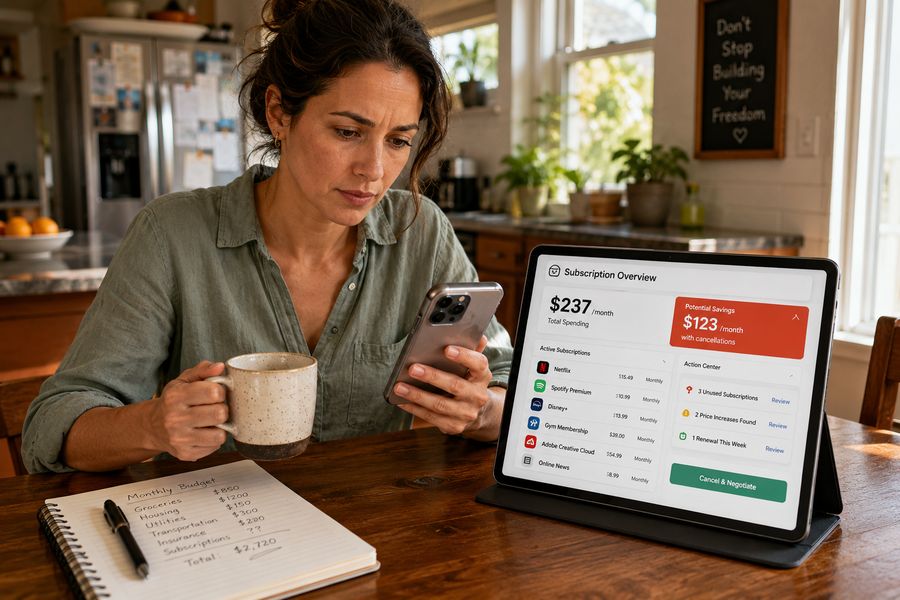
Somewhere in the financial life of nearly every modern household sits a small, quiet leak, a trickle of recurring charges that drains money month after month without anyone quite noticing, accumulating into a sum that would startle the person paying it if only they stopped to add it up. The streaming service signed up for one weekend and never cancelled, the fitness app downloaded with the best of good intentions back in January, the free trial that silently and automatically converted into a recurring paid plan, the premium tier of some tool used once and forgotten, the cloud storage that renews automatically each year, the news site behind a paywall read once, all of these and dozens more like them combine into a steady outflow that most people simply cannot estimate with any accuracy. This is the subscription economy, a fundamental shift in how goods and services are sold and paid for, and while it offers real convenience, it has also created a pervasive and largely invisible burden on personal finances, one that thrives precisely because it operates below the threshold of attention.
The scale of this problem is far larger than intuition suggests, and a body of research has documented a striking and consistent gap between what people believe they spend on subscriptions and what they actually spend, a gap that runs into hundreds of dollars per month for many households. Into this gap has stepped a category of technology designed expressly to close it, the subscription management application, a kind of tool that connects to a person’s financial accounts, identifies their recurring charges, surfaces the ones they have forgotten, and in many cases offers to cancel unwanted subscriptions or negotiate down recurring bills on the user’s behalf. These services promise to convert the invisible into the visible and to hand back to people a measure of control over an aspect of their finances that has quietly slipped away from them, and they have attracted millions of users and saved them substantial sums, even as they raise their own questions about privacy, cost, and effectiveness.
This article examines subscription management apps and the problem they address for readers who suspect they may be paying for more than they realize but do not know the full picture, beginning by quantifying the silent drain that recurring charges impose on household budgets using documented research. It then explores why people forget about subscriptions in the first place, examining both the psychology of recurring billing and the deliberate design choices that make signing up easy and cancelling hard, including the regulatory response to those choices. From there it explains how subscription management apps actually work, looks at what they do in practice through a documented example, and weighs honestly the trade-offs they involve, particularly around the sensitive matter of granting an application access to one’s financial accounts. It closes with a practical approach that any household can take to regain control over its subscriptions, with or without the help of an app, aiming to leave readers both more aware of the problem and better equipped to solve it.
The Silent Drain: Quantifying What Subscriptions Cost Us
The most revealing fact about subscription spending is not its size but the gap between its real size and what people believe they are spending, a discrepancy that research has measured with uncomfortable precision. In a widely cited study conducted by C+R Research in 2022, consumers were first asked to estimate their monthly subscription spending and offered an average guess of around eighty-six dollars, but when the same people were then walked through specific categories of subscriptions one by one and asked about each, the true total came to roughly two hundred nineteen dollars per month, about one hundred thirty-three dollars more than they had estimated. This is not a small rounding error but a gap of more than half again the amount people thought they were spending, and it reveals that the problem is not merely that subscriptions are expensive but that they are systematically invisible, escaping the mental accounting through which people track their money.
More recent research has suggested the figures have only grown as the subscription model has spread into ever more corners of daily life, with one study finding that Americans spend an average of around two hundred seventy-three dollars per month on subscription services while most people guessed their spending at only about one hundred eleven dollars, an even wider gulf between perception and reality. Whichever specific numbers one credits, the consistent finding across studies is that people dramatically underestimate their recurring spending, and that the underestimation runs to well over a hundred dollars per month for typical consumers, which translates into well over a thousand dollars per year of spending that is essentially happening outside of awareness. For a household trying to budget carefully, this represents a serious blind spot, a category of expenditure large enough to matter greatly yet hidden well enough to escape the scrutiny applied to more visible costs.
The portion of this spending that goes to subscriptions people have actively forgotten, as opposed to those they use but underestimate, is itself substantial and perhaps the most frustrating component of the drain. Research has found that a large share of consumers, on the order of forty percent, have forgotten that they are still paying for a subscription they no longer use, and that this forgotten spending alone amounts to hundreds of dollars per year for those affected, money paid month after month for services that deliver no value whatsoever because the person has entirely lost track of them and would cancel at once if reminded they existed. This is waste in its purest form, expenditure that benefits no one but the company collecting it, and its prevalence speaks to how easily a recurring charge can detach itself from any conscious decision and persist indefinitely, a small automatic payment that nobody remembers to question.
Understanding why these numbers reach such levels requires recognizing how thoroughly the subscription model has come to dominate modern commerce, extending far beyond the streaming entertainment services that first popularized it. Today a person might subscribe to services for video, music, news, software, fitness, meditation, food delivery, gaming, cloud storage, dating, productivity tools, online learning, pet supplies, meal kits, and countless other categories, each individually modest in cost but collectively significant, and the very proliferation of these small recurring charges is what makes them so hard to track. The research consistently shows that the great majority of consumers have most or all of their subscriptions set to renew automatically and that a large proportion find it genuinely easy to forget about these charges, a combination of automatic billing and low individual cost that allows the total to swell unnoticed, since no single charge is ever large enough to trigger the scrutiny a major purchase would receive, yet the many small charges together rival or exceed many of a household’s most carefully considered expenses. It is worth dwelling on what these sums mean in the context of a household budget, because the abstraction of a monthly figure can obscure the real significance of the waste. A gap of well over a hundred dollars per month between perceived and actual subscription spending amounts to more than a thousand dollars per year, a sum that for many families would cover a significant expense, build an emergency cushion, or relieve real financial pressure, and the portion of it that goes to entirely forgotten services is money that could be reclaimed without sacrificing anything of value whatsoever. Viewed over a span of years, the figures become genuinely consequential, since a few hundred dollars a year of forgotten subscriptions compounds into thousands of dollars over a decade, money quietly surrendered for nothing, and this long horizon is part of what makes the problem worth taking seriously rather than dismissing as a trivial matter of a few dollars here and there. The research suggests that the typical household is not making a small error but is systematically losing a meaningful fraction of its discretionary income to spending it cannot even accurately describe.
The silent drain, in other words, is not the result of any single extravagant choice but of the accumulation of many tiny, automated, forgettable ones, which is precisely the kind of problem that a tool designed to aggregate and surface them is well suited to address.
Why We Forget: The Psychology and Design of Recurring Billing
The pervasiveness of forgotten subscriptions is not a sign of unusual carelessness on the part of consumers but the predictable result of how recurring billing interacts with the limits of human attention and memory, and understanding these mechanisms helps explain why the problem is so widespread and so resistant to mere good intentions. At the most basic level, the human mind is poorly equipped to track many small, repeated, automatic events, since each individual subscription charge is too minor to register as significant and too routine to prompt reflection, and the automatic nature of the payment removes the moment of conscious decision that might otherwise serve as a memory anchor. When money leaves an account without any action required, there is no recurring prompt to reconsider whether the service is still wanted, and the charge simply recurs in the background, one of many such silent transactions, until something external draws attention to it.
The psychology of how people value and discount future events compounds this difficulty in the moment of signing up, when the decision to start a subscription is made. At that moment, the immediate benefit of the service feels concrete and appealing while the future cost feels abstract and small, a few dollars a month that seems trivial against the anticipated enjoyment or utility, and people consistently underweight the cumulative impact of a recurring commitment that will quietly continue long after the initial enthusiasm fades. The free trial intensifies this effect, offering immediate gratification at no apparent cost while deferring the decision to pay into a future the person does not fully imagine, so that by the time the trial converts to a paid subscription the initial intention may be entirely forgotten and the charge simply begins. This tendency to focus on the present and discount the future is a deep and well-documented feature of human decision-making, and the subscription model is, whether by accident or design, almost perfectly engineered to exploit it.
Beyond these individual psychological tendencies lie structural features of modern financial life that make tracking subscriptions objectively difficult even for a diligent person. Subscriptions are often spread across multiple payment methods, charged to different credit cards, debit cards, and digital payment accounts, so that no single statement shows the complete picture, and the charges appear under company names or billing descriptors that may bear little resemblance to the service as the consumer knows it, making them hard to recognize even when reviewing a statement carefully. The timing of charges varies, with some billing monthly, others annually, others on irregular cycles, so that an annual subscription might appear only once in twelve months and easily escape notice, and the sheer number of charges on a typical statement means that a recurring subscription can hide in plain sight among legitimate everyday transactions. There is also a social and emotional dimension to why subscriptions persist that deserves acknowledgment, since cancelling is not always a purely rational calculation. People sometimes keep subscriptions out of a vague sense that they might use the service again, an optimism about their future selves that rarely materializes but that makes cancellation feel like an admission of defeat, as when a person retains a fitness or learning subscription they no longer use because cancelling would mean conceding that they have abandoned a goal. Others keep services out of loyalty, habit, or simple aversion to the small unpleasantness of the cancellation process, and still others are deterred by the fear that they will lose access to content, data, or a price they will not be able to recover if they ever wish to return. These human factors interact with the psychological and structural ones to create a powerful inertia, a tendency for subscriptions to persist by default unless a deliberate effort is made to end them, which is exactly the effort that the difficulty of cancellation is designed to discourage.
These structural realities mean that even a person motivated to audit their subscriptions faces a genuinely laborious task, which is part of why so many never do it and why a tool that automates the work has real value.
Dark Patterns and the Difficulty of Cancelling
While some of the difficulty of managing subscriptions arises from natural psychological and structural factors, a significant portion is the result of deliberate design choices by companies that profit from making subscriptions easy to start and hard to stop, a practice that has come to be known by the term dark patterns. A dark pattern is a user interface designed to manipulate people into actions they might not otherwise take, and in the subscription context it manifests most commonly as a stark asymmetry between the ease of signing up and the difficulty of cancelling. Signing up is typically a matter of a single click or a quickly entered payment detail, smooth and frictionless by design, whereas cancelling may require navigating through hidden menus, completing multiple confirmation steps, calling a phone line during limited hours, speaking with a retention agent trained to dissuade, or enduring a series of offers and obstacles intended to wear down the person’s resolve.
This asymmetry is not accidental but a recognized business tactic, predicated on the understanding that every obstacle placed in the path of cancellation will cause some proportion of people to give up and continue paying, and that the friction of cancellation, combined with the forgetfulness already discussed, keeps revenue flowing from customers who would leave if leaving were easy. The cumulative financial effect of these tactics is enormous, since even a small increase in the difficulty of cancelling translates, across millions of subscribers, into vast sums retained from people who no longer want the service, and the practice has accordingly drawn the attention of regulators concerned with consumer protection. The very existence of a thriving industry of services that will cancel subscriptions on a person’s behalf is itself testimony to how difficult companies have made the process, since there would be no market for such help if cancelling were as simple as it ought to be.
The regulatory response to these practices has been significant though contested, illustrating both the seriousness with which authorities have come to view subscription traps and the difficulty of addressing them durably. In the United States, the Federal Trade Commission finalized a rule in October 2024, widely known as the click-to-cancel rule and formally an amendment to its negative option rule, which required that sellers make cancelling a subscription at least as easy as signing up, that they clearly disclose the material terms before taking payment, and that they obtain a consumer’s express and informed consent to recurring charges, with violations subject to substantial civil penalties. The rule represented a direct attack on the asymmetry at the heart of subscription dark patterns, but its path was not smooth, and in 2025 a federal appeals court vacated the rule on procedural grounds related to how it had been adopted, after which the commission moved in 2026 to begin the rulemaking process anew, seeking public input toward a revised version. The international dimension of the regulatory response is worth noting as well, since dark patterns and subscription traps are not a uniquely American problem and other jurisdictions have moved against them through their own consumer protection frameworks, addressing deceptive design, unclear terms, and the difficulty of cancellation. The broad direction of regulatory thinking across many countries has converged on the principle that consent to recurring payment must be genuine and informed and that leaving a subscription should not be meaningfully harder than joining it, a principle simple to state but evidently difficult to enforce against the persistent commercial incentive to retain customers through friction. For the individual consumer, the practical implication of this unsettled regulatory landscape is that one cannot yet rely on the law to guarantee an easy exit from every subscription, and that the burden of vigilance, while it ought to be lighter, remains substantially on the shoulders of the person paying the bills, which is precisely the burden that management tools attempt to ease.
This back-and-forth demonstrates that while there is clear official recognition of the problem and genuine appetite to address it, the legal mechanisms for doing so remain a work in progress, which leaves consumers, for the time being, substantially reliant on their own vigilance and on the tools that help them exercise it.
How Subscription Management Apps Work
Subscription management applications address the problem of hidden and forgotten recurring charges by automating the laborious work of finding, tracking, and cancelling subscriptions, and understanding how they function helps clarify both their usefulness and the considerations involved in using them. The foundation of nearly all such services is the linking of the user’s financial accounts, in which the person grants the application permission to view the transaction data from their bank accounts, credit cards, and other payment sources, typically through a secure intermediary service that specializes in connecting applications to financial institutions. This account linking is what allows the app to see the complete picture of a person’s spending that no single statement provides, aggregating transactions across all of their accounts into one view from which recurring charges can be identified, and it is simultaneously the source of the app’s power and the focus of the privacy considerations examined later.
Once an app has access to a user’s transaction history, its core function is the automatic detection of recurring charges, accomplished by analyzing the stream of transactions to find patterns that indicate a subscription, such as charges of the same or similar amount from the same merchant at regular intervals. This detection turns the difficult manual task of combing through statements into an automated process, and a good subscription manager will present the user with a clear list of their identified recurring charges, including ones the person may have entirely forgotten, often organized to highlight the total monthly and annual cost and to flag subscriptions that appear unused or that have recently increased in price. The intermediary services that connect these apps to financial institutions deserve a brief explanation, since they are a crucial and often invisible part of how the whole system functions. Rather than each app building a direct connection to every bank, which would be impractical and would require handling login credentials in ways that raise serious security concerns, the industry relies on specialized data-aggregation companies that maintain the connections to thousands of institutions and provide a standardized way for applications to access transaction data with the user’s permission. These intermediaries are designed to retrieve the data needed without exposing the user’s banking password to the application itself, an arrangement intended to improve security, though it also means that the user’s financial data passes through an additional company beyond the app they signed up for, a fact that is relevant to the privacy considerations discussed later and that many users do not fully appreciate when they click to connect an account.
By surfacing these charges in an organized and comprehensible form, the app accomplishes the first and most important step in addressing the silent drain, which is simply making the invisible visible, and for many users this revelation alone, the moment of seeing the full list and total, is the most valuable thing the service provides.
Beyond detection and tracking, the more advanced subscription management services offer active assistance with reducing the costs they uncover, principally through cancellation services and bill negotiation. A cancellation service allows the user to request that the app cancel an unwanted subscription on their behalf, with the company’s staff or systems contacting the service provider and navigating the cancellation process so that the user does not have to confront the dark patterns and retention tactics themselves, a feature that directly addresses the asymmetry that makes cancelling so onerous. Bill negotiation, offered by some services, goes a step further by having the company attempt to negotiate down the cost of bills that are not easily cancelled, such as those for internet, phone, or other essential services, contacting the provider to seek discounts or better rates on the user’s behalf and typically taking a share of the resulting savings as its fee. Many subscription management apps layer additional budgeting and financial features on top of these core functions, positioning themselves not merely as subscription trackers but as broader tools for understanding and managing personal finances. Such features commonly include the categorization of spending into groups like dining, transportation, and entertainment, the setting of budgets and the tracking of progress against them, alerts for unusual or upcoming charges, and tools to help users set aside money toward savings goals, all drawing on the same transaction data that powers subscription detection. This broadening reflects a logical extension of the underlying capability, since an app that can see all of a person’s transactions in order to find subscriptions is well placed to offer a fuller picture of their financial life, and for many users the subscription tracking serves as an entry point to a more comprehensive engagement with their spending. The breadth of features also complicates the comparison among services, since two apps that both manage subscriptions may differ greatly in their budgeting tools, their pricing, and their treatment of data, which is why a prospective user benefits from clarifying which functions they actually want before choosing.
These active services transform the app from a passive dashboard into an agent that acts in the user’s interest, though the way they are priced, often through subscription fees or a percentage of savings, introduces its own considerations that a prospective user should weigh carefully against the value received.
The Tools in Practice: What the Apps Actually Do
Moving from the general mechanics to a concrete example helps clarify what these services actually deliver, and the most prominent of them offers a well-documented illustration of the category in practice. Rocket Money, one of the best-known subscription management and budgeting applications, exemplifies the full range of functions described, combining the detection and tracking of recurring charges with active cancellation and bill negotiation services, and its scale offers evidence of both the demand for such tools and the savings they can produce. The service has reported more than ten million members, a figure that testifies to how widely the problem of subscription overload is felt, and it has stated that it has worked to save its members a cumulative total exceeding two and a half billion dollars across its various services, including bill negotiations after fees, subscription cancellations measured on an annualized basis, and money moved into savings.
The specific functions Rocket Money provides map closely onto the general model and illustrate how the features work together in a single product. The app connects to a user’s financial accounts and identifies recurring charges, presenting them in a dashboard that shows the user what they are paying for and helping them spot subscriptions they had forgotten, and the company has reported cancelling more than two and a half million subscriptions on behalf of its members, a striking figure that quantifies how much unwanted recurring spending such a tool can eliminate. For cancellation, premium members can use a feature that has the company contact the service provider to cancel on their behalf, removing the burden of navigating retention tactics, and the company has stated that a large majority of its users, on the order of eighty percent, save money through the service. These outcomes are reflected in strong ratings on the major app stores, where the application has earned high marks across several hundred thousand reviews on both major mobile platforms, suggesting genuine and widespread user satisfaction with the value provided, even as such aggregate figures should be read as the company’s own reporting rather than independently audited results.
The pricing model of such services is an essential part of understanding them in practice, since the help they provide is not free and the structure of the fees shapes whether the service represents good value for a given user. Rocket Money offers a free tier with basic tracking alongside premium features that, according to the company, cost in the range of several dollars to roughly a dozen dollars per month, with the premium tier unlocking the cancellation-on-your-behalf feature and other capabilities, and its bill negotiation service typically operates by taking a percentage of the savings it achieves. This pricing illustrates the central economic question that applies to the whole category, which is whether the fees a user pays are outweighed by the savings the service produces, a calculation that depends heavily on how many forgotten subscriptions the person has and how much they would otherwise overpay, since a person with few hidden charges might find the fee exceeds the benefit while a person with many could save far more than they pay. The broader category includes a range of other budgeting and subscription-tracking tools with varying features and pricing models, and the existence of free tracking options means that the core function of surfacing forgotten charges is available even to those unwilling to pay, with the paid services adding convenience and active assistance for those who value them.
The reported aggregate savings figures, impressive as they sound, deserve a measure of interpretation so that a prospective user forms realistic expectations. A cumulative total of billions of dollars saved across more than ten million members works out, on average, to a meaningful but not extraordinary sum per member, and the savings are not evenly distributed, since a user with several forgotten subscriptions and an overpriced internet bill stands to save far more than one whose finances are already tightly managed. The figures also blend different kinds of benefit, combining the elimination of unwanted subscriptions with the results of bill negotiation and the accumulation of savings deposits, so a user interested specifically in cancelling forgotten charges should focus on that component rather than the headline total. None of this diminishes the genuine value such services provide, but it underscores that the right way to evaluate them is against one’s own particular situation, estimating the savings one personally stands to capture and weighing that against the fees and the privacy considerations rather than relying on aggregate marketing figures that describe a large and varied population.
The Trade-Offs: Privacy, Fees, and Limits
For all their usefulness, subscription management apps involve real trade-offs that a thoughtful user should weigh, the most significant of which concerns privacy and the sensitivity of the data these services require. To function, a subscription manager must be granted access to a person’s financial transaction data, which is among the most revealing information about anyone, capable of disclosing where they shop, what they consume, where they travel, their habits, their relationships, and a detailed portrait of their life assembled from the pattern of their spending. Entrusting this information to a third-party application means relying on that company to protect the data, to use it only in ways the user would accept, and to resist the temptation to monetize it through sale or sharing, and while reputable services use secure connections and state clear privacy commitments, the user is nonetheless expanding the number of parties holding their sensitive financial information and accepting the risk that accompanies any such expansion. This privacy trade-off is the central consideration in deciding whether to use these tools, and it deserves careful thought rather than a reflexive click of acceptance.
The financial cost of these services constitutes a second trade-off that must be weighed against the savings they promise, since a service that charges a monthly fee or takes a share of negotiated savings is only worthwhile if it returns more than it costs. For some users the math is overwhelmingly favorable, particularly those with many forgotten subscriptions or significantly overpriced bills, for whom even a modest fee is easily recovered through the savings uncovered, but for others, especially those who already track their spending diligently and have few hidden charges, the fee may exceed any benefit the service provides. There is also a subtler irony worth noting, which is that a subscription management service is itself a subscription, an additional recurring charge added to the very category of spending it is meant to control, and a user who signs up for a paid tier and then forgets about it has merely replaced one forgotten subscription with another. The bill negotiation model, in which the company takes a percentage of savings, can be attractive because the user pays only when they benefit, but the percentages can be substantial and the user should understand exactly what they are agreeing to before authorizing such a service to act on their behalf.
The limitations of what these apps can accomplish form a third consideration, since the services are powerful but not omnipotent and cannot substitute entirely for a user’s own attention. Automatic detection of recurring charges is generally reliable but not perfect, and an app may miss subscriptions paid through methods it cannot see, may misclassify an occasional regular purchase as a subscription, or may fail to recognize a charge whose billing descriptor is sufficiently obscure, so the user should review the app’s findings rather than assuming they are complete. Cancellation services, while genuinely helpful, may not be able to cancel every type of subscription, particularly those requiring in-person action or those from providers that resist third-party cancellation, and the negotiation of bills depends on the willingness of providers to offer discounts, which is not guaranteed. A further limit worth keeping in mind is that the relationship between the user and a cancellation service can occasionally introduce its own complications, since handing the task of cancellation to a third party means trusting that the cancellation is actually completed and that the user is properly informed of the outcome. A subscription believed to be cancelled but in fact still active would continue to drain money while creating a false sense of security, so a prudent user verifies that cancellations have genuinely taken effect rather than assuming the request succeeded, checking their statements in the following billing cycle to confirm that the charge has truly stopped. This need for verification is not a reason to avoid such services but a reminder that delegating a task does not eliminate the user’s ultimate responsibility to confirm the result, particularly where money is concerned.
Perhaps most importantly, an app can surface and cancel subscriptions but cannot make the underlying decisions about what a person truly values and wishes to keep, which remain the user’s own, so that the tool is best understood as a powerful aid to attention and action rather than a replacement for the judgment that only the user can exercise about their own life and priorities.
Taking Control: A Practical Approach for Households
Whether or not a household chooses to use a subscription management app, regaining control over recurring spending is achievable through a deliberate and repeatable approach that anyone can adopt, beginning with the foundational step of conducting a thorough audit to establish the true picture. The audit involves reviewing several months of statements across every payment method the household uses, including all credit cards, debit cards, and digital payment accounts, and identifying every recurring charge, an exercise that is laborious but eye-opening and that establishes the baseline awareness without which no control is possible. For those who find the manual process too daunting, this is precisely the task a subscription management app automates, and even using the free tier of such a service to generate the initial list can accomplish the audit efficiently, after which the household has the comprehensive view of its recurring spending that the research shows so few people possess.
With the full list in hand, the next step is a deliberate evaluation of each subscription against the simple question of whether it delivers value worth its cost, a judgment that only the household can make but that the audit finally makes possible. This evaluation should distinguish between subscriptions that are actively used and valued, those that are used rarely and might be cancelled or downgraded, and those that have been entirely forgotten and deliver no value at all, with the last category representing pure waste that should be eliminated immediately. It often helps to consider each subscription as if encountering it for the first time, asking whether one would sign up for it today at its current price, since the inertia that keeps subscriptions alive is broken by the deliberate act of reconsidering each one afresh, and a household working through its list in this way frequently discovers that a meaningful portion of its recurring spending can be cut without any real loss to its quality of life.
Sustaining control after the initial audit requires building habits and safeguards that prevent the silent drain from quietly resuming, since subscriptions tend to accumulate again over time if left unattended. Useful practices include scheduling a regular review of recurring charges, perhaps quarterly, treating each free trial with caution and setting a reminder to cancel before it converts to a paid charge, and being deliberate at the moment of signing up for any new subscription by considering its true annual cost rather than its modest monthly figure. Some households find it helpful to use a dedicated payment method for subscriptions so that the recurring charges are concentrated in one easily reviewed place, and many find ongoing value in a subscription management app precisely because it provides continuous monitoring and alerts to new or changed charges, automating the vigilance that is otherwise difficult to maintain. It is worth approaching this practical work with a spirit of self-compassion rather than self-reproach, because the discovery of forgotten subscriptions can prompt a sense of foolishness or guilt that is neither warranted nor useful. The research makes plain that underestimating subscription spending and forgetting recurring charges are nearly universal experiences, the predictable result of how recurring billing interacts with ordinary human attention, and not evidence of any personal failing, so the appropriate response to finding waste is not to berate oneself but simply to fix it and to build the habits that prevent its recurrence. Framing the audit as a constructive act of taking control, rather than as the uncovering of an embarrassing lapse, makes it far more likely that a person will actually carry it out and repeat it, since shame tends to make people avoid the very scrutiny that would help them, whereas a matter-of-fact attitude toward the inevitable accumulation of subscriptions keeps the task manageable and routine.
The essential principle, whichever specific methods a household adopts, is that subscription spending must be brought into the light of regular attention, because the entire problem arises from these charges operating in the dark, and the simple act of looking at them consistently is the single most powerful protection against the slow accumulation of forgotten costs.
Final Thoughts
The phenomenon of forgotten subscriptions and the tools that have arisen to combat it illuminate something larger than personal budgeting, namely the way the design of modern commerce increasingly works to capture and hold our money through the exploitation of our limited attention rather than through the honest appeal of value freely chosen. The subscription model, for all its convenience, has demonstrated how readily a system can be built that profits from inertia and the friction of cancellation, extracting payment not because a service is wanted but because stopping it is hard and remembering to is harder, and the sums that research shows people spend beyond their own awareness represent a quiet transfer of wealth made possible by the gap between how the human mind works and how recurring billing is designed. Recognizing this reframes the management of subscriptions not as a tedious chore but as an act of self-respect and financial self-determination.
The tools that have emerged to address this problem represent a genuinely helpful response, harnessing technology to restore the visibility and control that technology had taken away, and their popularity and the substantial savings they have produced for millions of users testify to a real need being met. There is something fitting in the way these services turn the same capabilities that enable the subscription economy toward the protection of the consumer rather than the extraction of their money, automating the vigilance that the complexity of modern finance has placed beyond the reach of unaided attention. Yet the reliance on such tools also carries its own lesson, since the need to grant an application access to one’s most sensitive financial data merely to track one’s own spending reveals how far the basic task of knowing what one pays for has slipped from individual control, and it underscores that these services are a response to a problem that better design and stronger consumer protection could prevent at the source.
The intersection of this technology with social responsibility points toward the importance of the regulatory efforts that aim to address subscription dark patterns directly, requiring that cancelling be as easy as subscribing and that consent to recurring charges be genuine and informed. The uneven progress of such efforts demonstrates that the contest between consumer protection and the commercial interest in friction is far from settled, and it suggests that lasting relief will require not only better tools for individuals but durable rules that constrain the practices creating the problem in the first place. A financial system that respects people’s attention and autonomy would not require them to deploy specialized software simply to understand their own recurring expenses, and the ultimate measure of progress will be the degree to which the burden of vigilance is lifted from individuals through fairer design and clearer rights.
What remains within every person’s power, regardless of how the larger contest unfolds, is the decision to bring their subscriptions into the light of regular attention and to treat recurring spending as something worthy of deliberate choice rather than passive accumulation. The combination of awareness, periodic review, and the judicious use of tools where they help can transform subscription spending from an invisible drain into a set of conscious decisions aligned with what a person actually values, recovering not only money but a sense of agency over an aspect of life that had quietly slipped into autopilot. In an economy built to capture attention and automate payment, the simple discipline of looking clearly at where one’s money goes has become a quietly powerful form of financial wellbeing.
FAQs
- How much do people actually overspend on forgotten subscriptions?
Research has consistently found a large gap between what people think they spend and what they actually spend. A 2022 C+R Research study found consumers guessed their monthly subscription spending at around eighty-six dollars but actually spent about two hundred nineteen dollars, roughly one hundred thirty-three dollars more than estimated, and more recent studies have found even larger gaps. On top of this general underestimation, around forty percent of people have forgotten a subscription they no longer use, wasting hundreds of dollars a year on services that deliver no value at all. - Why is it so easy to forget about subscriptions?
Several forces combine to make forgetting almost inevitable. The human mind struggles to track many small, automatic, repeated charges, and automatic billing removes the moment of conscious decision that might prompt reflection. When signing up, the immediate benefit feels concrete while the future cost feels trivial, so people underweight the cumulative impact. Structurally, subscriptions are spread across multiple payment methods, appear under confusing billing names, and bill on varying cycles, so no single statement shows the full picture, making even a careful audit genuinely difficult to perform without help. - What are dark patterns in the context of subscriptions?
Dark patterns are user interface designs meant to manipulate people into actions they might not otherwise take. In subscriptions, the most common is a deliberate asymmetry between signing up and cancelling: signing up takes one frictionless click, while cancelling may require hidden menus, multiple confirmations, phone calls during limited hours, or conversations with retention agents trained to dissuade you. This friction is a recognized business tactic, predicated on the knowledge that every obstacle causes some people to give up and keep paying. The entire industry of cancellation services exists because companies have made cancelling so deliberately hard. - How do subscription management apps find my recurring charges?
They link to your financial accounts, with your permission, usually through a secure intermediary that connects apps to banks and card providers. Once connected, the app analyzes your transaction history to detect patterns that indicate a subscription, such as charges of the same or similar amount from the same merchant at regular intervals. It then presents these recurring charges in an organized list, often highlighting the total monthly and annual cost and flagging subscriptions that appear unused. This aggregation across all your accounts gives you the complete picture that no single statement provides. - What is Rocket Money and what does it do?
Rocket Money is one of the best-known subscription management and budgeting apps. It connects to your financial accounts, identifies recurring charges, and helps you spot forgotten subscriptions, and its premium tier can cancel unwanted subscriptions on your behalf and negotiate down certain bills. The company has reported more than ten million members, says it has worked to save members a cumulative total exceeding two and a half billion dollars across its services, and reports having cancelled more than two and a half million subscriptions. These figures are the company’s own reporting rather than independently audited results. - Are these apps free, or how do they charge?
It varies. Many offer a free tier with basic tracking, which is enough to surface your forgotten subscriptions, alongside premium features that typically cost from a few dollars to roughly a dozen dollars per month and unlock conveniences like cancellation on your behalf. Bill negotiation services often work by taking a percentage of the savings they achieve, so you pay only when you benefit, though the percentage can be substantial. The key question is whether the fees are outweighed by the savings, which depends heavily on how many hidden or overpriced charges you actually have. - Is it safe to give an app access to my bank accounts?
This is the central trade-off. To work, these apps need access to your financial transaction data, which is among the most revealing information about you, capable of disclosing your habits, relationships, and a detailed portrait of your life. Reputable services use secure connections and state clear privacy commitments, but you are nonetheless expanding the number of parties holding your sensitive financial data and accepting the associated risk. It deserves careful thought rather than a reflexive acceptance, and you should favor established services with strong security practices and transparent privacy policies. - Can I manage my subscriptions without using an app at all?
Absolutely. The core method is a manual audit: review several months of statements across every payment method you use, list every recurring charge, and evaluate each one against whether it delivers value worth its cost. Cancel anything forgotten or unused, and consider each remaining subscription as if encountering it for the first time, asking whether you would sign up today at its current price. Then schedule regular reviews, treat free trials with caution by setting cancellation reminders, and consider concentrating subscriptions on one payment method so they are easy to monitor. - Did the government do anything about hard-to-cancel subscriptions?
Yes, though the effort has been contested. The Federal Trade Commission finalized a rule in October 2024, widely called the click-to-cancel rule, requiring sellers to make cancelling at least as easy as signing up, to clearly disclose terms before charging, and to obtain express informed consent to recurring charges, with substantial penalties for violations. However, in 2025 a federal appeals court vacated the rule on procedural grounds, and in 2026 the commission began the rulemaking process anew. The episode shows clear official concern about the problem but an as-yet-unsettled legal mechanism for solving it. - What are the limits of what these apps can do for me?
They are powerful but not omnipotent. Automatic detection is generally reliable but may miss charges paid through methods the app cannot see, misclassify some regular purchases, or fail to recognize obscure billing descriptors, so you should review the findings rather than assume they are complete. Cancellation services cannot always cancel every type of subscription, particularly those requiring in-person action, and bill negotiation depends on providers being willing to offer discounts. Most importantly, an app cannot decide what you truly value and wish to keep, which remains your own judgment to exercise.