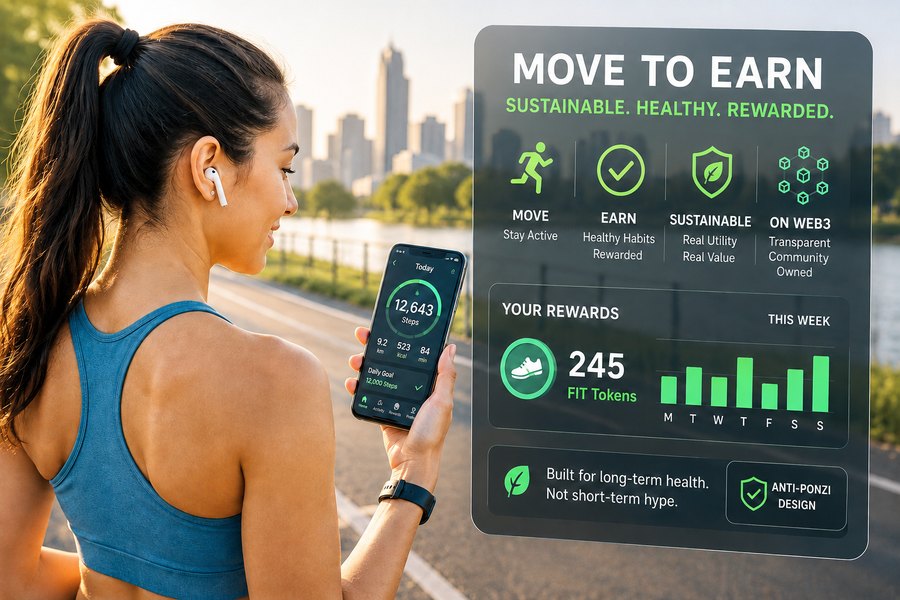
The idea that a person could be paid simply for walking, running, or exercising has an immediate and almost irresistible appeal, because it promises to turn an activity that many people struggle to do enough of, physical movement, into a source of financial reward, aligning the pursuit of health with the pursuit of money in a way that seems to solve two problems at once. For decades, the challenge of motivating people to exercise has occupied health experts, employers, and app designers, who have tried everything from step-counting badges to insurance discounts to gamified challenges, all aimed at the stubborn difficulty that people know exercise is good for them yet often fail to do it. The notion of paying people directly to move, with real money or something resembling it, appeared to offer a powerful new answer, and in the early part of this decade a wave of applications built on blockchain technology promised exactly that, rewarding users with cryptocurrency tokens for their steps and workouts under the banner of a concept called move-to-earn.
For a brief and dazzling period in 2022, this concept seemed to be working spectacularly, as a handful of move-to-earn applications attracted enormous numbers of users and saw the value of their associated tokens soar, creating the impression that a new model had been found in which getting healthy and getting paid could genuinely coexist. The most prominent of these applications drew hundreds of thousands of active users and reached valuations in the billions, and stories circulated of people earning meaningful sums of money simply by going for walks, which fueled a frenzy of enthusiasm and a rush of imitators. Yet almost as quickly as it had risen, this first generation of move-to-earn collapsed, with token values falling by enormous percentages, user numbers plummeting, and the dream of being paid to move appearing, to many observers, to have been exposed as an unsustainable illusion built on the familiar dynamics of a speculative bubble.
The collapse of the first move-to-earn wave did not, however, end the story, because the underlying idea, that aligning financial incentives with healthy behavior could genuinely benefit people, retained its appeal even after the early implementations failed, and a second generation of projects and thinkers has set about trying to do it properly, learning from the mistakes of the first. This article revisits the move-to-earn concept after the first generation’s collapse, examining what these applications promised, why the early versions rose so dramatically and fell so hard, and what a more sustainable approach to rewarding healthy habits might look like. It is written for readers who may have heard of the move-to-earn boom and bust without understanding what happened or why, and it aims to explain both the structural flaws that doomed the first wave and the design principles that might allow fitness rewards to endure, so that readers can judge for themselves whether being paid to move can ever be more than a passing craze.
The Promise of Being Paid to Move
To understand both the appeal and the eventual failure of move-to-earn, one must first understand what these applications actually offered and how they worked, beginning with the basic proposition that a person could install an app, engage in physical activity such as walking or running, and receive cryptocurrency tokens as a reward for that activity. The applications used the sensors in a smartphone, and sometimes additional devices, to track a user’s movement, verifying that they were genuinely walking or running rather than simply shaking the phone, and they translated that verified activity into tokens that had a market value and could, in principle, be exchanged for other cryptocurrencies or for conventional money. The promise, in its simplest form, was that exercise, normally an activity that costs time and effort and yields only the intangible reward of better health, could now also yield a tangible financial return, transforming the economics of physical activity.
The move-to-earn concept emerged from a broader movement in the cryptocurrency world built around the idea of earning tokens through activity, which had already produced play-to-earn games in which people earned cryptocurrency by playing, and the application of this idea to fitness seemed especially promising because it attached the financial reward to a behavior that was unambiguously beneficial. Where critics could question the social value of paying people to play games, paying people to exercise appeared to harness the powerful machinery of financial incentive in service of a genuinely worthy end, the improvement of public health, and this apparent alignment of profit and wellness was central to the concept’s appeal. The applications often required users to make an initial investment, typically by purchasing a digital item such as a virtual pair of sneakers represented as a non-fungible token, which then enabled them to earn, and the more one invested, the more one could potentially earn, an arrangement that would later prove central to the model’s problems.
The leading move-to-earn application, called STEPN, became the emblem of the concept’s rise, attracting attention and users at a remarkable pace through 2022 by offering precisely this model, in which users bought virtual sneakers as non-fungible tokens and then earned tokens by walking or running while wearing them in the app. STEPN operated with two different tokens, a structure that would become significant in its collapse, with one token earned through everyday exercise and intended to be spent within the app, and another token positioned as a governance and investment asset with a more limited supply, and the interplay between these two tokens, along with the virtual sneakers, formed the economic engine of the application. For a time, this engine appeared to run beautifully, drawing in users who were attracted by the prospect of earning and by the rising value of the tokens, and STEPN’s success inspired a host of competitors hoping to replicate its formula in what briefly seemed like the birth of an entire new category.
A distinctive feature of the early model that deserves attention is the role of verification, because the entire proposition depended on the application being able to confirm that a user had genuinely walked or run rather than merely simulated movement to harvest rewards, and the applications devoted considerable effort to this anti-cheating problem. They used the motion sensors built into smartphones to detect the characteristic patterns of real walking and running, applied location data to confirm that a user had actually moved through space, and sometimes imposed limits on how much could be earned in a given period, all in an attempt to ensure that rewards flowed only to authentic activity. This verification challenge was genuine and difficult, since any system that pays for behavior invites attempts to fake that behavior, and the cat-and-mouse contest between the applications and those seeking to cheat them was a persistent feature of the move-to-earn landscape, one that added cost and complexity and that any serious fitness reward model must continue to address if the rewards are to mean anything.
The enthusiasm that surrounded move-to-earn in its peak period was fueled not only by the appeal of being paid to exercise but by the broader speculative fervor of the cryptocurrency market at the time, in which rising token prices attracted buyers hoping for further gains, who in turn drove prices higher in a self-reinforcing cycle. Users were drawn to STEPN and similar applications not merely by the modest rewards of walking but by the possibility that the tokens they earned and the virtual sneakers they owned would appreciate in value, turning a fitness app into a potentially lucrative investment, and this speculative dimension supercharged the growth of the applications while also planting the seeds of their downfall. The promise of being paid to move had become entangled with the promise of speculative profit, and the difficulty of separating the genuine value of fitness rewards from the unsustainable dynamics of a token bubble would soon become painfully apparent as the first generation of move-to-earn reached its peak and began its dramatic descent.
The First Generation and Its Collapse
The rise and fall of the first move-to-earn generation unfolded with startling speed, compressing into a matter of months a complete cycle of explosive growth, dizzying valuation, and precipitous collapse that left the concept’s reputation in ruins and many users with worthless tokens and virtual sneakers. At its peak in the spring of 2022, STEPN, the leading application, reached a remarkable scale, with the number of users in its ecosystem peaking at more than seven hundred thousand in May 2022, a figure that testified to the enormous appeal of the being-paid-to-move proposition and to the speculative excitement that surrounded it. The associated tokens reached extraordinary valuations during this period, with the application’s governance token reaching an all-time high of roughly four dollars and nineteen cents in April 2022 and the everyday reward token climbing to around nine dollars and thirty-six cents, valuations that gave the project an enormous market capitalization and seemed to confirm that move-to-earn had arrived as a major new phenomenon.
The descent from these heights was swift and brutal, demonstrating how quickly the apparent success of the first move-to-earn generation could unravel once the conditions that had sustained it began to change. The everyday reward token, which had reached more than nine dollars at its peak, fell catastrophically, dropping by around ninety-eight percent in a span of just two months, while the governance token also declined sharply from its high, and the market capitalizations of both tokens contracted enormously, with the reward token’s market value falling from around one hundred forty million dollars in late May 2022 to roughly twenty-four million by the end of June, a decline that erased the great majority of the value in a matter of weeks. The user numbers collapsed alongside the token values, and where STEPN had counted more than seven hundred thousand users at its peak, by early 2023 it was reduced to a small fraction of that, with monthly active users numbering only in the tens of thousands, around forty-three thousand in February 2023, a shadow of the throngs that had crowded in during the boom.
Several specific factors contributed to the timing and severity of STEPN’s collapse, layered on top of the deeper structural problems that made the model fragile, and understanding these immediate triggers helps explain why the fall came when and how it did. One significant blow was the application’s decision in May 2022 to suspend its users in China, a large portion of its user base, in response to regulatory pressure, which removed a substantial source of demand and activity at a stroke and contributed to a loss of confidence. The broader cryptocurrency market was also turning downward during this period, draining the speculative enthusiasm that had inflated token prices across the sector, and as the prices of the move-to-earn tokens began to fall, the carefully balanced economic machinery of the applications began to break down, setting in motion a self-reinforcing decline that the model had no means of arresting. The combination of regulatory disruption, a deteriorating market, and the inherent fragility of the token economy proved devastating, and the speed of the collapse caught many users by surprise, leaving them holding tokens and virtual assets that had lost almost all their value.
The human cost of the collapse deserves acknowledgment alongside the dramatic figures, because behind the plunging token charts were real people who had invested real money, often substantial sums, in virtual sneakers and tokens on the expectation of earning returns, and who found themselves holding assets that had lost almost all their value. Some users had treated the applications as a serious source of income, investing heavily and even encouraging friends and family to join, and the rapid evaporation of value left many with significant losses and a sense of betrayal, a pattern that would become familiar across the speculative excesses of the period. The collapse was not merely an abstract market event but a chain of individual disappointments, and the memory of those losses has shaped the skepticism with which many people now regard any application promising to pay them for exercise, a skepticism that the more responsible second-generation projects must work to overcome by demonstrating genuine sustainability rather than repeating the promises that preceded the first collapse.
The collapse of STEPN and its imitators was widely interpreted as proof that the move-to-earn concept was fundamentally unsound, a verdict that contained an important truth but that also risked obscuring a more nuanced reality about what had actually gone wrong. The applications had not failed because exercise has no value or because rewarding healthy behavior is inherently impossible, but because the specific economic structures they had used to fund and distribute those rewards were unsustainable, dependent on a continuous influx of new participants and rising token prices that could not be maintained indefinitely. To understand why the model collapsed and what a more durable approach might require, it is necessary to look closely at the economic mechanics that drove the first generation’s spectacular rise and equally spectacular fall, the dynamics that turned a fitness application into a fragile speculative structure that could unravel with frightening speed once its growth stalled.
Anatomy of a Death Spiral
The collapse of the first move-to-earn applications followed a pattern that observers came to call a death spiral, a self-reinforcing downward cycle that, once begun, fed on itself and accelerated, and walking through its mechanics reveals precisely why the early model was so fragile. The applications typically used two tokens, an everyday reward token that users earned through exercise and that had a large or effectively unlimited supply, and a separate token with a more constrained supply intended to hold value, and the system depended on a steady stream of new users buying in, purchasing virtual sneakers and tokens, to sustain demand for the assets that existing users were earning. As long as new users kept arriving and buying, their money supported the value of the tokens that earlier users were accumulating, and everyone could appear to profit, in an arrangement whose dependence on continuous new entry would prove to be its fatal weakness.
The trouble began whenever the inflow of new users slowed or the broader market turned, because the everyday reward token was being continuously created and paid out to users for their exercise, creating a constant downward pressure on its price that could only be offset by sufficient demand from new buyers and from uses that absorbed the tokens. When that demand faltered, the supply of newly earned tokens overwhelmed the available demand, and the reward token’s price began to fall, which immediately reduced the real earnings of users, since the tokens they were earning for their exercise were now worth less, and this reduction in earnings made the application less attractive, causing some users to leave and reducing demand further. Each turn of this cycle worsened the next, as falling token prices reduced earnings, which reduced participation, which reduced demand, which further lowered prices, in a downward spiral that accelerated as it went and that the system had no built-in mechanism to halt.
The death spiral was made more severe by the role of the virtual sneakers and the speculative expectations attached to them, because users had often paid significant sums for these non-fungible assets in the expectation of earning returns, and as the token economy deteriorated, the value of the sneakers collapsed as well, inflicting losses on those who had invested and removing the incentive for new users to buy in. The interconnection of the everyday token, the governance token, and the virtual sneakers meant that weakness in any one part of the system propagated to the others, so that the decline of the reward token undermined the sneakers and the governance token, and the whole interlocking structure unwound together. What had appeared during the boom to be a thriving economy of mutually reinforcing assets revealed itself in the bust to be a fragile construction that depended entirely on continuous growth, and once growth stopped, the same interconnections that had amplified the rise now amplified the fall, producing the rapid and near-total collapse that befell the first move-to-earn generation. This pattern, in which a system can only sustain itself through perpetual expansion and collapses when expansion ceases, points directly to the deeper structural problem that the next section examines.
Why the Early Models Were Built to Fail
The death spiral that destroyed the first move-to-earn applications was not a matter of bad luck or poor execution but the inevitable consequence of a structural flaw in how the rewards were funded, a flaw that critics summarized with the unflattering term ponzinomics, suggesting that the economics resembled those of a Ponzi scheme. The essential problem was that the rewards paid to users came not from any external source of real revenue but primarily from the money brought in by new users, so that the earnings of earlier participants depended on a continuous influx of later participants whose buy-ins funded the payouts, an arrangement that bears a structural resemblance to the classic pyramid in which early entrants are paid with the contributions of those who come after. This is not to say that the founders necessarily intended to operate a fraud, but rather that the economic design, whatever the intentions behind it, had the mathematical character of a system that could only pay out as long as new money kept flowing in.
The reason this structure was unsustainable lies in the simple arithmetic of a system in which rewards exceed the real revenue generated, because if an application is paying users more in token value than it is taking in from genuine, non-speculative sources, the difference must come from somewhere, and in the move-to-earn model it came from the buy-ins of new users. A system can sustain payouts funded by new entrants only as long as the number of new entrants keeps growing, since each cohort’s rewards require an even larger cohort behind it, and because no pool of potential new users is infinite, the growth must eventually slow, at which point the payouts can no longer be sustained and the system begins to unwind. This mathematical reality means that an application whose rewards are funded by new participants rather than by real revenue is not merely risky but structurally doomed to eventual collapse, regardless of how popular it becomes or how beneficial the underlying activity, because the fundamental equation cannot balance once growth ceases.
The dual-token design that characterized the first generation, far from solving this problem, in many ways embodied and concealed it, because the separation of the everyday reward token from the constrained governance token created an appearance of sophistication and value that masked the underlying dependence on perpetual growth. The everyday token’s effectively unlimited supply meant that it was constantly being created and would inevitably lose value unless demand grew to match the ever-increasing supply, and the governance token’s apparent scarcity created the illusion of a sound investment asset, but both depended ultimately on the same engine of new user buy-ins, so that the elaborate two-token structure did not generate real value but merely distributed the inevitable losses in a more complicated way. When the growth stopped, the dual-token design provided no protection and indeed accelerated the collapse, as the interlocking tokens dragged each other down, revealing that the apparent complexity had been a veneer over a fundamentally unsustainable arrangement.
It is worth distinguishing this structural critique from the question of intent, because calling the early economics ponzinomics does not necessarily mean that the people who built these applications set out to defraud anyone, and many of them appear to have genuinely believed that their models could work and that the growth would continue. The resemblance to a Ponzi scheme lies in the mathematical structure of the payouts rather than in any deliberate deception, and a well-intentioned founder can build a system that is structurally unsustainable simply by designing rewards that depend on perpetual growth without realizing or acknowledging that growth must eventually stop. This distinction matters because it locates the problem in the economic design rather than in the morality of particular individuals, which means that the solution is also a matter of design, of building reward systems whose arithmetic actually balances, rather than merely of finding more honest operators to run fundamentally flawed models. The lesson is structural, and so must be the remedy.
The deeper lesson of the first generation’s failure is that a reward system can be sustainable only if the rewards are funded by genuine, recurring revenue from sources other than the participants themselves, a principle that the early move-to-earn applications violated at their core and that any durable model must respect. The tokens distributed to users represent a real cost, and that cost must be covered by real income, whether from advertising, from brands paying to reach users, from fees for genuine services, or from some other external source that does not depend on a continuous influx of new buyers, because only such external revenue can sustain payouts indefinitely without requiring perpetual growth. The first generation of move-to-earn ignored this principle, funding its rewards from the speculative buy-ins of an ever-growing user base, and its collapse was the predictable result, a lesson that the more thoughtful designers of the second generation have had to take seriously if they hope to build something that lasts rather than something that merely repeats the boom-and-bust cycle of the first wave.
Designing Rewards That Last
If the first generation of move-to-earn failed because its rewards were funded by new participants rather than by real revenue, then a sustainable approach must begin from the opposite premise, building the reward system on a foundation of genuine, recurring income that can support payouts without depending on perpetual growth, and this principle reshapes nearly every aspect of how such an application is designed. The central question for any durable fitness reward model is where the money to pay users actually comes from, and a sustainable answer must point to a source external to the users themselves, most plausibly the businesses and advertisers who are willing to pay for access to an engaged audience of people who have demonstrated, through their physical activity, that they are health-conscious and reachable. When the rewards are funded by such external revenue rather than by the buy-ins of new users, the fundamental arithmetic changes, and the system can in principle sustain itself as long as the external revenue continues, without requiring the endless expansion that doomed the first generation.
The contrast between the sustainable approach and the failed model is illustrated by Sweatcoin and its associated Sweat Economy, a fitness reward project that took a markedly different path from STEPN and that has endured where the dual-token speculative models collapsed, in large part because of how it funds its rewards. Sweatcoin is a free mobile application that rewards users for their daily steps with a unit called sweatcoins, awarding roughly nine-tenths of a sweatcoin for approximately every thousand verified outdoor steps, a deliberately modest and controlled rate of reward that reflects a sustainable rather than speculative philosophy. The project grew to an enormous user base, with the application reporting more than one hundred twenty million users globally as of May 2024 who had collectively generated tens of billions of the sweatcoin units, and a substantial population, reported at more than fifty million as of 2025, participating in the broader Sweat Economy that connects the step-based rewards to a cryptocurrency token, a scale that dwarfs the peak of the first-generation applications and that has been maintained rather than collapsing.
The crucial difference in Sweatcoin’s design lies in how it generates the revenue to support its rewards, because rather than funding payouts from the buy-ins of new users, the model relies on brands paying to feature their offers to the application’s large and engaged user base, an advertising-based revenue stream that provides genuine external income. This arrangement aligns the interests of the application, the users, and the advertisers in a way that the speculative model never did, since the application earns real money from brands, the users receive rewards and access to offers, and the advertisers gain access to a health-conscious audience, with the rewards funded by this genuine commercial activity rather than by a pyramid of new participants. The deliberately modest reward rate, the emphasis on a free application that requires no upfront investment in virtual assets, and the foundation of advertising revenue together produce a model whose sustainability rests on a real and recurring source of income, allowing it to endure through market cycles that destroyed the speculative applications.
The role of the cryptocurrency token within a sustainable model also deserves careful consideration, because the presence of a tradeable token was central to both the appeal and the fragility of the first generation, and a durable design must decide what function, if any, such a token should serve. In a sustainable model, a token can still play a useful role as a medium through which rewards are delivered and spent, connecting users to offers, services, and communities, but it works best when its value rests on genuine utility and demand rather than on speculative expectation, and when the system does not depend on the token’s price rising to function. The danger arises when the token becomes primarily an object of speculation, its price the focus of attention and the reason for participation, because this reintroduces the very dynamics that destroyed the first generation, and the most thoughtful designs therefore seek to keep the token’s role grounded in real use, ensuring that the application would remain valuable to its users even if the token’s market price were modest and stable rather than soaring.
A sustainable fitness reward model must also resolve the tension between rewarding users enough to motivate them and not promising so much that the rewards become unsustainable, a balance that the first generation conspicuously failed to strike and that thoughtful design must address through restraint and realistic expectations. The early applications attracted users with the prospect of substantial earnings, even framing exercise as a potential source of significant income, which both drew in speculators and created expectations that could not be met, whereas a durable model treats the financial reward as a modest supplement and motivator rather than a get-rich opportunity, setting expectations that the underlying revenue can actually support. This restraint may make the rewards less exciting and the growth less explosive, but it is precisely this modesty that allows the model to last, since rewards calibrated to real revenue can be sustained indefinitely while rewards inflated by speculation inevitably collapse. The projects that have endured have generally embraced this discipline, funding genuine if modest rewards from real income and resisting the temptation to promise more than the economics can bear, and this combination of external revenue and realistic reward levels forms the foundation on which a sustainable move-to-earn model can be built.
The Second Wave: New Approaches
In the aftermath of the first generation’s collapse, the move-to-earn concept did not disappear but instead evolved, as developers absorbed the lessons of the failure and began building a second wave of applications designed to avoid the structural traps that had destroyed their predecessors, often by shifting toward more mainstream, less speculative, and more genuinely revenue-supported models. This second wave has been characterized by a recognition that the path to durability runs through broad appeal and real revenue rather than through the speculative excitement that had powered and then doomed the first generation, and the new approaches have generally sought to lower the financial stakes, reduce the barriers to entry, and connect the rewards to sustainable sources of income, even at the cost of the explosive growth that the speculative model had produced.
One illustrative example of this evolution is the response of STEPN’s own developers, who in May 2024 launched a new product called STEPN GO, a social-lifestyle application that represented a deliberate pivot away from the speculative model that had characterized the original STEPN and toward something designed to appeal to mainstream audiences. STEPN GO introduced a new token earned through walking, jogging, and running, and added social and gaming features intended to broaden its appeal beyond the cryptocurrency-focused users of the original, but the most telling change was in how it sought to reduce the barriers that had made the first generation both exclusive and fragile. According to the company’s leadership, the new application was designed so that users could onboard friends and family into the experience without needing to create a cryptocurrency wallet or even buy the virtual sneakers that had been mandatory in the original, a change that lowered the cost and complexity of entry and signaled an intention to reach ordinary fitness enthusiasts rather than crypto speculators.
This pivot toward mainstream accessibility reflects a broader insight that has shaped the second wave, which is that the dependence on upfront investment in virtual assets had been both a barrier to broad adoption and a core component of the unsustainable economics, so that removing or reducing that requirement could simultaneously widen the potential user base and weaken the speculative dynamics that had caused the collapse. When users are not required to invest significant sums in virtual sneakers before they can participate, the application becomes accessible to a far larger population, and the economic model becomes less dependent on a continuous influx of buy-ins, shifting the foundation toward engagement and real revenue rather than speculation. The second wave’s emphasis on social features, on gamification that makes the experience enjoyable in its own right, and on lowering the financial barriers all point toward a model in which the application provides genuine value and entertainment to a broad audience, funded by real revenue, rather than functioning primarily as a vehicle for speculative earning.
The second wave has also benefited from a broader maturation in how the cryptocurrency industry thinks about value and sustainability, as the painful lessons of the speculative excesses of the early part of the decade prompted a wider reckoning with the difference between genuine utility and mere speculation across many categories of application. The collapse of numerous projects that had promised returns funded by perpetual growth, not only in fitness but in gaming and finance, taught developers and users alike to ask harder questions about where value actually comes from, and this skepticism, while painful, has produced a more discerning environment in which unsustainable models face greater scrutiny. The fitness reward applications of the second wave operate in this changed climate, where the easy enthusiasm of the boom has given way to a more demanding standard, and where survival depends on demonstrating real revenue and real usefulness rather than on the promise of riches, a standard that is healthier for the category even if it makes explosive growth harder to achieve.
The second wave remains a work in progress, and it would be premature to declare that the problem of sustainable fitness rewards has been definitively solved, since these newer applications must still prove that their revenue models can support their rewards over the long term and that they can retain users once the novelty fades and the speculative excitement is gone. The challenge for the new approaches is to demonstrate that a fitness reward application can sustain a large and engaged user base on the basis of genuine value and real revenue rather than the promise of speculative gains, a proposition that the endurance of advertising-funded models like Sweatcoin supports but that the broader category has yet to establish beyond doubt. What is clear is that the second wave has internalized the central lesson of the first generation’s failure, that rewards must be funded by real income rather than by new participants, and the applications that succeed will likely be those that build genuinely useful and engaging products supported by sustainable revenue, treating the financial reward as one motivating feature among many rather than as the speculative engine of growth that proved so spectacularly fragile the first time around.
What to Look For and What to Avoid
For a person considering whether to participate in a move-to-earn or fitness reward application, the history of the first generation’s collapse offers valuable guidance about what distinguishes a potentially sustainable product from one likely to repeat the boom-and-bust cycle, and learning to recognize these signs can help a newcomer avoid the losses that befell so many early participants. The single most important question to ask about any such application is where the rewards come from, because an application that funds its rewards from genuine external revenue, such as advertising or brand partnerships, rests on a far sounder foundation than one whose rewards appear to depend on a continuous influx of new users buying in, and a person evaluating a product should look carefully for evidence of a real revenue model rather than accepting the promise of rewards at face value. If the only apparent source of the rewards is the money brought in by new participants, the application carries the structural flaw that doomed the first generation, and caution is warranted.
A second crucial sign concerns the financial stakes and the barriers to entry, because applications that require significant upfront investment in virtual assets, such as expensive non-fungible sneakers, and that emphasize the potential for substantial earnings, tend to attract speculation and to depend on the unsustainable dynamics that caused the first collapse. A more sustainable application is likely to be one that is free or low-cost to join, that sets modest and realistic expectations for rewards, and that frames the financial benefit as a supplement to the intrinsic value of fitness rather than as a path to meaningful income, since the promise of large earnings is both a warning sign of unsustainable economics and a lure that has cost many participants dearly. The newcomer should be especially wary of applications that encourage large investments on the promise of returns, recognizing that such promises closely resemble those that preceded the first generation’s collapse.
The newcomer should also attend to the language and culture surrounding an application, because a focus on token prices, on the potential for the value of virtual assets to appreciate, and on earning as the primary reason to participate tends to indicate a speculative orientation that history suggests is fragile, whereas a focus on health, on the enjoyment of the activity, and on the application’s genuine usefulness points toward a more durable proposition. An application whose community is preoccupied with the rising or falling value of tokens and with the prospect of profit is one in which the speculative dynamics that drive boom-and-bust cycles are likely at work, and a person seeking a sustainable way to be rewarded for healthy habits would do well to favor applications that treat the financial reward as a modest motivator within a genuinely valuable fitness experience rather than as the central attraction. The healthiest relationship with such an application, both financially and physically, is one in which the user would find value in the activity even without the reward, so that the reward is a welcome bonus rather than the foundation of participation.
It also helps to consider the track record and transparency of the people and company behind an application, because a project that is open about how it generates revenue, that has operated through difficult market conditions without collapsing, and that sets honest expectations is more trustworthy than one that obscures its economics behind vague promises and marketing enthusiasm. An application that has survived a downturn, that publishes clear information about its business model, and that does not rely on hype about rising token prices to attract users has demonstrated something about its durability that a flashy newcomer making extravagant claims has not, and a cautious participant can weigh this history when deciding where to place their time and trust. Longevity and transparency are themselves signals of sustainability, since the applications most likely to endure are generally those that have already shown they can.
Finally, the prudent participant should approach all such applications with a clear understanding of the risks and a refusal to invest more than they can afford to lose, treating any financial reward as uncertain and any associated tokens or virtual assets as potentially worthless, regardless of how promising the application appears. The collapse of the first generation demonstrated how quickly the value of these tokens and assets can evaporate, and even the more sustainable second-wave applications carry real risks and unproven long-term economics, so that a person participating in them should do so with realistic expectations, valuing primarily the health benefits of the activity that the application encourages and treating any financial reward as a speculative and uncertain extra. By asking where the rewards come from, favoring low-stakes and free applications, attending to the culture around a product, and never investing more than they can afford to lose, a newcomer can engage with the move-to-earn concept in a way that captures its genuine benefits while guarding against the structural flaws and speculative dangers that brought down the first generation.
Final Thoughts
The story of move-to-earn is, at its heart, a story about the difficulty and the importance of aligning financial incentives with genuine human good, and about how easily a worthy aim can be undermined by an unsound economic design that mistakes speculative growth for real value. The aspiration behind move-to-earn, to harness the motivating power of financial reward in service of better health, remains a genuinely valuable one, addressing the real and persistent challenge of encouraging people to engage in the physical activity that benefits them, and the spectacular failure of the first generation should not be allowed to discredit the underlying idea so much as to instruct its future implementation. The collapse demonstrated not that rewarding healthy behavior is impossible but that doing so sustainably requires honest economics, in which the rewards are funded by real revenue rather than by the contributions of new participants in a structure that can only ever end in collapse.
The deeper significance of the move-to-earn experience extends beyond fitness applications to the broader question of how the technologies of cryptocurrency and tokenization can be used to create genuine value rather than merely to recycle the dynamics of speculation and bubbles. The first generation of move-to-earn, for all its enthusiasm and its genuine technological ingenuity, ultimately reproduced the oldest and most familiar of financial follies, the scheme that pays early entrants with the money of later ones, dressed in the novel garb of tokens and virtual sneakers, and its failure is a reminder that no amount of technological sophistication can rescue an economic model that violates the basic arithmetic of sustainability. The more promising path, illustrated by the advertising-funded models that have endured and by the second wave’s pivot toward mainstream accessibility and real revenue, lies in using these technologies to build products that deliver genuine value to users and that are supported by genuine income, treating the financial reward as a modest and sustainable motivator rather than as a speculative engine.
The question of accessibility also deserves emphasis, because the most sustainable fitness reward models are likely to be those that are free or low-cost to join and that reach a broad population rather than catering to those with capital to invest in virtual assets. The applications that have endured have generally been accessible to large numbers of ordinary users without significant upfront cost, and this accessibility is not incidental to their sustainability but central to it, since a model funded by advertising or brand revenue benefits from a large and engaged audience rather than from a smaller pool of investors. The future of move-to-earn, if it has one, lies in this direction, toward inclusive, low-stakes, genuinely useful applications that reward healthy habits sustainably.
The reimagining of move-to-earn after its first collapse is ultimately an exercise in learning from failure, in extracting from a spectacular bust the principles that might allow a worthy idea to succeed where it first stumbled. Whether the second generation will fully realize the promise of sustainable fitness rewards remains to be seen, and the challenges of retaining users, sustaining revenue, and resisting the perennial temptation of speculative excess are real and unresolved. Yet the direction is clear, toward honest economics, modest and realistic rewards, broad accessibility, and genuine value, and if the designers of the future heed the hard lessons of the first generation, the simple and appealing idea of being rewarded for taking care of one’s health may yet find a form that endures rather than burning brightly and collapsing as it did the first time around.
FAQs
- What exactly is move-to-earn?
Move-to-earn refers to applications, typically built on blockchain technology, that reward users with cryptocurrency tokens for physical activity such as walking or running. The app uses your phone’s sensors to verify your movement and translates that activity into tokens with a market value. The idea is to add a financial incentive to exercise, turning an activity that normally yields only health benefits into one that can also provide a modest financial reward. - Why did the first generation of move-to-earn collapse?
The first generation collapsed because its rewards were funded primarily by money from new users buying in, rather than by real external revenue. This made the model dependent on continuous growth, and when new users stopped arriving and the broader crypto market turned down in 2022, the reward tokens lost value, user earnings fell, participation dropped, and the system entered a self-reinforcing downward cycle known as a death spiral. - What happened to STEPN specifically?
STEPN, the leading move-to-earn app, peaked at more than seven hundred thousand users in May 2022, with its reward token reaching over nine dollars. Within two months that token fell roughly ninety-eight percent, and by early 2023 monthly active users had dropped to the tens of thousands. A decision to suspend users in China, a falling crypto market, and the model’s inherent fragility all combined to trigger the rapid collapse. - What is ponzinomics and how does it apply here?
Ponzinomics is a term critics use for economic designs that resemble Ponzi schemes, where rewards paid to earlier participants come mainly from the money of later participants rather than from real revenue. The first move-to-earn apps fit this pattern because user rewards depended on a continuous influx of new buy-ins. Such a structure can only pay out while it keeps growing, and it is mathematically destined to collapse once growth stops. - Can fitness rewards ever be sustainable?
Yes, but only if the rewards are funded by genuine recurring revenue rather than by new participants. A sustainable model draws income from external sources such as advertisers or brands paying to reach an engaged, health-conscious audience, and it keeps reward levels modest and realistic so that payouts can be supported indefinitely. The key is that the money paying users must come from real commercial activity, not from a pyramid of new buyers. - How is Sweatcoin different from STEPN?
Sweatcoin uses an advertising-based model in which brands pay to feature offers to its large user base, funding rewards from real revenue rather than user buy-ins. It is free to join, requires no purchase of virtual sneakers, and rewards steps at a deliberately modest rate of roughly nine-tenths of a sweatcoin per thousand outdoor steps. This design has allowed it to grow to over one hundred twenty million users and endure where speculative models collapsed. - What is STEPN GO and how does it differ from the original?
STEPN GO is a social-lifestyle app that STEPN’s developers launched in May 2024 as a pivot toward mainstream audiences. It added social and gaming features and, crucially, was designed so that users can join and onboard friends without creating a crypto wallet or buying virtual sneakers. This lowers the barriers and reduces the speculative dynamics that contributed to the original model’s fragility, aiming to reach ordinary fitness enthusiasts. - Do I need to spend money to participate in move-to-earn?
It depends on the app. The first generation typically required buying virtual sneakers represented as non-fungible tokens before you could earn, which was both a barrier and part of the unsustainable economics. More sustainable second-wave and advertising-funded apps are often free to join with no upfront purchase. As a general rule, an app that requires a large investment on the promise of returns should be approached with caution. - How can I tell if a fitness reward app is sustainable before joining?
Ask where the rewards come from, and look for evidence of real external revenue such as advertising or brand partnerships rather than dependence on new users buying in. Favor apps that are free or low-cost, that set modest reward expectations, and whose culture focuses on health and enjoyment rather than token prices and profit. Be wary of any app requiring significant upfront investment on the promise of substantial earnings. - Is it worth using a move-to-earn app at all?
It can be, provided you approach it with realistic expectations. The healthiest relationship with such an app is one in which you would value the activity even without the reward, treating any financial benefit as an uncertain bonus rather than a reason to participate. Never invest more than you can afford to lose, since tokens and virtual assets can become worthless, and prioritize the genuine health benefits of the activity the app encourages.