There is a particular kind of dread that sets in at an airport baggage carousel when the belt slows, the crowd thins out, and a passenger’s suitcase never appears. In that moment, the traveler has almost no information about where the bag actually is, who last touched it, or which of the two or three airlines and ground handling companies involved in the journey is responsible for finding it. The bag might be sitting on a cart in a transfer hub three time zones away, or it might have been loaded onto the wrong aircraft entirely, and from the passenger’s side of the counter there is no way to tell the difference. All that exists is a paper claim form, a reference number, and a promise that someone, somewhere, is looking into it. This experience is common enough that it has become a familiar joke in travel writing, but for the person standing at the carousel with no clean clothes and a business meeting in the morning, it is not funny at all, and it is not a small operational hiccup either. It is the visible symptom of a much larger problem: no single party in the modern air travel system has a complete, trustworthy view of where a checked bag has been.
That gap exists because a checked bag’s journey routinely crosses organizational boundaries that were never designed to share data cleanly with one another. A passenger flying from a regional city to an international destination might have their bag handled by a regional carrier, a hub airport’s ground handling contractor, and an international airline’s own baggage systems, each of which historically kept its own records in its own format, updated on its own schedule, and rarely cross-checked against what the other parties recorded. When a bag goes missing, reconstructing its journey means contacting each of these separate parties in sequence, comparing incompatible logs, and hoping that whoever is asked can actually find the relevant entry. This is slow by design, not by accident, because the underlying data was never built to be queried as a single, continuous record in the first place. It is this specific problem — not baggage handling in general, but the fragmentation of baggage data across competing and cooperating organizations — that a new generation of shared-ledger and blockchain-based tracking systems is trying to solve.
The pitch behind blockchain luggage tracking is straightforward, even if the underlying technology is not: instead of every airline, airport, and ground handler keeping a private record of what happened to a bag while it was in their custody, every party writes to a single, shared, tamper-evident ledger that everyone downstream can read. A ground handler in Frankfurt, an airline’s operations team in Singapore, and a passenger’s phone in Chicago would, in principle, all be looking at the same record of a bag’s journey rather than three different, potentially conflicting accounts. When a bag is short-shipped, misrouted, or simply delayed at a connection, the record shows exactly where the handoff broke down and which party had custody at that moment, which matters enormously both for reuniting a passenger with their luggage quickly and for settling the liability disputes that follow almost every serious mishandling case. This is not a hypothetical concern for the industry: baggage mishandling costs airlines billions of dollars a year in claims, replacement costs, and reputational damage, and the four-point tracking standard that the International Air Transport Association introduced specifically to address this problem, formally known as Resolution 753, has already reshaped how seriously the industry treats the underlying data problem.
This article looks at what blockchain and shared-ledger baggage tracking actually involves, from how a bag’s record gets created and verified at each handoff to what passengers, airline staff, and ground handlers each see when they check on a bag’s status. It examines the real benefits for every stakeholder in the baggage supply chain, and it walks through two documented, verifiable projects — a blockchain proof of concept run by one of Asia’s busiest airports in partnership with a major international carrier and a global technology provider, and a commercial shared-ledger baggage system now running in production for a European airline — that show what this technology looks like once it moves past a conference-stage demonstration. It also takes seriously the limitations: the persistent gap between a verified digital record and the physical bag it describes, the cost and integration burden that falls hardest on smaller carriers, and the sobering fact that several ambitious blockchain travel ventures have already wound down after concluding the industry was not ready for them. None of this is a promise that blockchain will make lost luggage a thing of the past. It is a look at a specific class of technology, what it has actually demonstrated so far, and why airlines, airports, and the passengers who trust them with their belongings are paying closer attention to it now.
The Problem: Why Bags Get Lost and Claims Take So Long
To understand why shared-ledger tracking is attractive to the aviation industry, it helps to look closely at how a bag actually gets lost, because the mechanics are more mundane and more structural than most passengers assume. The single largest driver of mishandling, year after year in industry reporting, is the transfer between flights, not the initial check-in or the final delivery. When a passenger has a connecting itinerary, their bag has to be physically moved from one aircraft to another, often within a tight window and sometimes across a change of airline or ground handling contractor entirely. If that connection is short, if the receiving flight’s baggage system does not immediately recognize an incoming bag from a different carrier’s manifest, or if a scan at the transfer point is skipped under time pressure, the bag can be sent to the wrong aircraft, held back for a later flight, or simply lost track of until someone notices it sitting on a cart with no matching passenger. Industry data consistently shows that transfers account for the largest single share of mishandling incidents, larger than any other stage of a bag’s journey, which is exactly what one would expect from a process that depends on two separate organizations correctly recognizing and acting on the same piece of information within a narrow window of time.
A second major source of mishandling is the sheer number of separate, often incompatible information systems a bag’s data has to pass through. For decades, airlines and airports exchanged baggage information using a decades-old messaging format transmitted over what was effectively a teletype network, a system built for a much smaller and slower era of air travel that struggles to carry the richer data — photographs, precise timestamps, granular event histories — that modern baggage management increasingly depends on. Even where airlines and airports have modernized their own internal systems, the connections between different organizations often still rely on this older messaging backbone, or on a patchwork of custom integrations built one partnership at a time. Every one of those integration points is a place where data can be delayed, garbled, or simply not passed along at all, and every airline or airport that has not yet modernized its side of that exchange becomes a weak link that the rest of the network has to work around.
A third contributor, less visible to passengers but significant to the industry’s own accounting of the problem, is the sheer growth in the volume of checked baggage moving through the system as global air travel has recovered and expanded. When passenger numbers surge, as they did sharply in the years following the pandemic-era travel collapse, the absolute number of bags moving through the system rises even if the underlying error rate per bag stays flat, and industry reports have specifically noted that mishandling rates spiked as air travel demand recovered faster than airport staffing and baggage infrastructure could keep pace. A system already operating close to its practical capacity has less slack to absorb an unexpected surge in transfer volume, staff shortages, or a single disrupted hub, which is part of why mishandling rates tend to rise sharply during periods of rapid passenger growth even when no single part of the system has gotten objectively worse.
What ties all of these causes together is the absence of a single, trusted, real-time view of a bag’s status that every party touching that bag can see and act on simultaneously. When an airline’s operations center, a ground handler’s warehouse system, and an airport’s baggage sortation system each maintain their own separate record, updated on their own timeline, reconciling those records after something goes wrong requires phone calls, emails, and manual lookups across organizational boundaries that were never designed for real-time cooperation. This is precisely the gap that IATA Resolution 753 was designed to close at a regulatory level, by requiring member airlines to track baggage at four specific points in its journey — check-in, loading onto the aircraft, transfer between flights, and delivery on arrival — so that at minimum, a consistent skeleton of tracking data exists for every checked bag regardless of which airline or airport is handling it. Resolution 753 does not by itself solve the problem of getting that data into a single, shared, trustworthy record that every party can query at once; it simply establishes what data has to exist. Solving the harder problem, of making that data visible, trustworthy, and shared across every party in a bag’s journey rather than locked inside separate corporate systems, is where shared-ledger and blockchain-based approaches enter the picture.
What “Blockchain Baggage Tracking” Actually Means
At its core, a blockchain is a shared, append-only record maintained across a network of participating computers rather than sitting on any single company’s private server. Once an entry is added and confirmed by the network, altering it after the fact would require rewriting that entry across a large share of the participating systems simultaneously, which becomes impractical as more parties join the network. Applied to baggage, this means that when a ground handler scans a bag onto an aircraft, or an airport’s system logs a transfer between flights, that scan becomes part of a permanent, time-stamped history that no single airline, airport, or handler can quietly edit later to shift blame or hide an error. This is the property that distinguishes a genuine blockchain-based system from an ordinary shared database, where a system administrator at any one of the participating organizations could, in principle, alter a historical record without the other parties ever finding out.
It is worth being precise about what this property does and does not guarantee, because a great deal of vague marketing language has been attached to “blockchain” in aviation over the past several years, and skepticism is a reasonable starting point. A blockchain can guarantee that a scan or status update, once entered, has not been silently altered afterward. It cannot guarantee that the scan was performed correctly in the first place, that the bag was actually where the scan claims it was, or that human error at the point of data entry did not introduce a mistake that the ledger will now preserve permanently and faithfully. This is sometimes described as the “garbage in, garbage out” limitation, and it is the single most important caveat to keep in mind when evaluating any blockchain baggage-tracking claim. The technology solves the specific problem of tampering and disputed record-keeping after data has been entered; it does not solve the separate, and in some ways harder, problem of ensuring the underlying scan or event was accurate to begin with. That still depends on well-designed hardware, trained ground staff, and operational discipline at every physical handoff point.
Given that limitation, the genuine value of blockchain baggage tracking comes from combining a tamper-evident ledger with the four-point tracking discipline that Resolution 753 already requires, and then making the resulting record visible to every airline, airport, and ground handler in a bag’s journey rather than keeping it locked inside each party’s own system. A well-designed system does not simply let any employee at any company type in a claim about a bag’s location; it structures the process so that specific, authenticated actors — a ground handling agent scanning a bag at a defined tracking point, an airport’s sortation system logging an automated event — are the ones who can write particular kinds of entries, typically through a barcode or radio-frequency identification scan rather than manual data entry. The shared ledger then becomes the common backbone that lets every downstream party, including the passenger, see the same version of a bag’s history without having to separately contact and trust each organization that touched it along the way.
In practice, virtually every operating baggage-tracking system in commercial aviation today, blockchain-based or not, uses what is called a permissioned network rather than a fully open one like the networks underpinning major cryptocurrencies. On a permissioned system, only vetted participants — airlines, airports, and ground handlers that have joined the relevant program — are authorized to write entries or operate the validating infrastructure, while the resulting baggage record can still be made visible to every authorized party, including, through an app or notification, the passenger themselves. This distinction matters because it addresses a common misconception that blockchain-based baggage systems require airline staff to understand cryptocurrency wallets or public keys; in the systems actually operating today, a ground handler’s interaction is scanning a barcode with existing handheld equipment, and a passenger’s interaction is checking a notification on their phone, with the validation and ledger mechanics handled entirely behind the scenes by the participating organizations’ technology providers. The tradeoff, as with any permissioned system, is that its trustworthiness depends on the operator vetting participants carefully and on the technical architecture genuinely preventing quiet, after-the-fact edits, rather than on the fully decentralized, trustless design that public blockchains are built around.
How a Bag’s Record Gets Created and Verified
The process begins at check-in, the first of the four tracking points that IATA Resolution 753 requires airlines to record. At this stage, a bag is tagged, its barcode is scanned and associated with the passenger’s booking, and this initial entry establishes the baseline record that every later scan will be compared against. From this point forward, the bag’s record grows through a sequence of scans rather than manual re-entry: a scan when the bag is loaded onto the aircraft, confirming it physically made it onto the correct flight; a scan at any transfer point, if the itinerary involves a connection, confirming the handoff between flights or between airlines; and a final scan at arrival, confirming delivery to the destination airport’s baggage claim system. Each of these four events is a discrete, time-stamped entry, and together they form the skeleton of tracking data that Resolution 753 mandates industry-wide, regardless of whether the underlying record-keeping system uses a blockchain or a more conventional shared database.
What a blockchain or shared-ledger layer adds on top of this skeleton is the assurance that once one of these four scans is recorded, it becomes part of a permanent, cross-organizational history rather than sitting in one company’s isolated system waiting to be manually reconciled with everyone else’s. In a well-integrated system, a ground handler’s scan at a transfer point in one country becomes immediately visible to the receiving airline’s operations team in another country, and to the original airline that sold the ticket, without any of those parties needing to separately query each other’s databases or wait for an overnight batch file to sync. This immediacy matters most exactly at the moments when things go wrong: if a bag fails to make a tight connection, the gap between the expected transfer scan and its actual absence becomes visible to every party in the chain almost as soon as it happens, rather than being discovered hours later when a passenger reports a missing bag at their final destination.
Verification at each of these four points depends less on cryptography and more on the physical scanning infrastructure and staff discipline behind it, which is an important and sometimes underappreciated point. A barcode scan at a transfer point is only as reliable as the barcode itself, the scanning equipment, and the ground handler’s adherence to the process under time pressure during a busy connection bank. Some airports and ground handlers have layered radio-frequency identification tags on top of barcodes specifically because RFID can be read automatically as a bag moves through a sortation system, without requiring a staff member to manually scan each bag, which removes one of the more common points of human error from the process. The blockchain or shared-ledger layer sitting on top of these physical scans cannot make an RFID read or a barcode scan more accurate; what it can do is make sure that whatever accurate or inaccurate data was captured at the point of scanning is then shared reliably, in real time, and without alteration, to everyone downstream who needs to see it.
A practical consequence of this design is that the quality of a blockchain baggage-tracking system depends heavily on how many of the parties in a bag’s actual journey have joined the shared network in the first place. A bag traveling on a single airline’s own metal, through airports and ground handling contracts the airline directly controls, is comparatively easy to track end to end on a shared ledger, because every party in the chain is already inside the same technical and contractual relationship. A bag on a more complex interline itinerary, crossing between airlines that have not integrated their systems with the same shared ledger, will have gaps in its record at exactly the boundaries where different corporate systems meet, which is precisely where mishandling risk is already highest. This is why industry-wide adoption, rather than any single airline’s internal technology, is the real determinant of how much blockchain-style baggage tracking can actually reduce mishandling across the system as a whole.
What Passengers, Airlines, and Ground Handlers Each See
For the passenger, the shared ledger itself is invisible; what they interact with is typically a notification inside an airline’s app or a tracking link sent by text message, showing that their bag has been checked in, loaded, and, where relevant, transferred successfully onto a connecting flight. Because this information is drawn from the same underlying record that ground handlers and airline operations staff are working from, rather than a simplified summary built separately for customer communication, a passenger who sees a “loaded” confirmation has a genuine, verifiable basis for that reassurance rather than a generic status message. Some airlines have begun offering passengers the ability to proactively opt into these notifications specifically so they know, before they even reach the arrival carousel, whether their bag made a tight connection successfully or is running behind.
For airline staff and ground handling agents working a mishandling case, the value of a shared ledger looks different: instead of calling or emailing a partner airline’s operations desk to ask where a bag was last scanned, an agent can pull up the complete, unified history of that bag’s journey on a single screen, including every scan recorded by every party involved, without needing separate logins or manual data requests across company boundaries. This matters enormously for how quickly a mishandled bag actually gets found and returned, because the agent working the case can immediately see the exact point in the journey where the expected scan never happened, narrowing the search to a specific airport, a specific time window, and often a specific ground handling team, rather than starting from nothing. Systems built around this kind of unified view have reported meaningfully faster resolution times for mishandling cases specifically because agents no longer have to reconstruct a bag’s journey manually from fragmented records held by different organizations.
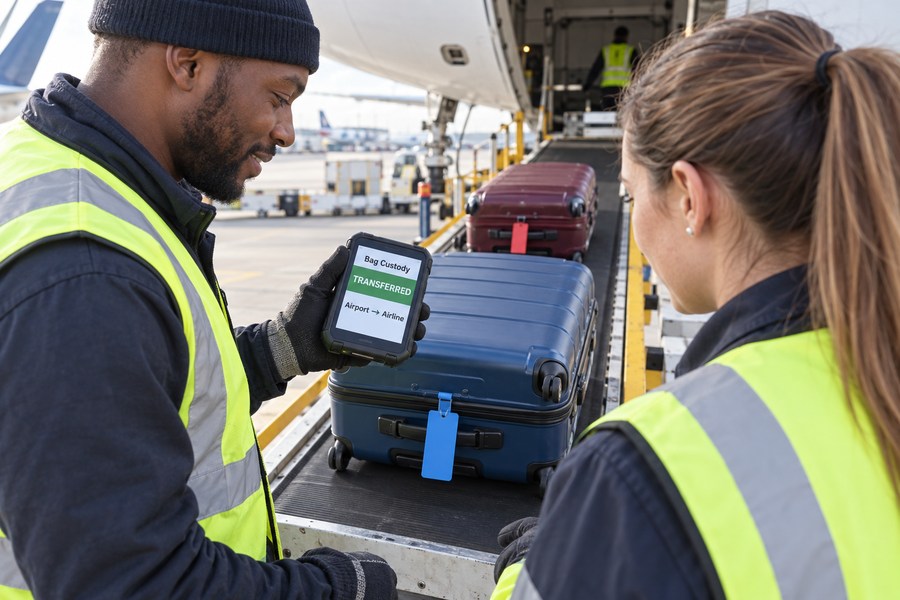
Ground handlers, who are often the party physically responsible for the scans that create these records in the first place, benefit from a related but distinct advantage: a shared, auditable record makes it much easier to demonstrate exactly when custody of a bag passed from one party to another, which matters directly for resolving liability disputes and settling the pro-rated costs of a mishandling claim between the airlines and handling companies involved. Without a shared record, determining which party was responsible for a bag at the moment it went missing often comes down to comparing separately maintained logs that may use different timestamp formats, different bag identifiers, or simply disagree with each other, which slows down claims processing and can leave the question of fault genuinely unresolved. A shared ledger does not eliminate disputes entirely, since data can still be entered incorrectly at the point of scanning, but it removes an entire layer of ambiguity about which version of events is authoritative.
Taken together, these different interfaces — a simplified, reassuring view for the passenger, a detailed diagnostic view for the agent resolving a case, and an auditable custody record for settling liability between handling parties — are what a shared baggage ledger actually looks like in daily operation, regardless of how much of the underlying architecture genuinely uses blockchain versus a more conventional but equally shared database design. What unites all three views is that they are drawing from the same underlying record rather than three separate, potentially conflicting ones, which is the core operational benefit that shared-ledger baggage tracking is built to deliver.
Benefits Across the Baggage Supply Chain
For passengers, the most immediate and tangible benefit of shared baggage tracking is simply reduced anxiety and faster resolution when something does go wrong. Someone whose bag failed to make a tight connection no longer has to wait helplessly at the carousel wondering what happened; they can often see, through the airline’s own app, that the bag is running behind and is expected on a later flight, along with a reference number and an active claim already in progress rather than one they have to initiate themselves after standing at an empty carousel. This shift, from passengers discovering a problem only when their bag fails to appear to airlines proactively identifying and communicating the problem before the passenger even lands, is one of the more significant quality-of-life improvements that better baggage data enables, independent of whether the passenger ever thinks about the underlying ledger technology at all.
Airlines benefit in a more directly financial way, since baggage mishandling represents a large and recurring cost center measured in the billions of dollars industry-wide every year, covering everything from the logistics of finding and delivering a delayed bag to compensation paid out for lost items and the reputational cost of a bad customer experience. A shared, real-time view of every bag’s status lets an airline’s operations team identify patterns — a particular connection bank that consistently causes transfer failures, a specific ground handling contractor with an unusually high miss rate — and address the underlying operational weakness directly, rather than treating each mishandling case as an isolated incident with no larger lesson attached. Airlines adopting shared baggage-tracking platforms have reported measurable reductions in both the direct cost of mishandling and the volume of formal mishandling claims filed against them, which is a meaningful business incentive layered on top of the customer-experience argument.
Airports gain a related but distinct advantage: because a shared ledger captures data from every airline and ground handler operating within the airport’s baggage system, airport operators can get a system-wide view of where mishandling risk concentrates — a particular transfer corridor, a specific time of day when connection banks overlap most tightly — that no single airline or handler, looking only at its own portion of the data, could construct on its own. This aggregate visibility supports better infrastructure planning and staffing decisions, letting an airport direct additional resources toward the specific physical bottlenecks that are actually driving mishandling, rather than spreading improvements evenly across a system where most of the risk is concentrated in a few identifiable choke points.
Ground handling companies, who often absorb a disproportionate share of blame and liability cost in mishandling disputes precisely because they are the party physically moving bags between aircraft, gain a form of protection alongside their obligation: a shared, timestamped record of exactly when they took custody of a bag and when they handed it off protects them from being held liable for failures that occurred before or after their part of the journey, while equally holding them accountable when a scan clearly shows a bag was in their custody when something went wrong. This clearer demarcation of liability benefits the entire system by reducing the time and expense that airlines and handlers currently spend disputing responsibility after the fact, freeing up resources that could otherwise go toward preventing the next mishandling incident rather than litigating the last one. Insurers and claims-processing teams gain a less obvious but still meaningful benefit from the same underlying shift: a verifiable, shared custody record makes it possible to settle a passenger’s mishandling claim based on an agreed, auditable sequence of events rather than competing accounts from different airlines, which shortens the time a passenger has to wait for compensation and reduces the administrative cost of processing each claim. Across every stakeholder in this chain, the underlying benefit is structurally the same: a single, trusted, shared source of truth substitutes for the slow, manual reconciliation between separate corporate records that has defined baggage claims processing for decades, and that substitution pays off differently for each party but adds up to a faster, less adversarial system overall.
Documented Case Studies in Blockchain and Shared-Ledger Baggage Tracking
The distance between the theoretical promise of blockchain baggage tracking and what has actually been built and used in commercial operation is significant, and it is worth examining real, documented systems rather than conference-stage pilots or white papers that never moved past a proof of concept. Two projects in particular illustrate both genuine technical achievement and the honest limits of how far this technology has actually traveled: a blockchain proof of concept run by one of the world’s busiest airports in partnership with a major international carrier and a global technology provider, and a commercial shared baggage-data platform now running in production under a multi-year agreement with a European airline.
Finding examples that meet a high bar for verification takes real effort, because the amount of promotional language attached to “blockchain aviation” over the past several years far exceeds the number of systems that were actually built and used at any meaningful scale. Several airlines explored blockchain partnerships for baggage-adjacent purposes — loyalty programs, maintenance records, decentralized travel identity — through ventures that generated significant press coverage at launch but far less follow-up reporting on actual results, and at least one dedicated blockchain travel platform that had partnered with major international carriers ceased operations entirely in 2024, with its own leadership citing the travel industry’s lack of readiness to adopt the technology at the scale originally envisioned. This pattern, common across many blockchain applications outside of finance, makes it especially important to distinguish projects with specific, named institutions, published dates, and measurable results from projects that exist mainly as an announcement.
The two cases examined here were chosen specifically because they clear that higher bar: both have identifiable institutions behind them, both have published timelines and figures rather than vague claims of transformation, and both have documentation available independently of any single sponsoring company’s own marketing materials. Neither is a finished, universally adopted system running at the scale that blockchain baggage-tracking advocates ultimately envision, and that gap between the current state of these projects and the fuller industry-wide vision is itself an important, honest part of the story.
Hong Kong International Airport’s Blockchain Baggage Pilot
Between October 2019 and June 2020, Hong Kong International Airport partnered with the International Air Transport Association, London Heathrow Airport, Cathay Pacific, and IBM to run what was described at the time as the world’s first study exploring blockchain technology as a single source of truth for checked baggage across an entire journey. The study built a pilot blockchain platform with multi-cloud capabilities, including a search portal with proactive alerts and a review of where smart-contract automation could be applied, and then tested that platform against real operational baggage flows rather than a simulated dataset. The pilot covered both direct flight scenarios between Hong Kong and London and more complex interline scenarios connecting Hong Kong, Sydney, London, and Taipei, gathering feedback directly from the airports’ and Cathay Pacific’s baggage operators across the handling of more than 50,000 pieces of passenger baggage.
The specific value the study documented centered on eliminating the fragmentation described earlier in this article: because every transaction recorded on a piece of checked baggage had to be confirmed across the participating network rather than sitting in any single party’s private system, the pilot demonstrated that a bag’s status could be checked with equal confidence by the airport, the airline, and eventually the passenger, without any of them needing to separately contact the others. Hong Kong International Airport specifically highlighted how this shared visibility would let a short-shipped bag be identified and located earlier, giving airlines the ability to notify an affected passenger before they even reached the reclaim carousel rather than after, along with a clearer, auditable basis for determining custodial liability when a bag was mishandled and for automating the billing and claims settlement between the airline and ground handling parties involved.
It is worth being precise about what this pilot did and did not establish, in keeping with the same honesty this article applies to every case study it covers. The study was explicitly framed by its own participants as a proof of concept intended to be scaled up with additional global partners, with its findings shared onward to IATA’s own Baggage Working Group and Baggage Information Exchange sub-groups for further industry discussion, rather than as a finished, commercially deployed system running across the participating airlines’ full networks. That said, a proof of concept handling more than 50,000 real bags across multiple airports and both direct and interline routing scenarios represents a substantially more rigorous test than a conceptual whitepaper or a small internal demonstration, and it gave the aviation industry one of its first concrete, documented answers to the question of whether blockchain-based baggage tracking could actually function under real operational conditions rather than only in theory.
The broader significance of this pilot lies less in any single reported statistic and more in the institutional weight behind it: a major international airport, a global airline alliance member, the industry’s own trade association, and one of the world’s largest enterprise technology providers all judged the underlying problem important enough to jointly fund and staff a real operational test, rather than treating blockchain baggage tracking as a purely theoretical exercise. That combination of institutional credibility and documented, measurable scale is precisely what separates this pilot from the much larger number of blockchain aviation announcements that generated headlines but never progressed to an actual operational test with real bags and real passengers.
Eurowings and SITA Bag Journey: A Shared Ledger Goes Live
Where the Hong Kong pilot demonstrates a blockchain proof of concept tested at meaningful scale but still short of full commercial deployment, the more recent agreement between Eurowings and SITA shows a shared baggage data system already running in paid, ongoing commercial operation. In January 2024, Eurowings signed a five-year agreement to implement SITA Bag Journey, a global baggage data repository that collects and consolidates baggage events from check-in through arrival and shares that unified record with airlines and airports in real time over SITA’s cloud infrastructure, giving every authorized party a single, searchable view of a bag’s complete history rather than separate logs held by each organization that touched it.
The commercial terms of the agreement make clear this is a production deployment rather than a limited trial: SITA is integrating Bag Journey across the majority of airports Eurowings serves, with full integration into SITA’s existing WorldTracer application used for tracing mishandled or delayed baggage, while smaller airports in the network use a complementary mobile scanning tool for the same tracking function where fuller infrastructure integration is not yet practical. The explicit motivation behind the deal, as described by both companies at the time of the announcement, was to bring Eurowings’ baggage operations into alignment with IATA Resolution 753’s four-point tracking requirement while giving staff real-time visibility into precisely where every bag is within the airport at any given moment, with a further plan to expose that same tracking data directly to passengers through the same platform’s programming interface.
The context behind this specific deal is itself part of the documented case: SITA’s own industry benchmarking reported that mishandled baggage rates had surged sharply in 2022, reaching 7.6 mishandled bags per thousand passengers as global air travel demand recovered faster than airport staffing and baggage infrastructure could keep pace, which is precisely the kind of system-wide strain that a shared, real-time tracking layer is designed to help absorb. SITA’s own published materials for the Bag Journey product describe reductions of up to 30 percent in the cost of baggage mishandling and up to 60 percent fewer mishandling claims among airlines and airports using the platform, framing it as a comparatively low-infrastructure path to Resolution 753 compliance rather than a system that requires airlines to rebuild their baggage operations from scratch.
It is important to describe this case accurately rather than overstating its technical novelty: SITA Bag Journey is best understood as a shared, cloud-based baggage data repository rather than a blockchain in the strict technical sense of a distributed ledger validated across independently operated nodes, and this article treats it honestly as a shared-ledger-style system rather than claiming a blockchain architecture it does not use. What makes it relevant alongside the Hong Kong blockchain pilot is that it demonstrates, in active commercial use rather than a bounded trial, the same underlying principle those blockchain pilots were built to test: a single, shared, real-time baggage record, visible to every airline and airport in the network simultaneously, genuinely reduces mishandling cost and claims volume when deployed at commercial scale. Whether the underlying data layer is a strict blockchain or a shared cloud repository built along similar principles, the operational and financial case for moving away from siloed, per-organization baggage records toward one collectively visible record is the throughline connecting both of the case studies examined in this article.
Limitations, Costs, and Open Questions
The most fundamental limitation facing any shared baggage-tracking system, blockchain-based or otherwise, is the persistent gap between a verified digital record and the physical bag it describes. No ledger, however tamper-evident, can inspect the actual contents of a bag or confirm with certainty that the item being scanned at a transfer point is genuinely the same bag that was checked in at the origin airport, rather than one carrying a duplicated or damaged tag. This gap can be narrowed through complementary measures — radio-frequency identification tags that are harder to duplicate than printed barcodes, tamper-evident tag materials, and spot-check audits by ground handling supervisors — but none of these measures is native to the ledger itself, and a system that markets its shared-ledger feature without also investing in the physical scanning infrastructure behind it is offering less real protection against mishandling than it may appear to on paper.
A second significant obstacle is cost and integration burden, and it falls unevenly across the industry in a way that works against the smaller carriers and regional airports that might benefit proportionally the most. Building or subscribing to a shared baggage-tracking platform, integrating it with existing reservation and operations systems, deploying scanning hardware at every required tracking point, and training ground staff across an entire network all require sustained investment that large international carriers and major hub airports can absorb far more easily than a regional airline or a smaller airport working with thin operating margins. This creates a genuine risk that shared, real-time baggage visibility becomes a competitive advantage available mainly to well-capitalized carriers and airports, while smaller operators continue relying on the older, siloed messaging systems that make transfers between different-sized carriers the most error-prone part of the entire journey, precisely the failure mode that shared tracking is meant to fix.
A related and more sobering limitation is the industry’s actual track record with blockchain-specific ventures in travel more broadly, which has been considerably rockier than early coverage suggested it would be. A dedicated blockchain travel platform that had signed partnerships with major international carriers to explore blockchain-based ticketing, baggage-adjacent services, and decentralized intermediary functions ceased operations in August 2024, with its own chief executive publicly attributing the shutdown to the travel industry’s lack of readiness to adopt the technology at the scale the venture had originally envisioned. This is not an isolated case; several other blockchain-branded aviation initiatives launched with considerable publicity in the years since 2018 have since gone quiet, stalled at the pilot stage, or continued only as small research exercises without a clear path to commercial deployment. This history is a useful corrective against overstating what blockchain specifically, as opposed to shared, well-integrated data systems more broadly, has actually delivered for baggage tracking so far.
There is also an unresolved question of data governance among organizations that are simultaneously partners and competitors. Airlines that codeshare or interline with one another have a shared interest in accurate baggage tracking but also compete directly for the same passengers, which raises reasonable questions about who controls a shared ledger’s infrastructure, what happens to an airline’s operational data if it later wants to leave the network or switch technology providers, and whether a platform run primarily by one dominant technology provider gives that provider outsized influence over how the entire industry’s baggage data is structured and priced. A shared ledger’s tamper-evident design does not by itself resolve these governance questions; they depend entirely on the commercial and contractual terms that the operating company or consortium sets for its participants, and those terms vary considerably between the different platforms currently competing for airline and airport business.
Finally, there is the ordinary challenge of achieving genuine interline coverage across a fragmented global industry made up of hundreds of separate airlines, thousands of airports, and countless independent ground handling companies, many of which operate on tight margins and have limited appetite for adopting new technology platforms without a clear, immediate return. The clearest path forward, based on the cases examined here, runs through large, well-resourced institutions — a major hub airport partnering with an international carrier and an established technology provider, or a global aviation IT specialist offering a shared platform as a managed service rather than requiring each airline to build its own infrastructure — absorbing the initial cost and complexity so that smaller participants can join a network that has already proven itself rather than being asked to build trust in an unproven technology from nothing. Whether shared baggage tracking eventually becomes a true industry-wide standard, comparable to how IATA Resolution 753 itself became a baseline expectation, will likely depend on how quickly that pattern of large institutions absorbing early cost and complexity continues to play out across the rest of the industry.
Final Thoughts
Shared baggage tracking is, at its most honest, a solution to a problem that is almost entirely organizational rather than technological: airlines, airports, and ground handlers have always been capable of scanning a bag and recording where it went, but they have rarely been able to see the same record at the same moment, and that gap in shared visibility is what turns an ordinary mishandled bag into a slow, frustrating dispute over responsibility and compensation. A tamper-evident, shared ledger does not replace the physical scanning discipline, the trained ground staff, or the operational coordination that has always done the real work of moving bags correctly through a complex, multi-organization journey. What it offers is a common, trustworthy backbone that lets every party in that journey act on the same information at the same time, closing the reconciliation gap that has made baggage claims slow and adversarial for as long as commercial aviation has existed.
The broader significance of this shift extends well beyond the convenience of any single traveler getting their suitcase back a day sooner. Trust between passengers and the airlines they fly is built cumulatively, through thousands of small, largely invisible interactions, and a lost bag is one of the few moments where that trust becomes visibly, personally tested, precisely because the passenger has no way to verify anything the airline tells them about what happened. A system that lets an airline say, with genuine confidence backed by a verifiable record, exactly where a bag is and why it is delayed does more than solve a logistics problem; it changes the emotional character of that interaction from an opaque apology into an accountable explanation, which matters for how much confidence travelers place in air travel as a system worth trusting with their belongings. This has a real accessibility dimension as well, since the passengers least equipped to absorb the cost and disruption of a lost bag — travelers on tight budgets, those without a change of clothes or medication readily replaceable at their destination, families traveling with children — are disproportionately harmed by exactly the kind of slow, uncertain claims process that better shared data is built to shorten.
None of this should be mistaken for a claim that the underlying problem has been solved. The cases examined in this article are real and documented, but they are also, in important ways, still early: a rigorously tested proof of concept that was explicitly designed to be scaled up rather than treated as a finished product, and a commercial platform now running in live operation for one airline’s network but still far short of the industry-wide interline coverage that would let every bag, on every itinerary, benefit from the same shared visibility. The physical gap between a verified digital record and the bag itself remains real and unresolved by any ledger technology alone, and the industry’s own history with dedicated blockchain ventures, several of which have already wound down after concluding the market was not ready, is a useful reminder that institutional readiness matters as much as technical capability. What has genuinely changed is that the infrastructure for closing this gap now exists, has been tested against real operational baggage flows rather than only theoretical models, and is already generating measurable reductions in mishandling cost for at least one carrier’s network. Whether it reaches the full global baggage system, across every airline and connection, will depend less on the ledger technology than on whether enough large, well-resourced institutions keep absorbing the cost of shared infrastructure that smaller carriers and airports can eventually join.
FAQs
- What does “blockchain luggage tracking” actually mean in practice?
It means that information about a checked bag’s journey — when it was checked in, loaded, transferred, and delivered — is recorded on a shared, tamper-evident record that airlines, airports, and ground handlers can all read from at the same time, rather than each party keeping its own separate log. In the most developed systems, passengers can also see a simplified version of this same record through an airline’s app or a tracking notification. - Does a blockchain record guarantee that a bag will not get lost?
No. A shared ledger guarantees that a scan or status update, once entered, cannot be silently altered afterward, but it cannot guarantee that the scan was accurate in the first place or that a bag was physically handled correctly at every step. The technology addresses fragmented, untrustworthy record-keeping after an event happens; it does not replace the physical scanning discipline and staff training that prevent mishandling in the first place. - How is this different from the tracking airlines already do under IATA Resolution 753?
IATA Resolution 753 requires airlines to record baggage events at four specific points — check-in, loading, transfer, and arrival — but it does not by itself require that data to be shared on a single, unified record across every airline, airport, and ground handler involved. Blockchain and shared-ledger systems build on top of the Resolution 753 requirement by making that four-point data visible to every authorized party simultaneously, rather than leaving it siloed in each organization’s own system. - Are there real, working examples of blockchain baggage tracking, or is it still mostly theoretical?
Both. Hong Kong International Airport, IATA, Heathrow Airport, Cathay Pacific, and IBM ran a documented blockchain proof of concept between 2019 and 2020 that handled more than 50,000 real bags across direct and interline routes. Separately, Eurowings signed a five-year commercial agreement in 2024 to run SITA Bag Journey, a shared baggage data platform, across its network, which is a genuine production deployment even though it is built on a shared cloud repository rather than a strict blockchain architecture. - Can a smaller regional airline or airport participate in these systems today?
It is harder for smaller operators than for major international carriers and hub airports, mainly because of cost and integration complexity rather than any deliberate exclusion. Most current systems are being adopted first by larger carriers and airports that can absorb the upfront investment, and industry-wide coverage will likely depend on established technology providers offering these platforms as a lower-cost managed service that smaller airlines and airports can join more easily. - Why does baggage tracking matter so much for connecting flights specifically?
Transfers between flights are consistently the single largest driver of baggage mishandling, because a bag has to be physically identified, moved, and reloaded by a different team, often a different airline’s ground handling contractor, within a narrow time window. A shared record makes the exact point where a connection failed immediately visible to every party involved, rather than only becoming apparent hours later when a passenger reports a missing bag at their final destination. - What are the biggest weaknesses of blockchain-based baggage tracking right now?
The two most significant are the persistent gap between a verified digital record and the physical bag it describes, which no ledger can close on its own, and the uneven cost of adoption, which makes these systems easiest to deploy for large, well-resourced airlines and hardest for the smaller carriers and regional airports that most need better cross-organization visibility. - Have any dedicated blockchain travel ventures actually failed?
Yes. A blockchain travel platform that had partnered with major international carriers on blockchain-based ticketing and related services ceased operations in August 2024, with its leadership publicly citing the travel industry’s lack of readiness to adopt the technology at the scale originally planned. This history is a useful reminder that institutional and industry readiness matters as much as the underlying technology’s technical capability. - Will blockchain baggage tracking eventually replace the claims process passengers deal with today?
It is more likely to speed up and simplify that process than eliminate it entirely. A shared, verifiable record of a bag’s custody history gives airlines and ground handlers a faster, less disputed basis for determining what happened and who is responsible, which shortens the time a passenger waits for resolution or compensation, but a formal claims process will likely remain in place for the cases where a bag is genuinely lost rather than simply delayed. - What should a passenger actually expect to change because of this technology?
In airlines that have adopted shared, real-time baggage tracking, passengers can generally expect earlier and more accurate notifications when a bag is delayed or fails to make a connection, rather than only discovering a problem at an empty carousel, along with faster resolution once a formal mishandling report is filed. The underlying ledger technology itself remains invisible to the passenger; what they experience is simply a faster, more transparent version of the same baggage-tracking process airlines already run.